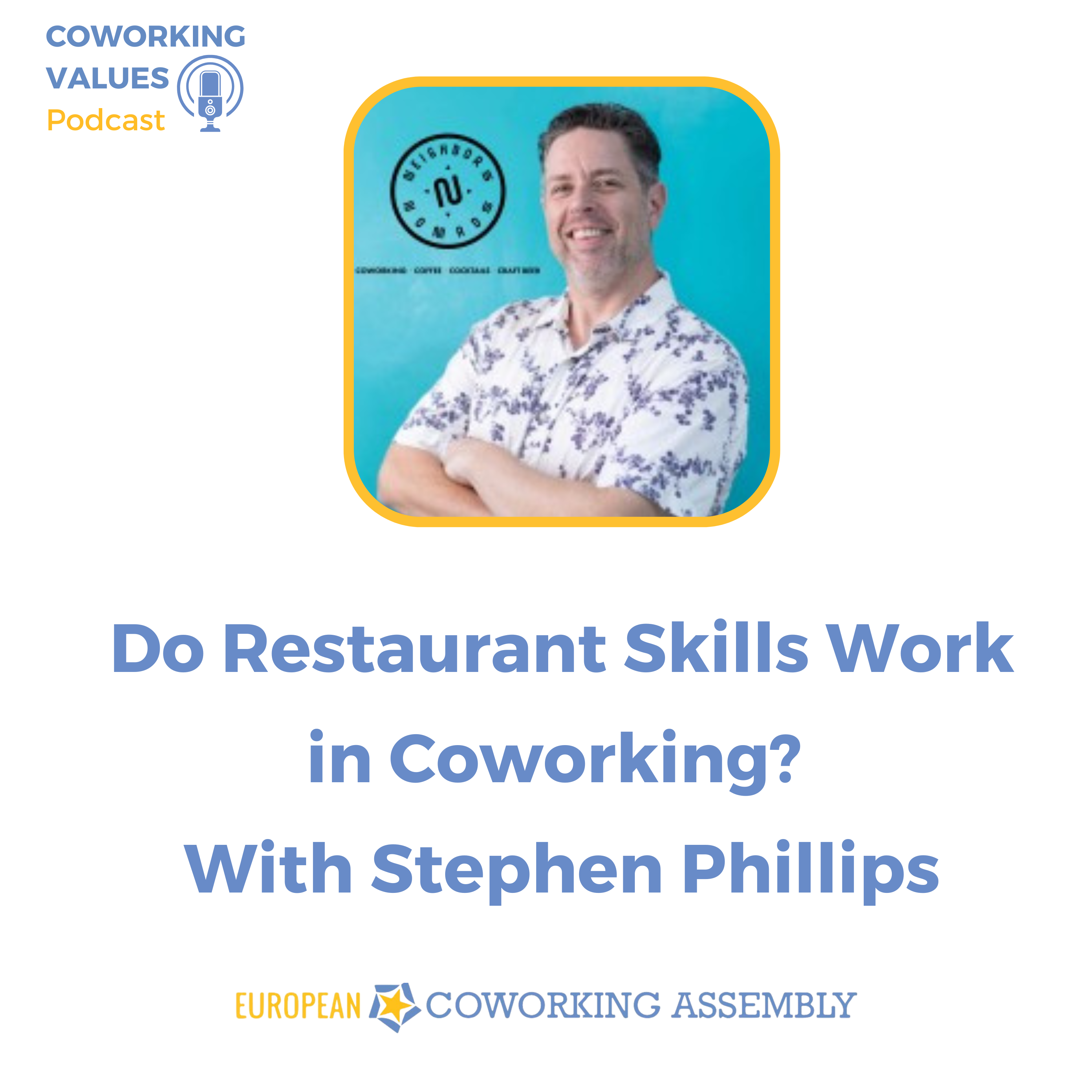
Do Restaurant Skills Work in Coworking? with Stephen Phillips
What happens when London restaurant experience meets Philippine island infrastructure, power cuts, and the real cost of building community.
“We have people literally knocking on the door... ‘Do you want to buy 100 Google reviews?’ We made the call very early doors that that was not in line with our values, and we would never do that.”
Stephen Phillips spent most of his adult life in London’s casual dining world. Now he’s co-founded Neighbours & Nomads—a coworking space, bar, and community hub in El Nido, Palawan, Philippines.
The transition wasn’t gentle. Double the budget. Twice the time. Learning to navigate Philippine construction, permits, and bureaucracy from scratch. Opening in the downseason with a fragile local power grid and the constant threat of infrastructure failure.
But here’s what makes this conversation worth your time: Stephen brought something from those London restaurant years that most coworking operators never develop. The ability to create genuine hospitality at scale.
The instinct for when to apply commercial savvy and when to just be human. The understanding that you have far more time to build rapport in a coworking space than you ever had serving tables—and what to do with that gift.
This isn’t a “follow your dreams” story. It’s a clear-eyed account of what it actually takes to build community infrastructure in a place where digital nomads worry the Wi-Fi will fail mid-call and the power will cut out during their deadline.
Stephen solved the infrastructure problem—dual fibre connections, backup systems, air conditioning that works—but that’s just the entry ticket.
The real story is in the human systems. How do you obtain genuine Google reviews without resorting to bribery? How do you recover from service failures when you’ve got weeks, not minutes, to make it right?
How do you balance the economics of serving both Manila professionals working remotely and nomads earning global salaries? And why does the word “nomad” mean something completely different in the Philippines than it does in Bali or Lisbon?
If you’re running a coworking space in a destination location, or thinking about it, this episode will save you months of expensive mistakes. If you’ve ever worked in hospitality and wondered how those skills transfer, Stephen’s already done the translation work for you.
Timeline Highlights
[01:48] “Creating local spaces that open doors to locals and remote workers and create opportunity for growth and community”
[03:33] “Double the budget and twice the amount of time... If we could have done, I think having more time to build the community”
[05:22] “I now know how to build, construct a building in the Philippines... what permits I have to get and how to get them and how to avoid fines”
[07:27] “The hook for me was confidence... their assumption is the infrastructure... will be terrible. You've got to give them the confidence that you’ve worked that out.”
[09:34] “You can’t get volume out of locals when it comes to reviews... Often, just asking... is half the battle”
[12:25] “We have people literally knocking on the door... ‘Do you want to buy 100 Google reviews?’ We made the call very early doors, which was not in line with our values.”
[14:01] “Commercial savvy with genuine hospitality. I think the two have got to really work hand in hand.”
[16:53] “It’s more of the upside and far, far less of the downside... You have the time to build rapport and relationships.”
[19:38] “We saw that they’d used a half-day pass and we just recredited it... sent them a note... It’s easy to look for those opportunities to wow people.”
[22:24] “We call them remote workers because in the Philippines, nomads still probably got that slightly 19th-century connotation to it”
[25:45] “A nomad has got that connotation of a hobo... the drifter... The word has just not been modernised like it has in the West.”
[26:52] “We need a bit more critical mass... Pure volume is going to bring our ideas to life.”
[28:16] “We’re going to put all the infrastructure in and all the training in... now it’s got to be stress-tested”
The Infrastructure Confidence Game
Digital nomads researching the Philippines face a harsh reality: the infrastructure may not be reliable. Power cuts. Unreliable Wi-Fi. Backup systems that aren’t actually backed up.
Stephen’s first job wasn’t building community—it was solving the infrastructure problem so thoroughly that remote workers would believe him when he said it worked.
Dual fibre-optic connections. Reliable power. Air conditioning that actually runs all day. These aren’t luxury amenities in El Nido; they’re proof that you’ve done the homework.
But here’s where it gets interesting: you can’t just solve the problem. You have to prove you’ve solved it. That’s where the Google reviews become critical. A digital nomad choosing between Bali, Thailand, or the Philippines will do desktop research.
They’re looking for social proof that someone like them successfully worked from your space without their client call dropping or their deadline getting torched by a power outage.
The infrastructure is the entry ticket. The reviews are the invitation. Neither works without the other. Stephen learned this faster than most because he came from the hospitality industry, where the gap between what you promise and what you deliver can destroy businesses overnight.
The Art of the Genuine Ask
Stephen’s team doesn’t buy Google reviews. People knock on the door weekly, offering to sell them 100 five-star ratings. They say no every time.
Instead, they’ve built a system that feels human: they wait until someone’s last day, when the experience is fresh and complete. They ask directly—would you mind leaving us a review? If the person says yes and genuinely had a good time, they offer a coffee as a thank you.
The coffee costs less than 20 pence. That’s not the point. The point is timing and intent. These remote workers have spent weeks in the space.
They’ve built relationships with the team. They’ve seen the kitchen, met the chef, and experienced the care. By the time someone asks for a review, it’s not a cold transaction—it’s a natural extension of the rapport that’s already there.
This only works because the underlying experience is genuine. You can’t manufacture five-star reviews with a 20p coffee if the Wi-Fi failed three times and lunch was consistently late.
The “commercial savvy” Stephen talks about isn’t manipulation—it’s recognising the moment when someone genuinely wants to help you and making it easy for them to do so.
The contrast with fake reviews isn’t just ethical. It’s strategic. Fake reviews create expectations you can’t meet. Genuine reviews, even if they take longer to accumulate, bring you the right customers—people who actually want what you’re offering.
Hospitality Time Versus Restaurant Time
In a restaurant, you have 90 minutes to make an impression. Maybe two hours if it’s a special occasion. Everything moves fast. If something goes wrong, you’ve got minutes to recover before the experience is ruined and the customer leaves forever.
Coworking spaces operate on a completely different timescale. Someone buying a monthly pass will be in your space for weeks. You build rapport gradually.
You learn their name, their work patterns, and their coffee order. When something goes wrong—and it will—you have time to notice, time to fix it, and time to go beyond fixing it.
Stephen tells the story of a lunch order that got lost in the kitchen for 25 minutes. In a restaurant, that’s a disaster requiring immediate comped drinks and a grovelling apology. In the coworking space, the customer didn’t even care. They’d met the chef. They knew the standard. They’d built enough relationship capital that one mistake registered as human error, not system failure.
But Stephen’s team didn’t stop there. Days later, they noticed the customer had used a half-day pass and proactively recredited it with a note. The customer was overwhelmed. They’d already moved past the incident, and here was the team going out of their way to make things right.
This is what Stephen means by “all the upside and far, far less of the downside.” In hospitality terms, coworking gives you the relationship benefits of regular customers without the time pressure of table turns. You can look for opportunities to delight people because you’re not constantly fighting the clock.
The Numbers Behind Neighbours and Nomads
Stephen said it plainly in an earlier conversation: “You run the numbers and you realise that they’re pretty scary.”
This is the economic reality of destination coworking that most operators discover too late. You can’t make the numbers work on coworking memberships alone—especially when you’re providing dual fibre-optic internet, backup power systems, and air conditioning in a place where those things cost serious money to maintain.
That’s why Stephen knew from the start that Neighbours & Nomads needed a full café and bar operation. The F&B isn’t a nice-to-have amenity—it’s the financial model that makes the coworking viable.
You need people buying coffee, lunch, and evening drinks to subsidise the infrastructure investment that makes reliable remote work possible.
The pricing reflects this reality. Monthly passes sit at 12,500 Philippine pesos. For context, a local graduate’s monthly salary in the Philippines ranges from 13,000 to 25,000 pesos. A daily pass costs 800 pesos—more than the daily minimum wage in Manila.
This isn’t unique to Stephen’s space. It’s the economic tension that exists in every destination coworking location, from Lisbon to Bali to Siargao. When you’re building first-world infrastructure in developing economies, the pricing naturally serves people earning global salaries rather than local wages.
Stephen’s vision was always to connect both groups—the digital nomads and what he calls “locals.” But the “locals” who can afford regular membership are typically Manila professionals who’ve relocated to El Nido for quality of life, freelancers earning international rates, or entrepreneurs already plugged into the tourism economy.
They’re remote workers who left the capital and now find themselves “trapped inside their houses because it’s got good internet and it’s got backup power,” but desperately need community and a third space.
This is the balancing act of destination coworking: building infrastructure reliable enough for remote workers earning $2,000+ USD monthly while trying to create genuine community connections in a place where that monthly pass represents a whole month’s wages for service workers in the local economy.
Stephen’s navigating this tension by positioning the space as a “social club meets coworking meets café meets bar”—creating multiple entry points and price levels.
You don’t need a monthly pass to grab a craft beer on the rooftop or attend a community event. But the core coworking infrastructure, by economic necessity, serves a specific tier of worker.
The economic reality doesn’t make the vision wrong. It makes it harder. When high season arrives and volume increases eight to ten times, we’ll see whether the “neighbours and nomads” concept can genuinely bridge that economic gap—or whether the gap is the fundamental constraint that shapes who gets to be a neighbour and who remains a tourist passing through.
Why “Nomad” Means Drifter Here
Words mean different things in different places.
In the West, “digital nomad” has been modernised—it suggests freedom, flexibility, and location independence. It’s an aspirational identity.
In the Philippines, the term “nomad” still retains its 19th-century connotation. Drifter. Hobo. Someone without a home or stability. It’s not a modern, positive term—it’s slightly derogatory.
So Stephen’s team uses “remote worker” instead. Same customer, different framing. This isn’t pedantry—it’s understanding that language shapes how locals perceive the business and how customers perceive themselves.
The space is called Neighbours & Nomads, which creates an interesting tension. The name itself is asking a question: can these two groups—the rooted and the transient—actually coexist? Can someone spending six weeks in El Nido become a neighbour, even temporarily?
Stephen believes they can. The vision was always about connecting locals and remote workers, creating genuine exchange rather than tourist transactions. But the language you use to describe that vision matters.
Call someone a nomad in the Philippines and you’ve already created distance. Calling them a remote worker is not about questioning their legitimacy or stability, but instead describing what they do.
This is the kind of local knowledge you only gain by being there, by listening to how your team and your local members respond to the words you use. It’s easy to export Western coworking language to other contexts without realising the meanings don’t transfer.
Building for Critical Mass
Neighbours & Nomads opened during El Nido’s rainy season—the downseason when tourist numbers are a fraction of what they are. This wasn’t Stephen’s first choice, but pressure to open and start generating revenue decided for him.
What that means is they’ve spent six months testing systems and building relationships without the whole stress test. The real challenge arrives in December when high season begins and volume increases eight to ten times.
Stephen’s honest about what critical mass unlocks: group tours, talks, workshops, skill-sharing events, and proper mixing between locals and remote workers. Right now, they don’t have enough people in the space simultaneously to make that magic happen. They need volume to bring their ideas to life.
But volume also means stress-testing everything—the infrastructure, the service systems, the team’s training, the recovery processes when things go wrong. It means discovering which things work at a small scale but break at a large scale.
This is the gap between vision and reality that most coworking operators experience. You can design beautiful programmes and carefully craft your community values, but until you have enough people showing up consistently, it’s all theoretical. Critical mass isn’t just a nice-to-have—it’s the threshold at which community actually becomes possible.
Stephen’s preparing for that threshold with the clear-eyed realism of someone who’s opened restaurants before. You put the infrastructure in, you train the team, and then you see what breaks. High season will reveal the gaps. The question is whether you’ve built enough resilience into the systems to adapt quickly when it does.
What High Season Will Reveal
Stephen’s waiting to see what breaks. That’s the honest position of any operator who’s built something without fully stress-testing it yet.
High season in El Nido runs from December through May. No rain, maximum tourist volume, the space at capacity. That’s when you discover whether your Wi-Fi can actually handle 40 people on video calls simultaneously.
Whether your kitchen can keep up with lunch orders. Whether your team can maintain the hospitality standards when they’re serving triple the volume.
It’s also when the real community-building opportunities emerge. With critical mass, you can run workshops that matter. You can create introductions between locals and visitors that lead somewhere. You can build the skill-sharing and knowledge exchange that makes coworking more than just hot-desking with good coffee.
But volume also amplifies every weakness in your systems. The service recovery that works beautifully when you’re at 30% capacity might collapse at 100%. The infrastructure that feels rock-solid in the downseason might show cracks when everyone’s running air conditioning and video calls all day.
Stephen knows this because he’s done it before in restaurants. You build the systems, you train the team, you open the doors, and then reality teaches you what you got wrong. The question isn’t whether things will break—it’s whether you’ve built enough flexibility to adapt when they do.
For coworking operators watching this story unfold, that’s the lesson: your downseason or soft launch isn’t the real test. The real test is when demand exceeds your comfortable capacity and you have to deliver the same experience under pressure. That’s when you find out if you built a business or just a good idea.
✅ Coworking Trends Survey 2025
The Coworking Values Podcast is keen to support Carsten Foertsch and Deskmag - The Coworking Magazine Coworking Trends Survey - the longest-running global study tracking the evolution of coworking and flex spaces.
If you’re a coworking community builder or operator, take 5–10 minutes to share how your space is doing this year. Your input helps shape the most accurate industry snapshot out there.
Help make sure voices from all types of spaces - big and small, rural and urban - are heard.
Links & Resources
Stephen Phillips’s Work
- Neighbours & Nomads Website
- Watch Stephen’s LinkedIn video updates of the building process.
- Follow Neighbours & Nomads on Instagram and Facebook
- Connect with Stephen on LinkedIn
- 🎙️How to Make Your Coworking Space Feel Like a Mezcal Bar with Stephen Phillips
Community & Events
- Actionism Screen - 25-minute documentary about taking collective action in your neighbourhood
- London Coworking Assembly
- Unreasonable Connection Going Live - February 2026 event for 150 coworking community builders
Bernie’s Projects
- Coworking Values Podcast on LinkedIn
- Register for European Coworking Day, May 2026
- Join the 8k Members in the LinkedIn Coworking Group
- Connect with Bernie on LinkedIn
One More Thing
Coworking brings communities together, helping people find and share their voices.
Each episode of the Coworking Values Podcast explores Accessibility, Community, Openness, Collaboration, and Sustainability—values that shape the spaces where we gather, work, and grow.
If this resonates with you, rate, follow, and share the podcast. Your support helps others discover how coworking enriches lives, builds careers, and strengthens communities.
Community is the key 🔑
Written by
What's Next?
They Come for the Promise. They Stay for the Hospitality. with Dr. JJ Peterson
"They come for the promise. They stay for the hospitality." — Dr. JJ Peterson Episode Summary JJ Peterson has spent eleven years inside the StoryBrand universe. He co-authored Marketing Made Simple with Donald Miller. He helped Will Guidara write the certification for Unreasonable Hospitality. He hosts the Badass Softie podcast — for leaders who are unapologetically driven but want to lead with their hearts. He is flying to London in June to teach at the first workshop in the world to b
Why AI Can't Feel the Room: Practical Operations with Carlos Almansa
"The AI cannot feel the space. It can't feel the dynamics or the vibe. But it can free up time for you to talk to your members, to have a coffee with them, to understand and to read people." — Carlos Almansa Ballesteros Episode Summary Most conversations about AI in coworking are either evangelical or dismissive. Carlos Almansa Ballesteros, co-founder of Nexudus and author of the Coworkings AI newsletter, isn't interested in either. He's been building software for this industry for 13
The Golden Thread: Why Unreasonable Hospitality Needs a Story First with Sonya & Julie
Why your coworking space needs a Story before it can practise hospitality "Marketing makes these promises and service delivers that. So for us, StoryBrand and unreasonable hospitality, really work together hand in glove. And StoryBrand is really about thinking about how you communicate that you care to your customers. And the unreasonable hospitality side of things is how you prove it." — Sonya Whittam Sonya Whittam and Julie Firth run Story22, a customer-centric marketing agency base
You're Never Broke If You Got Ideas: How Koder Brings Music to the Neighbourhood
"Ideas are currency, you know. And you're never broke if you got ideas... Everything we are looking at around us came from an idea. So for me, they are, it is a currency within itself." — Koder Koder runs Undeniable Studios, a music production conglomerate built from youth clubs, pirate radio, and 10,000 hours of free studio time in Brockley. He's now the first Creative in Residence at Blue Garage in Lewisham, where he's installing a commercial music studio, planning his Circle the Ends
Start With the Building, Miss the Person — It Happened Again This Week
I spent this week watching the same argument break out in different places, with different people, in completely different conversations. None of them planned it. * Caleb Parker published a manifesto for high street coworking. * Suzanne Murdock sent her monthly newsletter from The Hub Newry. * Parisa Wright kept resharing her Hope Hub episode. And * Ann-Marie Kinlock and Anna Chuicharoen finally opened KindHaus in Hackney after three years of hurdles, setbacks, and proving that a space wher
Start Cooking. The Recipe Will Follow.
We're moving everything up a gear. At the last Unreasonable Connection Live in Lewisham, you told us the groups were too random and the curation could be tighter. You were right. 75% of you left with more momentum than you arrived with. The room worked. The curation didn't. The people in the room, the conversations that happen, and how those conversations are curated—it all matters deeply. That's why on May 19th, Tilley Harris and the team from Akou are collaborating with us to facilitate