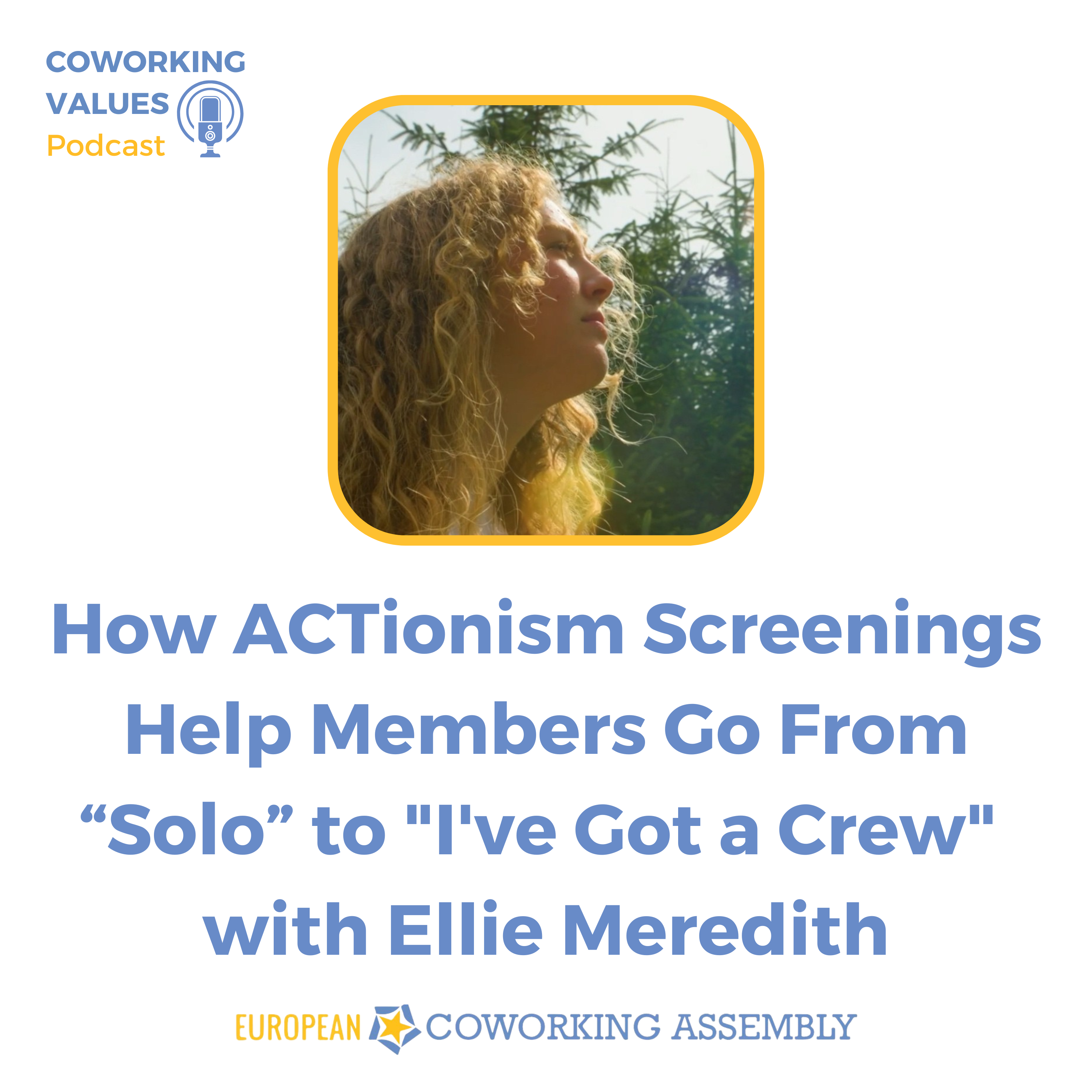
How ACTionism Screenings Help Members Go From Solo Mission to "I've Got a Crew" with Ellie Meredith
The 25-minute documentary, circle method, and facilitation tools that turn your coworking
Episode Summary
“I really struggled to relate to people at school because the conversations that I was hoping to be able to have with my friends were about the things that were going on outside the school gates... But what I love about finding the collective is that it’s given me permission to imagine another way of doing things, and that it really has felt like a real homecoming.”
Ellie Meredith is 19 years old. She’s a Community Cultivator at Re-Action Collective, co-organiser of Shrewsbury’s Climate Café, and the protagonist of a 25-minute documentary called ACTionism that’s currently screening in living rooms, pubs, libraries, and coworking spaces across the world.
But two years ago, she was crawling inside herself, overwhelmed by climate anxiety, trapped in a classroom where nobody wanted to talk about the things that actually mattered.
The shift came from two questions. Not from a therapist. Not from a careers advisor. From Jon Alexander, whom she’d emailed after reading his book about citizenship.
He asked, "What gives you joy?" And where does that joy meet the work that needs doing in the world?
Those questions cracked something open. Within weeks, she’d met the crew at Re-Action Collective—a grassroots organisation challenging the outdoor industry’s throwaway culture by teaching repair, running gear rental schemes, and making the outdoors accessible to people who’ve been priced out. She’d found her people. She’d stopped trying to save the planet alone.
This conversation isn’t just about Ellie’s journey. It’s about what coworking spaces can do with a 25-minute film, a room full of chairs arranged in a circle, and an invitation to dream together about what could happen next in your community.
Bernie and Ellie walk through the mechanics of hosting a community screening—how to avoid the tumbleweed moment after the credits roll, why repair workshops and art supplies work better than Q&As, and what actually happens when you give people permission to imagine differently.
If you’ve ever wondered how to use your space for something deeper than hot-desking, this is the blueprint. Find your people. Host a screening. See what begins.
Timeline Highlights
[01:14] Bernie sets the frame: this is about getting like-minded people in your coworking space, watching something together, and having intentional conversations afterwards
[02:21] Ellie’s realisation: “Do you know how much of a life fluke that is?” — finding your people quickly after leaving school
[02:35] “I was feeling quite lost at sea and fairly lonely. I really struggled to relate to people at school because the conversations I was hoping to have were about things going on outside the school gates.”
[04:21] The origin of Ellie’s climate concern: volunteering with Shropshire Wildlife Trust, watching flooding happen more and more, seeing nature collapse on her doorstep
[07:51] Bernie’s question about neurodiversity: Does feeling things more deeply make the horror worse when you see a flood?
[09:09] “Being neurodivergent certainly adds another level of complexity to the read that I have on the world.”
[10:19] How ACTionism works: community screenings in living rooms, pubs, libraries, anywhere people gather—not on streaming platforms, not touring cinemas
[12:37] Bernie asks the hard question: how do you avoid the awkward silence after showing a film?
[14:25] The circle method: sit everyone in a big circle, including the filmmaker, so it’s not one person answering questions but the whole room having a conversation
[16:04] What happens after screenings: dreaming activities with post-it notes, repair workshops, art supplies for visual responses
[19:09] Bernie: “How on Earth did you find yourself in a film?”
[21:12] The email that changed everything: Ellie writes to Jon Alexander after reading his book about citizenship
[24:46] Bernie’s main takeaway from the Conduit event: we don’t have to have all the answers
[29:00] Where to find Ellie: LinkedIn, and obviously the Re-Action Collective
The Neurospicy Activist Who Hated Four Walls
School was suffocating for Ellie. Not in the vague, everyone-hates-homework way.
In the specific, visceral, ‘I’m-crawling-inside-myself’ way that happens when you’re neurodivergent and the world insists you sit still in four walls whilst climate collapse is happening outside the gates.
She describes herself as a “neurospicy human”—a phrase that does more work than any clinical diagnosis could. It signals: I feel things on a different frequency.
The mounting pressure of exams didn’t just stress her out; it became too much. The conversations at school weren’t about what mattered. They were surface-level whilst floods were getting worse in Shropshire, whilst nature was collapsing on her doorstep from her volunteer work with the Wildlife Trust.
Bernie picks up on this immediately. He asks if neurodiversity exacerbates the feeling of horror when you see a flood.
Ellie’s answer: “I definitely feel things a lot more deeply than other people. My senses around it are very much heightened, and I don’t really know where to put any of that energy unless it’s part of collective action.”
This is the heart of why ACTionism matters for coworking spaces. Your members aren’t all neurotypical. They’re not all processing climate anxiety, economic precarity, or community collapse in the same way.
But many of them are feeling it deeply, and they don’t know where to put that energy. The solo mission to save the world—buying a reusable cup, recycling properly—feels joyless because it is. It’s action without connection. It’s doing something to feel less helpless, not because it actually changes anything.
Ellie found the outlet she needed when she found Re-Action Collective. Not because they had the answers, but because they gave her a crew. People who cared about the same things. People who were doing something together, not alone.
Two Questions That Rerouted Everything
After leaving school, Ellie emailed Jon Alexander. She’d read his book about citizenship—stories of ordinary people doing extraordinary things—and it cracked something open. She wasn’t expecting much back. Maybe a thumbs up. Maybe nothing.
Instead, Jon invited her to London. They sat down together, and he asked two questions:
- What gives you joy?
- Where does that joy meet the work that needs doing in the world?
Those questions are deceptively simple.
They’re not: What do you want to be when you grow up? Or what’s your five-year plan? They’re citizen questions, not consumer questions. They assume you have agency. They assume the world needs what brings you alive.
Ellie’s answer: she loved being outside, volunteering with the Wildlife Trust, and she wanted to do more with other people in her community.
Jon made the connection to Re-Action Collective, a grassroots organisation in the French Alps working on circular economy solutions for the outdoor industry.
Two years later, she’s a Community Cultivator there, and her journey is the spine of a documentary being screened in hundreds of communities worldwide.
For coworking operators, this moment is instructive. The most valuable thing you can offer your members isn’t faster WiFi or better coffee.
It’s the connection between what gives them joy and the work that needs to be done. Sometimes that connection happens in a casual hallway conversation.
Sometimes it happens because you hosted a film screening and someone realised they weren’t alone.
Jon Alexander didn’t solve Ellie’s climate anxiety. He asked better questions. Your coworking space can do the same.
Community Screenings as Civic Infrastructure
ACTionism isn’t on Netflix.
It’s not touring cinemas.
It’s moving through the world via community screenings—living rooms, pubs, libraries, coworking spaces.
Anywhere people can gather with open hearts and curious minds.
This is intentional. The film is designed to be a conversation starter, not a consumption experience. You request a screening kit, pay what you feel (they suggest £100 to keep the magic going), and host it wherever makes sense for your community.
- The guide Ellie wrote walks you through it.
- The film itself is 25 minutes.
- What happens afterwards is where the work begins.
Bernie asks the operator’s question: How do you avoid the tumbleweed moment? You show something. You ask for questions. Silence.
Ellie’s learned from organisations like 99p Films in Cornwall, who’ve turned community screenings into a ritual: communal feast, mindful breathing, film, then discussion. But the key shift is the circle.
Don’t stand at the front like you’re answering questions from an audience. Sit in a circle with everyone else. Let the person next to someone speak first, so others gain the confidence to join in.
The screenings that work best don’t end with Q&As. They end with action. Some communities do “wouldn’t it be wonderful if...” dreaming activities—stack post-it notes with ideas, then figure out together how to make one happen.
Others run repair workshops, teaching darning or visible mending whilst people chat. Some bring out art supplies and let people respond visually, because words don’t always reach the places that need reaching.
For coworking spaces, this is plug-and-play civic infrastructure.
- You already have the room.
- You already have the chairs.
- You already have members who care about their community but don’t know how to move from caring to doing.
- A 25-minute film and a facilitated conversation can be the bridge.
From Passive Watchers to Active Participants
The language around ACTionism is precise. It’s not activism in the traditional sense—protests, petitions, pressure campaigns. It’s actionism. Acting towards something, not just resisting what is. Reimagining what could be.
This distinction matters for community spaces. Traditional activism can feel inaccessible or intimidating to people who don’t see themselves as “activists.” Actionism is quieter.
It’s repair cafés and skill shares. It’s dreaming activities and Post-it notes. It’s the shift from being a passive spectator to an engaged participant in your own community.
Ellie talks about how the people in her crew at Re-Action are mostly neurodivergent, and they’re all drawn to this work because it’s big. Systems change. Circular economy. Making the outdoors accessible.
These aren’t small projects, but they don’t require you to chain yourself to anything. They require you to show up, learn a skill, share what you know, and stay connected to the others.
The film screenings facilitate this shift in real time. You walk in as someone who’s worried about climate change but doesn’t know what to do. You watch 25 minutes of Ellie’s journey from isolation to collective action.
You sit in a circle with neighbours and talk about what gives you joy and where that meets the work that needs doing. You leave with names, ideas, maybe even a date for the next gathering.
For coworking operators, this is the dream. You want members who don’t just rent desks—they build things together. They start projects. They connect with the wider community. A film screening is a permission structure for all of that to begin.
The Circular Economy Starts with Repair
Re-Action Collective challenges the outdoor industry’s linear model: take, make, use, dispose. High-performance gear is expensive, designed to be replaced, and often ends up in landfill because it’s too complex to recycle profitably.
The alternative is circular: repair, rental, reuse, repurpose. Teach people to mend their own gear. Run rental schemes so people can access equipment without buying it.
Collect old uniforms from corporate partners and repurpose them. Make the outdoors accessible to people who’ve been priced out by the £200 waterproof jacket.
This isn’t just environmental—it’s economic. The outdoor industry thrives on consumption, but the people who love the outdoors often can’t afford to participate.
By teaching repair skills and running rental schemes, Re-Action is building a parallel economy based on access rather than ownership.
The screenings that include repair workshops make this tangible. People bring clothes, bikes, and electronics. They sit together, learn to darn or fix a zip, and suddenly they’re not just talking about sustainability—they’re practising it.
The conversation happens naturally because you’re doing something with your hands, side by side with someone you don’t know yet.
For coworking spaces, the lesson is clear: give people something to do with their hands whilst they talk. Art supplies. Repair tools. Post-it notes for dreaming. The conversation flows differently when it’s not just faces staring at faces.
Finding the Others Is the Whole Point
Ellie uses the phrase “find the others” multiple times. It’s not her phrase originally—it’s from the citizen movement Jon Alexander writes about—but it’s become her North Star.
After years of feeling isolated, of trying to carry climate anxiety alone, she’s found a crew. People who don’t think exactly like her but want to show up for the planet in similar ways.
Bernie pushes on this: Does the ‘find the others’ thing nourish you?
Ellie’s answer is immediate. Yes. Through screenings, workshops, and her work at Re-Action, she’s constantly bringing people together.
Not people who agree with her about everything—that would be a cult—but people who want to show up, who are willing to sit in uncertainty, who care enough to try.
This is the unspoken promise of every coworking space. You’re not just renting desks—you’re helping people find their others.
- The freelancer who thought they were the only one struggling.
- The social entrepreneur who felt alone in caring about impact over profit.
- The creative who’d been isolated in their spare room for two years.
A film screening gives you a structure to make that connection explicit. You’re inviting your members and your wider community to show up, watch something together, and see who else cares. The conversation afterwards isn’t just about the film—it’s about discovering you’re not alone.
Bernie’s final observation lands perfectly: I always think I have to have all the answers. But actually, everyone who doesn’t have all the answers and introduces an idea is the person I pay the most attention to.
You don’t need to solve climate change to host a screening. You need to care enough to create the space where others can find each other.
Links & Resources
Ellie Meredith’s Work
- Ellie on LinkedIn
- ACTionism Film: 25-minute documentary
- Re-Action Collective
- Download the ACTionism Screening Kit
🎙️ Referenced Coworking Values Podcast Episodes
- Jon Alexander on Coworking Values Podcast
- Gavin Fernie-Jones on Coworking Values Podcast
- Tony Bacigalupo with Jon Alexander 2024 The State of Belonging: Repairing Our Social Fabric
- Peter Block Small Groups, Big Changes: Impact On Coworking Conversations
Community & Events
- Join this and other conversations with people in the LinkedIn Coworking Group
- Unreasonable Connection Monthly online gatherings for Coworking Community Builders.
- Workspace Design Show London 2026
- European Coworking Day May 2026
- London Coworking Assembly
- European Coworking Assembly
- Workspace Design Show — February 2025, London
- Unreasonable Connection Going Live! — One-day event for 150 Coworking Community Builders, February 2025, London
Bernie’s Projects
- London Coworking Assembly 5-Day AI Crash Course for Coworking Spaces
- Urban MBA - London
- Coworking Values Podcast on LinkedIn
- Connect with Bernie on LinkedIn
🧠 One More Thing
Coworking brings communities together, helping people find and share their voices.
Each episode of the Coworking Values Podcast explores Accessibility, Community, Openness, Collaboration, and Sustainability—values that shape the spaces where we gather, work, and grow.
If this resonates with you, rate, follow, and share the podcast. Your support helps others discover how coworking enriches lives, builds careers, and strengthens communities.
Community is the key 🔑
Written by
What's Next?
They Host Church, Stop Brain Drain, and Won't Put Their Film on Netflix—And They're Winning
LinkedIn Show Notes #34 from the Coworking Values Podcast Bullpen. 🎙️ Listen to these stories and hundreds of others on the Coworking Values Podcast. Three different community builders. Two continents. One pattern: They stopped optimising for scale and started building for depth. And the people who needed them showed up. This week from the Coworking Values Podcast Bullpen: We've been tracking why some spaces feel like communities and others feel like expensive libraries with good Wi-Fi. T
They Come for the Promise. They Stay for the Hospitality. with Dr. JJ Peterson
"They come for the promise. They stay for the hospitality." — Dr. JJ Peterson Episode Summary JJ Peterson has spent eleven years inside the StoryBrand universe. He co-authored Marketing Made Simple with Donald Miller. He helped Will Guidara write the certification for Unreasonable Hospitality. He hosts the Badass Softie podcast — for leaders who are unapologetically driven but want to lead with their hearts. He is flying to London in June to teach at the first workshop in the world to b
Why AI Can't Feel the Room: Practical Operations with Carlos Almansa
"The AI cannot feel the space. It can't feel the dynamics or the vibe. But it can free up time for you to talk to your members, to have a coffee with them, to understand and to read people." — Carlos Almansa Ballesteros Episode Summary Most conversations about AI in coworking are either evangelical or dismissive. Carlos Almansa Ballesteros, co-founder of Nexudus and author of the Coworkings AI newsletter, isn't interested in either. He's been building software for this industry for 13
The Golden Thread: Why Unreasonable Hospitality Needs a Story First with Sonya & Julie
Why your coworking space needs a Story before it can practise hospitality "Marketing makes these promises and service delivers that. So for us, StoryBrand and unreasonable hospitality, really work together hand in glove. And StoryBrand is really about thinking about how you communicate that you care to your customers. And the unreasonable hospitality side of things is how you prove it." — Sonya Whittam Sonya Whittam and Julie Firth run Story22, a customer-centric marketing agency base
You're Never Broke If You Got Ideas: How Koder Brings Music to the Neighbourhood
"Ideas are currency, you know. And you're never broke if you got ideas... Everything we are looking at around us came from an idea. So for me, they are, it is a currency within itself." — Koder Koder runs Undeniable Studios, a music production conglomerate built from youth clubs, pirate radio, and 10,000 hours of free studio time in Brockley. He's now the first Creative in Residence at Blue Garage in Lewisham, where he's installing a commercial music studio, planning his Circle the Ends
Start With the Building, Miss the Person — It Happened Again This Week
I spent this week watching the same argument break out in different places, with different people, in completely different conversations. None of them planned it. * Caleb Parker published a manifesto for high street coworking. * Suzanne Murdock sent her monthly newsletter from The Hub Newry. * Parisa Wright kept resharing her Hope Hub episode. And * Ann-Marie Kinlock and Anna Chuicharoen finally opened KindHaus in Hackney after three years of hurdles, setbacks, and proving that a space wher
Start Cooking. The Recipe Will Follow.
We're moving everything up a gear. At the last Unreasonable Connection Live in Lewisham, you told us the groups were too random and the curation could be tighter. You were right. 75% of you left with more momentum than you arrived with. The room worked. The curation didn't. The people in the room, the conversations that happen, and how those conversations are curated—it all matters deeply. That's why on May 19th, Tilley Harris and the team from Akou are collaborating with us to facilitate