
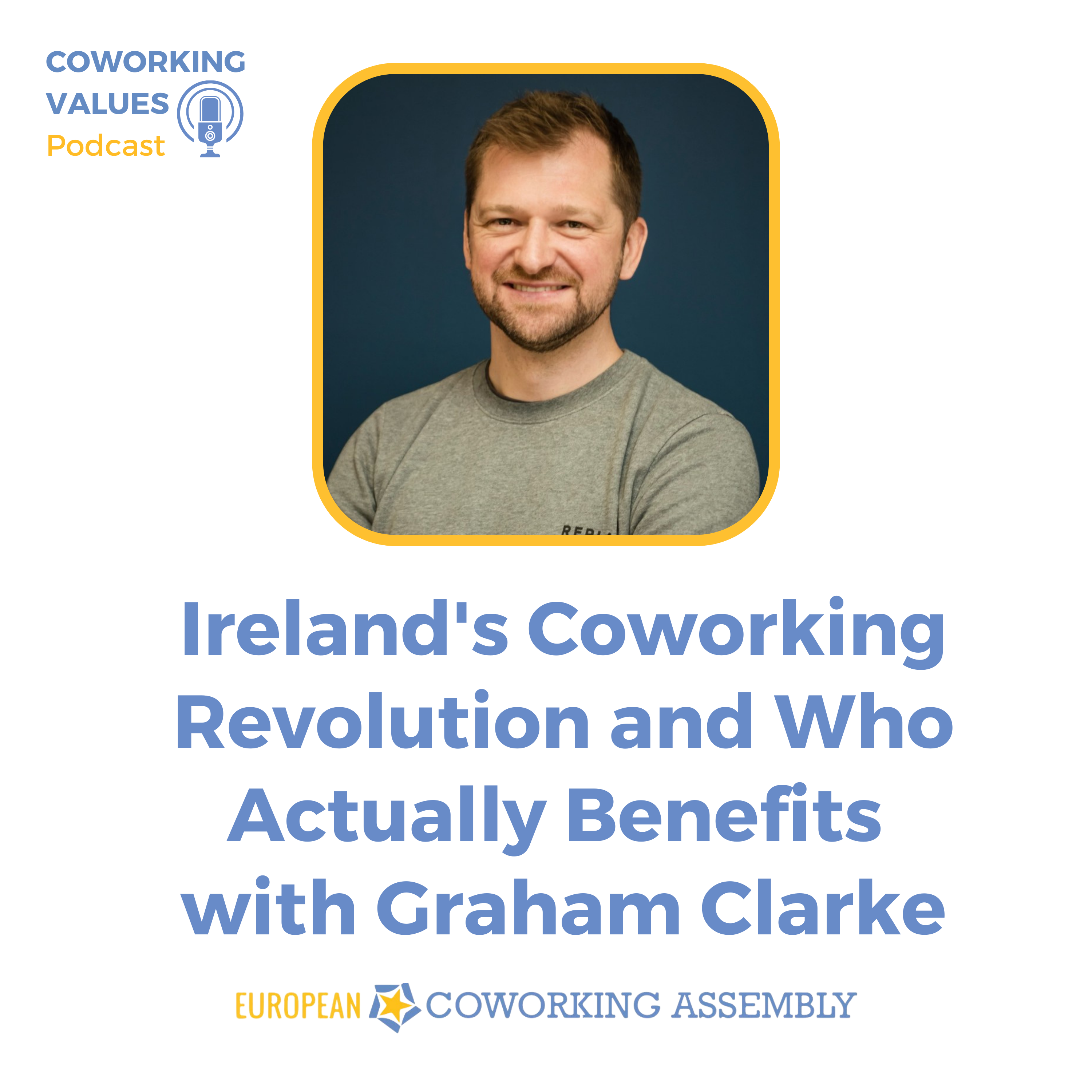
Ireland's Coworking Revolution and Who Actually Benefits with Graham Clarke
Why one booking system became civic infrastructure
Episode Summary
“We seem to be out front with this when it comes to, I suppose, government support at a national level of coworking as an industry.”
Graham Clarke
Tired of running yourself into the ground?
Then stop running alone.
On February 24th, the London Coworking Assembly presents Unreasonable Connection Goes Live!—a one-day working session for the people running London’s most vital neighbourhood spaces and the public sector allies working to help them thrive.
It’s a day to share the load, find real solutions, and build a new playbook, together.
Graham Clarke didn’t set out to wire an entire country for coworking.
He was a community manager in a space in Ireland, burnt out from running events just to hit KPIs, when the Western Development Commission approached Baseworx with a question: Could a single booking system connect over 100 rural hubs?
That was 2018. Now it’s 407 locations. For-profit, not-for-profit, social enterprises, and major operators—all on one platform.
You can land at Dublin Airport, hit “near me,” book a hot desk in Skibbereen, and get a pin code sent to your phone before you leave the terminal. If the hub has integrated access control, you can walk in and start working without speaking to anyone.
But the real story isn’t the technology.
It’s what happened when hub managers across Ireland started talking to each other once a month. When they realised they could pool their buying power to negotiate better deals on EV chargers. When a digital nomad could extend their holiday because they found a desk 30 minutes from the beach.
Graham has seen both sides: the operator trying to keep the lights on, and the software builder trying to automate the boring bits so operators can focus on the human work. In this conversation with Bernie, they explore the economics of who pays for coworking (the bootstrapper vs. the corporate remote worker), the “golf clubification” thesis (what if coworking memberships were curated like BNI chapters?), and why the best thing software can do is act as “guard rails” to prevent community manager burnout.
This episode is for anyone who thinks coworking is just about desks and WiFi. Graham and Bernie talk about Ireland’s post-crash entrepreneurial mindset, the housing crisis threatening the “brain gain” success, and why proximity still matters when your members could work from anywhere.
Timeline Highlights
[02:55] Bernie asks Graham to explain Connected Hubs: “That’s revolutionary”
[03:24] Graham on Ireland’s lead: “We seem to be out front with this when it comes to, I suppose, government support at a national level of coworking as an industry.”
[04:58] The three pillars of Connected Hubs: “A team to run it... capital funding to upgrade... a standardised booking engine.”
[06:23] Graham on the national event calendar and economic impact: “I think it’s after contributing, as of last year, 1.6 billion to the economy in its current structure.”
[09:58] The collaborative culture: “Once a month, there’s an open call, and they have a dedicated community manager who gets all the hub managers together.”
[10:23] Group buying power in action: “They were able to sit down and compare notes, and actually collaborate and say, Right, if we wait 10 of them off you, what can you do as a deal on?”
[14:28] Ireland’s startup support system: “Every county council has its own local enterprise office.”
[16:00] The runway advantage: “If you’re a startup that can do business globally and you don’t need to be paying Dublin rent, then that absolutely has an effect on your runway as well.”
[20:56] Graham’s “golf clubification” thesis: “Is there an opportunity to have a coworking space where you have one person from one space or one industry... it’s, I don’t want to say exclusive, but it is like you’re voted in”
[24:23] Bernie on intentional business groups: “When you sit down with a group of fellow business people with intention and vulnerability and openness and trust, it all moves faster.”
[26:56] The directory solution: “That’s why I think it’s important to have a directory anyway in your coworking space.”
[29:14] The demographic shift: “I would contest that that may not be the same today because the audience and the user type of coworking space has shifted, where you have more employees of larger businesses now.”
[33:09] The critical hire: “One of the most important people you can have in your coworking business is a good community manager.”
[34:42] Software as protection: “If you can get all that stuff automated and worked out, you can leave them in the community management place.”
Connected Hubs: When Booking Becomes Infrastructure
Bernie called it revolutionary. He’s right.
But to understand why, you have to understand what the Western Development Commission was actually solving for.
The West Coast of Ireland wasn’t just losing young people to Dublin. It was experiencing decades of structural abandonment—the legacy of an economy that concentrated wealth and opportunity in urban centres whilst rural areas managed decline. When the 2008 crash hit, multinationals laid off skilled workers who would have historically emigrated to London or Boston.
This time, the Irish government tried something different.
The WDC identified over 200 spaces suitable for knowledge workers. Enterprise centres. Community halls. Dated business centres that needed upgrading but had good bones.
Their research said you need three things:
A team to run it. Capital funding to bring spaces up to modern standards. A standardised booking system.
Baseworx became that third pillar.
Now there are 407 locations. Graham clarifies: “All of the different, I suppose, entity types and for-profit, not-for-profit, social enterprises, and even some of the larger well-known operators, all on one system.”
This isn’t just Airbnb for coworking. It’s post-austerity infrastructure. It’s what happens when a government treats remote work as a regional development policy, not a tech perk.
You can book a hot desk, a meeting room, or an office. Depending on the hub’s access control setup, you might receive a QR code or a PIN on your phone. You sell the service yourself.
But the system also powers community infrastructure: event calendars, blogs, a collaborative news board. By default, Ireland now has a national coworking event calendar. You can see what’s happening in every corner of the country.
The economic case is measurable: independent economists estimated the project contributed €1.6 billion to the Irish economy as of 2024.
Graham talks about the human side, though. Extended holidays. Working near home. Choosing to stay in the village instead of moving to the city.
The Collaborative Culture That Makes It Work
Picture this: It’s a Tuesday morning. You’re a hub manager in rural Ireland. Your WiFi’s been dodgy. Your biggest member just left. You’re trying to decide whether to invest in an EV charger but you’ve never bought one before and the quotes you’re getting range from €3,000 to €12,000.
You’re alone with this.
Except you’re not.
Most coworking networks are competitive. Connected Hubs is collaborative.
Once a month, an open call brings hub managers together. They share what’s working. They talk about what failed. They compare notes.
Graham tells the EV charger story.
EV chargers were new. Quotes varied wildly. Hub managers were getting different prices, different recommendations, no clear sense of what they actually needed.
“They were able to sit down and compare notes, and actually collaborate and say, Right, if we wait 10 of them off you, what can you do as a deal on?”
Group buying power. Collective intelligence. Practical cost savings for operators who are usually cost-conscious and under-resourced.
This is the infrastructure underneath the infrastructure. The booking system connects the spaces. The monthly calls connect the people running them.
Bernie picks up on this: it’s not just about efficiency. It’s about preventing the isolation and burnout that kills independent operators.
When you’re running a space on your own, the loneliness is structural. Connected Hubs makes it social.
Ireland’s Post-Crash Entrepreneurial Ecosystem
Graham grew up during the Celtic Tiger. Everyone was doing well. Then the crash happened.
But Ireland had something most countries don’t: free third-level education (with some registration fees, but “quite attainable”). Multinationals had laid people off. Those people were skilled, educated, and stuck.
Historically, they would have left for the UK or the US.
This time, they stayed. “You know what? I could do this better than the company I was working for.”
That mindset—combined with strong startup support—built the ecosystem Graham now operates in.
Every county council has a local enterprise office. If you’re starting a business in Ireland today, your first stop is the local enterprise office or Enterprise Ireland. There’s a “well-worn path” with advisors, resources, and funding.
Graham’s point: “You mix an entrepreneurial mindset with 400 coworking hubs.”
If you’re building a startup that can do business globally, you don’t need to pay Dublin rent. Your runway extends. Your burn rate drops. You can survive longer.
The Connected Hubs project didn’t just provide desks. It removed one of the biggest barriers to rural entrepreneurship: professional workspace.
The Success Trap: When the Hub Works Too Well
But there’s a shadow to the success story.
Skibbereen, where Graham’s Ludgate Hub operates, is now a digital capital. It has world-class 1GB fibre. It attracts returners like Graham, who moved from Galway during COVID. It hosts remote workers for multinationals.
The hub worked.
The housing didn’t keep up.
The guest research document surfacing in the background of this conversation tells a different story: West Cork is experiencing a severe housing crisis. Airbnb saturation. Long-term rentals converted to short-term tourist accommodation. Locals priced out. Young people are still leaving—not because there are no jobs, but because there are no homes.
The “brain gain” is creating a “housing drain.”
Graham and Bernie don’t dwell on this in the conversation, but it’s the unlit corner. When civic infrastructure succeeds in reversing rural decline, it can inadvertently trigger gentrification. The digital nomads and returners who make the hub viable also compete for the housing stock that service workers need.
This isn’t unique to Ireland. It’s the pattern everywhere remote work touches down in under-resourced regions. The infrastructure arrives faster than the housing policy.
Connected Hubs solved the workspace problem. The accommodation problem remains unsolved.
The Golf Club Thesis: Curated Coworking
Graham throws out an idea that Bernie immediately recognises.
What if coworking spaces worked like golf clubs? Or BNI chapters? One person per industry. Curated membership. Referral-first culture.
Graham worked in a golf club as a kid. He remembers a builder telling him: “I saved up the hello money to get into this place. And I haven’t had to look for work since I got in here.”
The thesis: In an industry where rent keeps climbing and corporates can outspend you on marketing, your community is the only moat you have. So why not engineer it?
One accountant. One web developer. One lawyer. One marketing consultant. Members refer work to each other because it’s in everyone’s interest.
Bernie counters with his friend Mark, who runs an IT support company in London. Mark joined a group—sponsored by Google and Microsoft—of six IT companies serving the same niche. They weren’t competing for the same clients. They were comparing notes, sharing pricing strategies, and highlighting risks.
“When you sit down with a group of fellow business people with intention and vulnerability and openness and trust, it all moves faster.”
The difference between networking and collaboration: intention.
Graham worries about the optics, though. “Maybe too close to the bone of the golf club analogy.” The risk: it looks like an old-boys’ club. Exclusive. White. Male.
But this is where the conversation doesn’t go far enough.
If coworking curates for economic value, who decides what “value” means? Who gets voted in? Who gets locked out?
The golf club model worked for that builder because he had the capital to pay the “hello money.” What about the bootstrapper who can’t afford the deposit? The immigrant entrepreneur without the social proof? The single parent who can’t attend evening networking because of childcare?
Curation isn’t neutral. It’s a class question, a race question, a gender question, an access question.
The spaces that do this well will be explicit about who they’re for—and honest about who they’re not for. The spaces that do this badly will replicate the gatekeeping of the institutions coworking was supposed to disrupt.
The Myth We’re Selling Ourselves
There’s a moment in the conversation where Graham questions an industry truism.
Bernie references old research: 87% of freelancers in coworking spaces said most of their business came from people sitting nearby.
Graham pauses. “I would contest that that may not be the same today because the audience and the user type of coworking space has shifted, where you have more employees of larger businesses now or even employees of smaller businesses.”
This is the discovery moment.
The coworking industry has been selling itself on proximity-driven serendipity for over a decade. The “magic” of sitting next to someone who happens to need exactly what you offer. The referral engine. The business development you didn’t have to do because the community manager made the introduction.
Graham ran a coworking space. He remembers a member needed a website. Another member sitting next to him built websites but had never mentioned it.
“I literally didn’t even introduce them. I was like, Do you know this is what he does?”
That was the magic of early coworking: proximity created serendipity. Freelancers and bootstrappers working next to each other, discovering they could help one another.
But the demographic has shifted.
Corporate remote workers. Employees expensing their membership. People who aren’t building their own businesses are just doing their jobs.
They’re tourists. They consume the vibe but don’t build it.
The “who pays” question matters. Graham wrote about this in a blog post.
If the member is paying out of their own pocket (the bootstrapper), they care deeply about value. High churn risk, but high citizenship potential.
If the employer is paying (the corporate remote), the revenue is secure, but the member might not care about the community. They’re consumers, not builders.
Graham’s point: that 87% statistic might not hold today. The data quality, the question framing, the demographic mix—it’s all shifted.
The spaces that still see high referral rates are the ones being intentional about who they let in.
This is the uncomfortable truth the industry doesn’t want to say out loud: the “for everyone” model dilutes the referral engine. The curated model works better economically—but raises ethical questions about access.
Community Managers and the Burnout Shield
Graham fell into the KPI trap.
He was a community manager in Ireland, running events just to hit numbers. Documentary club. Five people showed up. Low quality. High effort. Exhausting.
“The quality dipped because I was just trying to hit numbers.”
He can still feel it. The Sunday night dread. The spreadsheet with the event calendar. The pressure to prove the community was “active” even when forcing activity was killing the actual community.
Now he builds software for people like his former self.
Baseworx is designed to act as “guard rails”—automating the boring work (invoicing, bookings, access control) so community managers don’t burn out handling admin.
“One of the most important people you can have in your coworking business is a good community manager.”
But they’re under-resourced. They’re doing the work of three people. They’re handling the emotional labour of holding space for others.
Graham’s philosophy: “If you can get all that stuff automated and worked out, you can leave them in the community management place.”
Software shouldn’t replace the community manager. It should protect them.
Bernie agrees. Community managers are often the longest-tenured, most valuable people in a space—but they’re frequently pulled into ops, buried in KPIs, disconnected from the human work that makes them good at their jobs.
The best community managers are like Patrick Stewart’s Professor X. You ask for a one-legged Dalmatian who likes David Bowie and needs a sardine sandwich, and they’ll tell you, “Talk to Jack in the corner.”
But that only works if they have the mental space to see people.
The documentary club failure taught Graham something: fewer, better events. Say no to the things that don’t serve the actual humans in the room. Protect the community manager’s capacity for the work that matters.
The Creator Economy Collision
Graham and his co-host Anne-Marie Murphy are tracking a new tension in coworking: the rise of Creators.
Podcasters. YouTubers. Content producers. People who need sound booths, lighting, and privacy—often at short notice.
They’re doing “loud work” in spaces designed for “quiet work.”
Graham describes it as a zoning issue. “These members aren’t just working; they are broadcasting. They are performing work as content.”
The old coworking model—open plan, library rules—doesn’t fit. The Creator needs a studio. The coder needs silence. The therapist needs privacy. Booking systems now need “soundproof logic.”
Graham predicts: “Are we moving towards ‘Studio-as-a-Service’ where the desk is irrelevant?”
Bernie laughs. He’s seen this. Jane Jacobs wrote about the “sidewalk ballet”—mixed-use creating vibrancy. But coworking spaces are seeing a collision of incompatible uses.
The spaces that adapt will survive. The ones that cling to the open-plan orthodoxy won’t.
Links & Resources
Graham Clarke’s Work
- Baseworx: baseworx.com
LinkedIn: Graham Clarke
Connected Hubs Ireland
Ludgate Hub, Skibbereen
Projects & Community 2026
- Unreasonable Connection Live! London Coworking Assembly Forum Feb 24th
- Workspace Design Show London 25th / 26th Feb
- RGCS Symposium Berlin 5th and 6th March
- European Coworking Day: 6th May
- Coworking Alliance Summit 3rd June
- London Coworking Assembly
- European Coworking Assembly
- LinkedIn Coworking Group
Bernie’s Projects
One More Thing
Coworking brings communities together, helping people find and share their voices. Each episode of the Coworking Values Podcast explores Accessibility, Community, Openness, Collaboration, and Sustainability—values that shape the spaces where we gather, work, and grow.
If this resonates with you, rate, follow, and share the podcast. Your support helps others discover how coworking enriches lives, builds careers, and strengthens communities. Community is the key 🔑
Written by