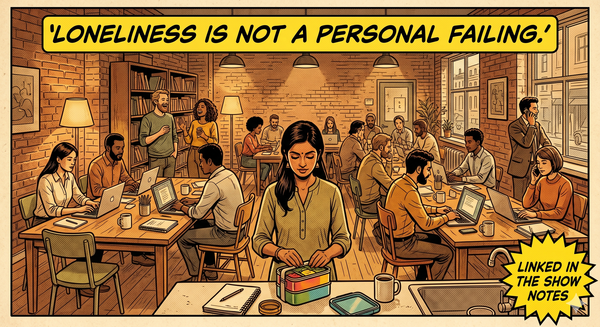
Loneliness Awareness Week. Four perspectives the main coworking conversation skips past.
Thor. Sangeeta. Amy. Lisa. Four people I know. All of them walked into rooms that weren't built for them.
✅ Become a Founding Coworking Community Builder
Before I started freelancing, I'd always worked in hospitality. Kitchens, bars, clubs. From five-star hotels in Mayfair to Pizza Hut in Lakeside Shopping Centre — I did it all.
There was formal training, of course, but where you actually learned was side by side with other people. You'd overhear how someone handled a difficult customer, watch a chef fix a sauce that was about to split, absorb the rhythm of how things got done. Nobody sat you down and taught you. You picked it up by being there.
When I started my own business as an 'independent economic agent' 20 years ago, there was so much I didn't know. And the reason was simple: I couldn't hear other people doing it.
One of the best things that ever happened to me professionally was sitting in a coworking space and listening to other people talk about their projects, their clients, and the tools they were using. Not at a networking mixer with a name badge.
Day to day. Over time. You'd hear someone on the phone with a difficult client and think: oh, that's how you handle that. You'd overhear someone mention a tool you'd never heard of, look it up later, and it would change how you worked.
I've loved being around people who were reading books and talking about them over lunch. That produced an incredible amount of learning. The kind you can't get from a webinar.
I say all this because it's Loneliness Awareness Week, run by the Marmalade Trust in the UK, we'll get to that.
🏳️🌈 It's also Pride Month, and I can't write an article like this without pointing out the hostility I've read about from some communities in the UK towards celebrating Pride this year. It's gut wrenching - Penni Pickering, co-founder of Cowork Crew with her wife Jo Pickering - wrote this on LinkedIn yesterday.
💚 It's also the 10th anniversary of the murder of Jo Cox MP, and I deeply believe in her words:
We are far more united and have far more in common than that which divides us.
And the instinct this week — I feel it too — is to write something about how coworking spaces cure loneliness. How community is the answer. How we've been saying this all along.
I'm not going to write that.
Previously in LinkedIn show notes
The last two editions of these show notes — #53 on mental health infrastructure and #54 on getting coworking said at Prime Minister's Questions — got me more DM;s and comment than ever.
What came through was that there's an intersection between loneliness, mental health, the economy, safe spaces, and productivity that the industry tends to talk around rather than about.
This week I didn't have time to record new episodes. So I dug into the archives and found four people I know who have been talking about these things for years. Friends, not case studies. People I've met through Drive the Collaborative Network, through Write Club, through coworking spaces we've shared.
What they taught me, each from a completely different angle, is that loneliness is a structural deficit. Built in. And the spaces we build can either address it or deepen it.
This Week in the Bullpen
- Thor A Rain on what it takes to walk into a shared space when your body and mind are already running on empty.
- Sangeeta Pillai (Soul Sutras) on safety, names, lunchboxes, and why your diversity banner means nothing if the daily interactions tell a different story.
- Amy Morgan on designing for actual human nervous systems instead of the "stereotypical average person" who doesn't exist.
- Lisa Kissane on the question nobody should be asking, and what to ask instead.
The Assignment
When someone walks into your coworking space, what is their nervous system actually asking?
And what does your space have to say back to someone who is lonely, or struggling, but still needs to get their work done?
Thor: The First Aid Kit
I know Thor through Drive Network. They are one of the most articulate people I've ever met on the subject of wellbeing, mental health, and self-care — the kind of person who makes you notice things you'd been ignoring in yourself.
In 2025, Emily Breder hosted Thor on the Coworking Values Podcast as part of our inclusion and accessibility series with David O'Coimin + Nook sensory pods .
Thor is a health activist who lives with fibromyalgia and ME/CFS. They created the First Aid for Feelings manual, built around an ABC technique — Awareness, Breath, Body, Choice — drawn from their Buddhist practice. You can find Thor's guided meditations on Insight Timer.
Thor is also trans-masculine, non-binary, and belongs to multiple minority communities. Which means they have spent their life scanning rooms for cues of safety before most people have even noticed the room.
When I wrote about emotional safety in coworking spaces recently, I quoted something Thor had shared. It's the internal dialogue of someone managing depression while trying to exist in a shared workspace:
"Do I have the energy to speak to people today? Can I be quiet without being seen as rude? If I sit in the corner, will people think I'm a failure?"
That's not a quote about furniture. It's about what the culture of a room demands from you before you've even sat down.
Thor was clear on the podcast: what they look for in a coworking space is a balanced focus. Not just "how's the business going" but "how are you going." If the only thing anyone asks about is output, the message is: perform or leave. And the people who most need to be there will leave first.
🎧 Listen to Thor on The Power of First Aid For Feelings, hosted by Emily Breder
Sangeeta: Names, Food, and the Litmus Test
I met Sangeeta Pillai at Write Club in 2018, at a coworking space in London called Bathtub to Boardroom. We've been members of two coworking spaces together over the years. We've sat around tables at Write Club and heard people talk about being lonely in a city of eight million people — how you can be surrounded by bodies and still feel completely unseen.
Sangeeta runs the Masala Podcast and a feminist network called Soul Sutras. When we recorded the podcast she had just finished a memoir called Bad Daughter that took her six years to write. She grew up in a slum in Mumbai. When she talks about what safety actually feels like, she's not theorising.
On How to Be Seen, she said something I find myself returning to:
"Safety is being okay in that space as you are. In your culture, your name, your food."
Most coworking spaces have some version of "everyone is welcome here" on the wall or the website. Sangeeta's experience is that the banner doesn't mean much when the daily interactions tell a different story.
If people keep stumbling over your name and not bothering to get it right, your body registers that. If you bring your lunch to the communal kitchen and someone makes a comment about the smell of the spices, you are being reminded, in small constant doses, that you are operating in a space built around someone else's default.
The litmus test is simple. If the people in your space can show up in their culture, with their name, with their food, and feel fine — you might have something real. If they can't, you have a desk rental business and a diversity banner.
🎧 Listen to Sangeeta on How to Be Seen: Loneliness, Culture & Safe Spaces
Amy: Choice Is the Key Message
Amy Morgan is part of the team at 360 Workplace, a consultancy that thinks about physical space through the five senses, through neurodivergence, through the actual experience of walking into a room rather than what it looks like in a brochure.
We ran London Coworking Assembly workshops together with Amy and Urban MBA, including one at the Workspace Design Show London 2025 where teams designed an inclusive coworking space out of Lego.
When Urban MBA got their affordable workspace grant, Amy spent a day helping them design the refit. I've watched her take a room full of operators who were nervous about getting it wrong and turn them into people who couldn't stop talking about lighting, acoustics, and wayfinding.
On Simple Steps to Inclusive Coworking, she put it like this:
"Creating choice is the key message."
Research published in the British Medical Bulletin by Dr Nancy Doyle estimates that between 15 and 20% of the population is neurodivergent — a figure backed by Birkbeck University and the UK Local Government Association. Walk into most coworking spaces and there is zero evidence anyone has considered this.
Most spaces still have harsh echoing noise, open-plan layouts with your back exposed to a busy walkway, and the unspoken assumption that everyone can filter out background conversation and do deep work.
Amy's framework costs nothing extra: adjustable lighting at individual workstations, movable furniture so nobody's trapped, quiet corners with a back against a solid wall and a view of the exits, and a welcome guide sent before someone's first visit so they already know what to expect when they walk through the door.
For someone who gets overstimulated easily, that specific chair in that specific corner is not furniture. It's the difference between a productive afternoon and a low-grade anxiety attack.
And she was direct on the podcast: designing inclusively from the start doesn't cost more than designing it badly. "If you've already got a space, ask your community what they need. That's absolutely fundamental."
🎧 Listen to Amy on Simple Steps to Inclusive Coworking
Lisa: The Question Nobody Should Be Asking
I met Lisa Kissane through Drive the Collaborative Network. She's a writer — Medium is her medium, as she puts it — and has run meetup groups for childless freelancers and business owners. She is childless, not by choice. She wanted children and couldn't have them.
On Creating Inclusive Spaces: Rethinking Networking for Non-Parents, she described what happens when you walk into a new room full of strangers and the first icebreaker question, almost without fail, is: "So, do you have kids?"
"I found that a really difficult question because the answer is no, but people don't generally take no for an answer. They want to know more. They want to know, 'Well, why don't you have kids? What's wrong with you? What happened?'"
Lisa calls this pro-natalism — "the ideology that's so pervasive that puts us on the sidelines, that makes us feel like we've done life wrong."
Her advice is straightforward: don't assume. Don't ask. If someone has children, it will be apparent within the first five minutes of conversation. If they don't, you are demanding information you have no right to.
She suggested some alternatives: what are you reading at the moment? What are you enjoying watching? What's been putting a smile on your face this week? It sounds small. Lisa had stopped going to some networking events entirely because the anticipation of that question was making her so anxious. When the basic social script of a room assumes a life template you don't fit, you stop walking through the door.
"You don't have the right to that information about another person ever."
🎧 Listen to Lisa on Creating Inclusive Spaces: Rethinking Networking for Non-Parents
The Pattern
Thor. Sangeeta. Amy. Lisa. Four people I know. Four completely different angles on the same thing.
Loneliness is a structural deficit. Over the last decade, we engineered human contact out of daily life — remote work, app-based everything, frictionless living — and then acted surprised when people started falling apart.
A 2024 survey of 1,154 US workers by Ringover found that 67% felt lonely at work sometimes or often. It's a small sample of one country, and it shouldn't be read as a global verdict.
But it points in the same direction as everything else. The health impact of chronic loneliness is comparable to smoking 15 cigarettes a day. Public health officials now use epidemiological language on purpose, because the biological damage is measurable.
Polyvagal theory
Polyvagal theory — developed by neuroscientist Dr Stephen Porges in the 1990s and widely used in trauma therapy — explains that the vagus nerve is constantly scanning your environment for cues of safety or threat. It runs from your brainstem through your face, throat, heart, lungs, and gut.
It's the reason a gut feeling is called a gut feeling. When your vagus nerve detects social threat, your body behaves as if it's in danger. What's actually happening is nobody in the room can pronounce your name correctly.
What the numbers don't tell you is what the four people above tell you.
They don't tell you what it feels like to scan a room for a place where you can be quiet without being judged.
They don't tell you what it costs to bring your lunch to work and brace for a comment.
They don't tell you what happens when the first question you're asked in every room reminds you of the life you wanted and couldn't have.
The fix is humans who notice other humans. And the spaces where that happens — the coworking spaces, the libraries, the community hubs — are doing this work whether the government sees it or not.
What You Can Do This Week
These aren't abstract principles. Each one comes from a specific person in this piece.
1. Find the chair with its back to the wall. (Amy's move.) Walk your space this week. Find one spot where someone can sit with a solid surface behind them and a clear view of the exits. For someone whose nervous system is on high alert, that single spot can be the thing that makes the space usable at all.
2. Notice who hasn't spoken to anyone in three days. (Thor's move.) Not to ambush them with conversation. Just to register them. Being seen without being demanded of is a microdose of co-regulation. If you don't know who your quiet members are, start there.
3. Audit one assumption your space makes about who belongs there. (Sangeeta's move, and Lisa's.) Look at your marketing, your events, your kitchen conversations. Who's the assumed template? If you honestly don't know the answer, ask the person in your space who looks least like everyone else. Then listen. And maybe switch the icebreaker from "do you have kids?" to "what are you reading at the moment?"
4. Ask one person "Are you actually okay today?" Not "How are you?" as a greeting. A real check-in. Have the emotional capacity to handle the real answer. This is the unscalable labour. This is the work.
5. Follow Loneliness Awareness Week, run by the Marmalade Trust - read their articles. Join in where you can and keep spreading the word about connection, it's not one day of loneliness!
From the People to the Policy
Two weeks ago #53 made the case that coworking spaces are mental health infrastructure, and included Amanda Perry's Linkedin post and quote:
"Why in 2026, when 55% of business owners identify as neurodivergent — that's approximately 2 million people — are we still working in spaces that are sensory hell for us?"
Last week #54 showed what happens when one operator — Roland Stanley at Dragon Coworking in Rochester — took that seriously, invited Lauren Edwards, his MP in, and six months later she stood up at Prime Minister's Questions and made Keir Starmer answer a question about coworking.
- There are 650 Members of Parliament. Most of them think a coworking space is just a room with desks and Wi-Fi.
- They don't know about the Thor in the corner.
- They don't know about the Sangeeta who finally found a space where someone learned how to say her name.
- They don't know about the Lisa who stopped going to networking events because she couldn't face one more "do you have kids?"
If you run a coworking space and haven't invited your MP to visit yet, this week is a good time to send the email. FlexSA has a template.
- Jane Sartin shared the FlexSA MP Engagement Toolkit here.
But a local story beats a copied letter every time. Tell them about the member who told you your space was the first place they spoke to another human that day.
One operator. One invitation. One MP. Roland proved it works.
Fearless Front-Facers This Week
Thor A. Rain — for writing the First Aid for Feelings manual and talking honestly about what it costs to exist in shared spaces when your body and mind are already running on empty.
Sangeeta Pillai — for six years of writing Bad Daughter and a lifetime of naming the micro-moments that make or break belonging.
Amy Morgan — for proving inclusive design costs listening, not money.
Lisa Kissane — for saying out loud what too many people are carrying.
Better Space London in Farringdon and SPACE4 in Finsbury Park — both part of the Islington Council Affordable Workspace Programme, providing community-first coworking to local residents and underserved communities in the borough.
Making space inclusive and accessible, in partnership with their local authority. We ran our May 19th Unreasonable Connection event at SPACE4, it was the right 'space for' it. 🎉
Connect with This Week's Guests
- Thor A. Rain — The Power of First Aid For Feelings | Insight Timer
- Sangeeta Pillai — How to Be Seen: Loneliness, Culture & Safe Spaces
- Amy Morgan — Simple Steps to Inclusive Coworking | Urban MBA
- Lisa Kissane — Creating Inclusive Spaces: Rethinking Networking for Non-Parents
From the Archives
- #53: Your Coworking Space Is Someone's Mental Health Infrastructure
- #54: "Coworking" was said at Prime Minister's Questions today. Here's how it got there.
- What Emotional Safety Really Looks Like in a Coworking Space
Coming Up
We're thinking hard at the moment about how coworking spaces articulate their value — to their local area, to their MP, to their local authority.
Not just the economic case, but the harder-to-measure stuff: what it actually costs when a space like yours isn't there. More on this soon.
Coworking community builder - back the work
The London Coworking Assembly and Coworking Values Podcast are the home of independent journalism and research for the people building coworking communities. It's 100% reader-funded. No ads. No sponsors. No pay-to-play.
The podcast, the research, and the writing you just read exist because coworking community builders decided to fund them. If this work matters to you, you can back the LCA as a Coworking Community Builder for £100 a year.
It keeps the Coworking Values Podcast free and public, funds the Coworking Citizenship research, pays Urban MBA students to work on our projects, and sends 10% to European Coworking Assembly projects.
✅ Become a Founding Coworking Community Builder
Written by
What's Next?
You're not in the property business. Five of us said it this week — nobody planned it.
I spent this week reading what people in our community have been writing. Karen Tait had a terrible Tuesday at The Residence in Bishop's Stortford. Stacey Sheppard's space was on BBC Spotlight. Felicia Fai and Philip Tomlinson's report on the value of local growth hubs. James Panepinto wrote about weaponising community. Bernie (that me!) published LinkedIn Show Notes#55. They weren't in the same room. They weren't on the same call. They are all pointing at the same thing. Karen Tait had
Coworking said out loud at Prime Minister's Questions
In this week's news: * Coworking gets raised at PMQs * Have your MP visit your space * Loneliness Awareness Week * Back the work as a Coworking Community Builder Coworking gets raised at PMQs This week at Prime Minister's Questions, Lauren Edwards MP made the case for coworking. She told the Chamber that flexible and coworking spaces regenerate town centres like hers in Rochester and Strood, bring people onto the high street, and support local economies. Then she put the Valuation Offi
Start With the Building, Miss the Person — It Happened Again This Week
I spent this week watching the same argument break out in different places, with different people, in completely different conversations. None of them planned it. * Caleb Parker published a manifesto for high street coworking. * Suzanne Murdock sent her monthly newsletter from The Hub Newry. * Parisa Wright kept resharing her Hope Hub episode. And * Ann-Marie Kinlock and Anna Chuicharoen finally opened KindHaus in Hackney after three years of hurdles, setbacks, and proving that a space wher
Start Cooking. The Recipe Will Follow.
We're moving everything up a gear. At the last Unreasonable Connection Live in Lewisham, you told us the groups were too random and the curation could be tighter. You were right. 75% of you left with more momentum than you arrived with. The room worked. The curation didn't. The people in the room, the conversations that happen, and how those conversations are curated—it all matters deeply. That's why on May 19th, Tilley Harris and the team from Akou are collaborating with us to facilitate