
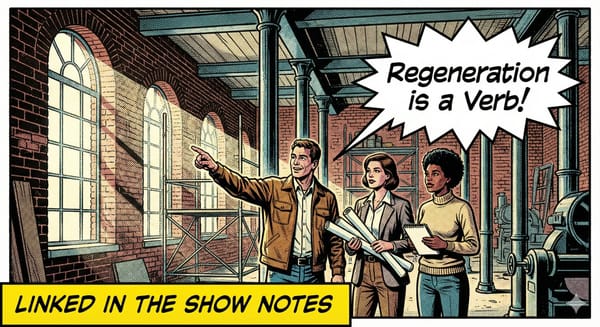
Regeneration Is a Verb. Not a Building.
LinkedIn Show Notes #44 from the Coworking Values Podcast Bullpen.
🎙️ Listen to these stories and hundreds of others on the Coworking Values Podcast.
Walk down any high street in the UK. Look up.
Above the vape shops and the boarded-up windows, you see the bones of what used to be. Victorian brickwork. Industrial ambition. The ghosts of an economy that made things.
Developers love these buildings. They love the word “Regeneration.”
Usually, that word means luxury flats. It means cleaning the brickwork, tripling the rent, and watching the original community vanish like smoke.
But you can build housing without hollowing out the soul of a town. You can stop the “Brain Drain”—that slow leak of talent from places like Wigan and Newry to London and Manchester.
It requires doing the hard thing. It requires building Civic Infrastructure alongside the apartments.
This week in the Bullpen, we spoke to three people who are refusing to let their towns become dormitories. Lee Dalgleish, Suzanne Murdock, and Jane Sartin are fighting for the right to work where you live.
Let’s break it down.
Lee Dalgleish: Stop the Brain Drain
Wigan has a problem. The same problem as a hundred other towns in the North.
Young people grow up, get educated, look around, and leave.
They go to Manchester. They go to London. They take their energy, their spending power, and their future with them. The town becomes a dormitory—a place you sleep, not a place you live.
Lee Dalgleish works for The Heaton Group, the developers behind @Cotton Works (formerly Eckersley Mills). They’re building apartments, yes. But they’re doing something different with the rest of the footprint.
They aren’t just selling units. They’re building an ecosystem.
They realised that if you want people to stay in Wigan, you have to give them a “Third Place.” You have to give them a reason to be there after 5 PM.
So alongside the housing, they created Weave Coworking. They support the Wigan Youth Zone.They host Feast at the Mills, bringing street food and music into the old industrial footprint. They partner with The Brick to fight poverty in Wigan. I’ve driven around Wigan with Lee and seen all of this in action.
This is strategy, not charity.
Lee calls it stopping the “Brain Drain.”
If you build a luxury flat but no coworking space, the freelancer moves to Manchester because they’re lonely. If you build a Youth Zone, that kid grows up feeling like their town invested in them.
In the summer months, over 2,000 people come through Feast at the Mills every weekend. People are coming up to Lee saying, “We’ve got clients based in Wigan that we’ve never, ever had before... we turned up for a lager... and all of a sudden... the doors have started to open up.”
The question Lee keeps asking: How do we keep people in Wigan?
The answer: Give them somewhere to work, somewhere to gather, and somewhere to belong.
Jane Sartin: The System Strikes Back
But here’s the catch. You can have the vision. You can have the empty mill. You can have the community ready to move in.
And then the envelope lands on the doormat.
Business Rates.
Jane Sartin, Executive Director of the Flexible Space Association (FlexSA), is fighting a battle that most of us are too scared to look at because it’s boring, technical, and terrifying.
The Valuation Office Agency (VOA) is using a legal precedent—Cardtronics v Sykes—to argue that every single room in your coworking space should be taxed separately.
Think about the absurdity of that.
It means that if you have 20 small offices in your building, the VOA wants to treat each one as a separate business premise. They want to send twenty separate bills. They want to fragment your building into a thousand taxable shards.
It destroys the flexible model overnight.
This is a systemic failure. The government says it wants “Growth” and “High Street Regeneration.” But its tax system is designed for 1980s corporate headquarters.
Jane has been working on this for over a year. In 2023, the same issue emerged. She resolved it quietly behind the scenes—most of the industry never even knew how close they’d come.
Then it came back in spring 2024. This time, ministers kept batting her back to the VOA. “It’s a technical matter for the agency,” they said. “Not a political decision for government.”
So Jane went public.
She’s written the playbook. She’s drafted the letter to your MP. She’s leading the campaign to fix the plumbing so the rest of us don’t drown in red tape.
The minister has already told people he’s aware of the issue because of the letters he’s received. More letters increase the pressure.
Jane makes it clear: “If people haven’t already, I would definitely encourage them to write to their MP.” Keep it local—mention the number of businesses you support, the number of people who work from your space, and the local economic contribution.
Keep it short—one page of A4, maximum. Make a specific ask—invite them to visit your space, ask them to write to the Exchequer Secretary to the Treasury.
Suzanne Murdock: Open the Door Wider
So, Lee is helping build the space. Jane is fighting the tax man.
Who gets to come inside?
Suzanne Murdock is the founder of The Hub Newry in Northern Ireland. She looked at the standard coworking demographic and realised we were leaving talent on the table.
She’s been working with the European Coworking Assembly on RES-MOVE Project an EU-funded project that supports migrant entrepreneurs using coworking spaces as a gateway to economic integration.
But her work goes deeper. The Hub Newry has 20-30 desks in their Margaret Street building, but they’ve designed for different personalities and work styles. Introverts can work quietly in private offices. Extroverts have breakout spaces for collaboration. There’s the Hub Lounge downstairs for coffee and one-to-ones.
Suzanne puts the emphasis on the person and the family feel as opposed to the work element each day. As she says: “If you’re having a day or it’s a bit of a shit show going on and you’re juggling family and business and everything else thrown at you, there are people here who are going through exactly the same thing.”
This is the next layer of regeneration. You can refurbish the mill, but you have to make sure the single mum and the new arrival can both access the economic engine you’ve built.
Otherwise, you’re building a private club in a public building.
The Pattern: Build, Protect, Include
- Lee builds the Ecosystem: Housing + Work + Youth + Food. It’s a loop, not a line.
- Jane protects the Model: Fighting the systemic threats (Rates) that would make the ecosystem illegal.
- Suzanne widens the Gate: Ensuring the “Brain Gain” includes everyone, not just the usual suspects.
This is what real regeneration looks like. It’s messy, it’s legal, it’s human.
Fearless Front-Facers This Week
Shout-out to developers who build Youth Zones. You’re proving that profit and purpose can share the same postcode.
Shout-out to everyone writing to their MP about Business Rates. It’s boring work, but it’s the work that saves the industry.
Shout-out to the spaces supporting migrant founders. You’re the front line of economic integration.
Don’t Do It Alone
Reading this is easy.
Putting it into action—gathering the people, working out how to work together, making the project actually happen—that’s the hard part.
Maybe you’re at a local authority, overrun, trying to make an affordable workspace programme work with no budget. Maybe you’re a one-person coworking operation, overwhelmed, trying to keep the lights on and build something that matters. Maybe you’re somewhere in between.
I get it. Everything I work on is done with limited resources, alongside other people working with limited resources.
That’s why, on February 24th, we’re taking this conversation offline.
Independent coworking space owners, community managers, local authority representatives, and people running affordable workspace schemes have signed up to spend the day at Blue Garage in Lewisham—working together, building their local communities, and sharing knowledge.
Look at who’s in that room.
This is a local coworking community-building conversation, not a global one. This is coworking for the neighbourhood, not the 1%.
The people showing up are exactly the people who need to be hanging out together to make everything we’ve talked about in this newsletter actually happen.
Lee’s ecosystem work in Wigan requires local authority support. Jane’s Business Rates fight needs MPs who understand what coworking does for their constituency. Suzanne’s inclusion work depends on local affordable workspace programmes.
The better your local authority and your MP understand the value of your coworking space—both the community-building aspect and the local economic impact—the stronger we all become.
When operators and local government are in the same room, that’s when the plumbing gets fixed. That’s when the Youth Zones get funded. That’s when the Business Rates letter to your MP lands differently because they’ve actually stood in your space and met your members.
This day is a full collaboration between the Urban MBA London Coworking Assembly and BLUE GARAGE 💙
In fact, the Urban MBA crew will be staffing and running the logistics for the entire day—walking the talk of building next-generation infrastructure.
We aren’t going to have a panel where experts talk at you. We’re going to spend the day building the peer infrastructure that keeps us all alive.
We will talk about the economics of care. We will share the pricing models that work. We will find the others.
If you believe that coworking is the lifeblood of the local economy—and if you want to meet the other people who believe it too—then I need you in that room.
Get Your Seat at Unreasonable Connection Live (Feb 24th)
Connect with today’s guests:
- Lee Dalgleish | The Heaton Group
- Suzanne Murdock | The Hub Newry
- Jane Sartin | Flexible Space Association
🎙️ Listen to their stories and hundreds of others on the Coworking Values Podcast.
From the Archives: Who Else Is Building the Village?
This week’s theme connects back to previous Bullpen editions:
Infrastructure Isn’t Concrete. It’s the Safety Net You Build — Last week’s edition where we unpacked why “infrastructure” has become an overused word and what it actually means in practice, with Tom Ball, Rose Radtke and Georgia Norton.
Is Your Coworking Space Solving Real Problems or Selling Lifestyle Products? — Where we met Williamz Omope (Space4 Job Club) and Alycia Levels Moore (Polaris BHM) removing barriers and creating employment infrastructure.
They Built Infrastructure for the Energy Money Can’t Capture — Where we heard from Michael Korn (Blue Garage) on building for makers, not just laptop workers.
We’re documenting next from the Bullpen.
More “Gap” strategies. More bridges. More villages.
The neighbourhood infrastructure movement is growing. We’re just documenting the proof.
Thank you for your time and attention today!
Bernie 💚🍉
Community is the key 🔑
P.S. The work doesn’t happen in the newsletter. It happens when people show up in the same room and figure out how to move forward together.
February 24th. You’re either there, or you’re not. Get Your Ticket Here.
Written by