
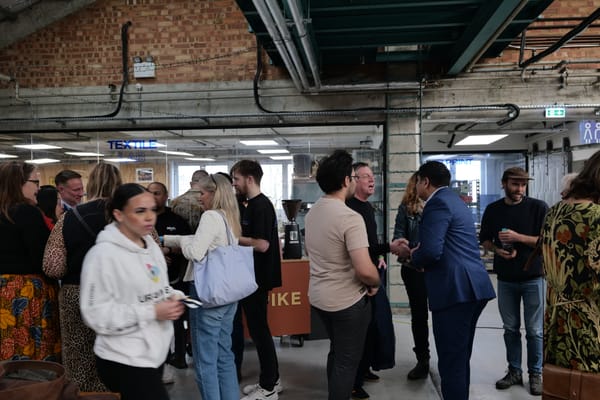
Service is black and white. Hospitality is colour.

You know that moment when the room shifts?
The noise lifts. The energy changes. Everyone is moving, talking, laughing, working—all at once.
It's not luck. It's architecture.
It's what happens when people feel welcome. When they're given agency. When the space is designed not just to serve them but to see them.
I spent years working in bars, clubs, restaurants, and hotels. That Saturday night buzz in a packed restaurant? I've always seen it in coworking spaces when everyone's in action.
Last year, our friends Sonya and Julie—two of the handful of certified Unreasonable Hospitality facilitators in the UK—ran a workshop at Urban MBA for the London Coworking Assembly.
We had jerk chicken and jollof rice before we sat down. One of the moments of collective joy was mapping our customer journeys together.
They're back on the Coworking Values Podcast next week.
Personally, I think it would be a shame if you viewed the magic in Will Guidara's Unreasonable Hospitality book as just a business tactic.
It's not. It's a way of being.
Ian Minor—who has forgotten more about the practical application of hospitality in the workspace industry than most people will ever know—puts it this way:
"Hospitality is the art of being hospitable."
We've engineered the humanity out
In Simon Sinek's foreword to Guidara's book, he writes:
"Over the last few decades, we've drifted apart. Church attendance is down dramatically and bowling leagues and rec centers have all but disappeared. Yet our intense desire to feel a sense of belonging remains—it's an innate human need. That's where Unreasonable Hospitality comes in."
Guidara spent his career proving one thing:
Service is black and white; hospitality is colour.
Service is the transaction. The right plate to the right table. Efficient. Measurable. Black and white.
Hospitality is the relationship. The moment someone feels seen, valued, welcome. That's colour.
Ian described this on the podcast:
"It's not just about giving them the menu and the drinks menu and then coming back a few minutes later and seeing what they want to order. That's the basic standard operating procedure... But an experience is getting and actually having a conversation with the customers."
We've optimised for service. We've stripped the colour out in the name of efficiency.
And it's not just restaurants.
Jon Alexander, Omezzine Khelifa, Immy Kaur, and Indy Johar were in conversation recently on the How to Save Democracy podcast. They made the exact same diagnosis at a civic level.
Johar said this:
"That is where democracy will be born, in the back streets and the back homes. It can't be born in Westminster."
He's talking about what happens when government treats citizens like consumers—passive recipients of top-down services. When systems prioritise transactions over relationships.
Kaur described the Retrofit House in Birmingham as a space that gave people "a release and a capacity... agency to the world that they could live in."
That's hospitality. That's colour.
What you're building is permanent
Here's the connection:
What Guidara attempts to create for three hours in a dining room, you're attempting to build permanently into the fabric of your neighbourhood.
Guidara writes:
"You can be in the financial services business, or in the business of providing people with a plan so they can provide a future for their families. It's the difference between coming to work to do a job and coming to work to be a part of something bigger than yourself."
You're not in the business of renting desks.
You're in the business of belonging.
Ian put it this way:
"If someone goes to a restaurant... they're not there to actually be buying that particular cuisine or a really expensive bottle of wine... what they're really doing is they're going for the experience. They're going for the company... The food and the drink are part of the product, but they're not the main thing."
The desk is the food.
The belonging is the meal.
The NHS didn't start in Parliament. It grew from working-class communities organising for collective health. The neighbourhood GP was a community idea before it became government policy.
Your coworking space is that infrastructure for this moment.
But here's the problem:
There are so many good people running neighbourhood coworking spaces in London, and their neighbours don't know they exist.
Instead of people connecting in their neighbourhoods to work—spending money locally, building neighbourhood power—they're buying sandwiches at Liverpool Street and commuting past your door.
They extract rent. You circulate value.
But only if people know you're there.
May 6th: The day you practice this
European Coworking Day is Wednesday, May 6th, 2026.
Not a marketing campaign. An inch-wide, mile-deep civic practice.
Adrienne Maree Brown—quoted in that same How to Save Democracy conversation—put it like this:
"Shifting from mile-wide, inch-deep movements to inch-wide, mile-deep movements that schism the existing paradigm."
One space. One neighbourhood. One open door—held with unreasonable intention.
Ian calls this "the journey":
"The journey is the day of the member. It's what happens to them as soon as they walk in the building at 9:00 AM... to the point they leave at 5:00 PM.
How many touch points along that 9:00 AM to the 5:00 PM graph, can I get a nod to them in the corridor or a smile or a quick one minute chat along their day just to make it a little bit better for them."
How many moments between 9am and 5pm can you make someone's day a little bit better?
That's May 6th - European Coworking Day.
Last week I shared five ways to make your space visible and findable on the day—from hosting a Talk Club to screening the ACTionism documentary (which is Jon Alexander's work put on screen for your community).
People in the LinkedIn Coworking Group are already sharing what they're planning.
→ Watch the video in the LinkedIn Coworking Group
30 seats left: May 19th at Space4, Finsbury Park
Once a quarter, we meet in person.
No keynotes. No panels. Just the people actually doing this work—in a room together.
We were originally going to do 150 seats. But 60+ at Blue Garage in February felt just right.
Small is the new big.
About 30 seats remain.
Help us find the best time for Unreasonable Connection Online
We've been running Unreasonable Connection Online since 2024—an hour of genuine conversation for coworking operators and community builders.
No sales pitches. No sponsors. Just real talk about running spaces and nurturing community.
Small breakout groups (3-4 people), then we share insights with the full group.
We want to find the best time for everybody to come each month.
Help us decide: What time on a Tuesday, Wednesday, or Thursday works best for you?
60 seconds. That's all it takes. -> Did I mention it ONLY takes 60 seconds??
On the podcast
Head to the Coworking Values Podcast to hear from people who were in the room at Blue Garage.
And over on LinkedIn Show Notes: "Your Shopping Centre Has a Hope Hub. Your Coworking Space Doesn't. Why?"—Bromley and Glasgow.
Sonya and Julie will be back next week to talk about Unreasonable Hospitality.
Ian said this on the podcast, and I think it's the perfect way to close:
"You're going home from your shift or your night's work or your day's work, knowing that for those 8 hours or 10 hours, you did the best that you could do in that period of time and you can go home happy...
You're adding some level of positivity to someone's life, but also your own."
May 6th is the day you practice that.
Written by