
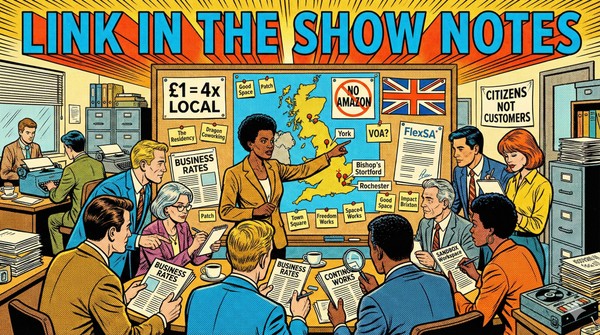
The £1 That Goes Around Four Times: Why Local Coworking Is Civic Infrastructure
LinkedIn Show Notes from the Coworking Values Podcast Bullpen.
LinkedIn Show Notes from the Coworking Values Podcast Bullpen.
🎙️ Listen to these stories and hundreds of others on the Coworking Values Podcast.
🔥Dear Substack Readers, The anti-conference is real. February, London, 150 people. Flash sale opens next week — details below.🔥
Local money stays local.
Spend a pound with Amazon, and it vanishes. Spend it with a Bishop’s Stortford baker; it circulates through the local economy four times.
Three operators showed us what that actually looks like. Here’s what they’re building.
The Question We’re Chasing
What happens when you stop chasing scale and start building local?
Karen Tait made a decision two years ago: no Amazon. Everything The Residence needs comes from Hertfordshire businesses.
Roland Stanley built Dragon Coworking inside his dad’s hotel in Rochester. Now 140 local businesses operate from it—76% local.
Freddie Fforde wrote his Work Near Home manifesto in March 2021. He’s been building Patch across UK commuter towns ever since—six spaces now, every one of them focused on reviving local high streets.
Different models. Different scales. Same bet: that rooting a workspace into its neighbourhood creates something the “work from anywhere” story never will.
And right now, they’re proving something the rest of us need to hear: when you plug a coworking space into its town, the money doesn’t leave. It goes around.
The Injustice We’re Tracking
The dominant story says scale or die.
Optimise for convenience. Work from anywhere. The logical endpoint is everyone working alone, ordering everything from Amazon, wondering why their high street is boarded up.
This story hollows out the places where we actually live.
In the UK right now, there’s a fight that proves how little the system understands this. The Valuation Office Agency wants to treat coworking spaces as single properties—stripping 150,000 freelancers of their Small Business Rates Relief.
The legal precedent they’re using? A Supreme Court case about ATMs in supermarkets.
Freelancers. Consultants. Three-person startups. The VOA is treating them like vending machines.
“If they literally picked their office up and put it on the street outside, they would qualify for small business rates relief,” Roland says. “Just because they’ve had the audacity to come and get in a coworking space, they’re going to lose that benefit.”
The market won’t fix this. Westminster won’t fix this.
People do.
Karen Tait: Why She Banned Amazon From Her Space
Karen wasn’t trying to make a statement. She was trying to run a business.
A commuter-belt mum who’d done the London grind—investment banking in Docklands, then Epping, then Bishop’s Stortford as the kids came and affordability pushed her further out.
Every morning, the same question: why am I still getting on that train?
So she built what she needed.
On a mixed-use farm development with a café next door, a gym, a beautician. Everything within walking distance.
“That five-minute life cycle that we often want—drop our children at school, be able to park outside, go for lunch in the café, do our workout. I’ve seamlessly worked that alongside a workspace.”
Then came the decision that changed everything.
No Amazon.
Her coffee beans come hand-roasted from Saffron Walden. Her cleaners, engineers, IT support—all Hertfordshire. She gave up square footage to build a kitchen with a big sofa, because that’s where her 150 members eat lunch together and talk through what’s keeping them awake at night.
“We will not use Amazon. We will work with people in our community to supply everything that we need for the community.”
For every pound spent with a local business, that pound creates four times the economic impact of money spent with a distant chain.
This isn’t just a nice idea. It’s New Economics Foundation research. Islington Council built their 2020 Community Wealth Building strategy around it.
Spend it with a mega-corp? It vanishes.
“If every single person who lived in Bishop’s Stortford spent £200 on their local high street, their local high street could survive.”
This isn’t charity. It’s economic infrastructure.
Karen’s space is the hub that keeps it moving.
Roland Stanley: The Chef Who Wove 140 Businesses Into Rochester’s Fabric
Roland trained as a chef at Canterbury College. Worked in France. Did stints in London.
Eventually came to help his dad at St George Hotel for a couple of weeks.
He stayed 24 years.
The hospitality background matters. When you’ve spent eight years in kitchens, you learn to read rooms. You learn that some people want to eat and leave, others want to linger. You learn that the feeling matters more than the transaction.
Dragon Coworking started because there was a spare function room costing money just sitting there. Someone mentioned hot desking. Roland went to London, saw what was possible, thought: why isn’t this in Medway?
“I really wanted to run a business authentically and make it a reflection of who you are. I’m not a cutthroat businessman. I try to be a nice guy as much as possible.”
Eight years later, Dragon has 140 businesses operating from it.
Seventy-six percent local.
The perks programme isn’t about discounts. It’s about weaving the space into Rochester’s fabric.
Free garlic bread at the local pizza place. A brownie after six coffees at the independent café. They build relationships first—connecting on LinkedIn, visiting in person—before anyone mentions a deal.
“We do it to support local businesses. We want local people to go and spend money locally. It just works in a nice little local ecosystem.”
Roland’s part of an informal group of indie operators—Teresa from Collaborate, Ewan from Contingent Works, Karen from The Residence, John from Freedom Works. They meet a couple of times a year, share a WhatsApp group, talk about everything in coworking.
One informal rule: no discussing mugs in the sink.
That peer support costs nothing. No £10K-a-month mastermind. Just people who do the same thing, showing up for each other.
“Anyone that’s in coworking, reach out to other coworking space operators. Especially local ones.”
Freddie Fforde: The Manifesto That Changed How We Think About Commuting
Freddie wrote it in March 2021, when the pandemic had finally ripped the Emperor’s clothes off commuting culture.
Work Near Home, he called it.
Not just a desk with good internet. A new category describing what happens when we reinvest time, money, and talent into the places where we actually live.
“Commuting is a low ambition idea. If you assume that the only way of getting people to be productive is bringing everyone together into a central location, you’re excluding everyone for whom that can’t be true.”
The technology was already there before COVID.
Video calls. Cloud documents. All of it.
What shifted was attitudes—specifically, the attitudes of managers for whom commuting worked just fine.
“Childcare, affordability, and health factors don’t always present the same challenges to the traditional managerial class. They wouldn’t change the rules because it suited them.”
Patch now operates coworking spaces across UK commuter towns. Spaces designed to be outward-looking—places where “you can come feel like yourself, you don’t have to code-switch into a different corporate being.”
What Freddie discovered: local authorities are actually the most natural partners for coworking.
Their incentives align. More economic activity, more dwell time on high streets, more local employment.
“They think in town-scale level. An independent landlord just cares about the rent. But a local authority is going to see all these exogenous benefits.”
The first thing Patch does in any new location—even before the deal closes—is meet with the council.
They’re sharing in the press release for York. It sends a signal.
“Being able to talk up in their meetings about how businesses are coming back to the town centre—they want that story.”
Remote work has flatlined at 20-25% of working days. Not dropping back to pre-pandemic levels.
The future Freddie described isn’t coming.
It’s here.
The Pattern: What These Three Operators Understand That Corporate Real Estate Doesn’t
Coworking isn’t real estate. It’s civic infrastructure.
This isn’t theory. Islington Council measured £1.24 million in social value from their affordable workspaces in two years.
Karen’s space isn’t selling desks. It’s circulating money through Bishop’s Stortford four times over.
Roland’s space isn’t renting offices. It’s 140 businesses plugged into Rochester’s economic fabric.
Freddie’s spaces aren’t competing with WeWork. They’re rebuilding high streets that were hollowed out when everyone commuted elsewhere.
There are two stories about coworking.
Story One: Corporate real estate. Reimagining the office on a global scale. Enterprise clients, brand partnerships, scaling for efficiency.
Story Two: Civic coworking. Not building a product that extracts. Creating places that root. Not enterprise sales. Economic access. Not a platform. A community.
Jon Alexander’s Citizens framework cuts through here: the dominant story treats us as Consumers—passive recipients who choose between options. The Citizen story says we’re active participants who shape our communities.
Karen, Roland, and Freddie are building for Citizens.
People who show up, contribute, reinvest locally, and make their towns better by being there.
“More than all of that, what you need is people, community, a space to work,” Karen says. “A space where you could network every day—someone new to meet, someone who’s got an idea for you or a lead for you.
Because seeing people regularly builds familiarity. It builds trust.”
Your coworking space is already this infrastructure.
You don’t need anyone’s permission to keep building it.
Who This Is For (And Why It Matters If You’re Outside the UK)
If you run a space under 150 members and you’ve been told you’re failing because you haven’t scaled—this is for you.
If you’ve chosen depth over reach, local over global, and sometimes wonder if you made the right call—this is for you.
If you’re tired of the “optimise everything, scale or die” story and you know in your bones that connection is the product—not a byproduct—this is for you.
The business rates fight is UK-specific.
The pattern is universal.
Local spaces keep money in communities. Operators choosing depth over reach. The pressure to scale when staying rooted is actually the point.
You don’t need permission to keep building.
The Movement Is Building (And It’s Not Just Operators)
This isn’t one voice shouting. It’s a chorus.
In the UK, operators are meeting with their MPs—Roland in Rochester, Karen in Bishop’s Stortford, Ewan in Bromley. Jane Sartin from FlexSA is walking into ministerial meetings.
And it’s not just operators.
Shout-out to Georgi Aleksiev (Cobot | Coworking Software), Lauren Walker (Coworks), Ivo Tabakov (Nexudus), Helga Moreno (Spacebring), Christian Schmitz (Salto), Crispin Piney (OfficeRnD) and Hector Kolonas (This Week In Coworking)—all looking for ways to spread the word and support their coworking friends.
That’s what a movement looks like.
Not one hero. A chorus.
How Roland’s Peer Group Started (And How You Get Yours)
Roland’s informal group—Teresa, Ewan, Karen, John—the one we’ve been talking about this whole newsletter?
Roland met Ewan at a London Coworking Assembly event.
That’s how it started. Two operators in the same room, realising they carried the same weight. Now they share a WhatsApp group, meet a couple of times a year, talk through everything.
We’ve been building toward this for seven years. 100+ London Coworking Assembly events. A free monthly Unreasonable Connection call. Jon Alexander, author of Citizens, doing Q&As with us in person—twice.
February 24th is where online meets offline.
150 community builders in one room. Not a conference. Not panels of people who haven’t unclogged a toilet in fifteen years.
Small groups working through real problems together. Hybrid chaos. Local authority partnerships. Burnout. Making affordable workspace work without going broke.
What are the three most important things you’ve learned in your life?
How many came from talking with another person who understood?
How many came from sitting in an audience?
For most people, the answers are three and zero.
That’s why this isn’t a conference. It’s a room where your stories meet other people’s stories. Where online connections become real relationships. Where—if we do this right—you leave with your own peer group forming.
This is the first of multiple events in 2026. People you meet in February, you’ll see again.
Flash sale opens this week. Thursday and Friday. 48 hours only. Pre-Christmas. Never happening again.
If you’re on the waitlist, you get access to the First In ticket price. If you’re not, you don’t.
➡️ Join the Flash Sale Waitlist →
Full price tickets are £150. The First In price? You find out when you join the list. Miss the flash sale, and tickets go on sale at full price at the end of January.
🇬🇧The Toolkit: What UK Operators Need Right Now
📺 Watch first: The 7-minute explainer on what the VOA is doing and how to fight back.
1️⃣ FlexSA Email your MP Toolkit - Everything you need to contact your MP. Download.
2️⃣ Find Your MP - Postcode in, name and email out. Takes 30 seconds. members.parliament.uk
3️⃣ LinkedIn Coworking Group - 8,000+ operators. Business rates thread is pinned.
4️⃣ Connect with the guests:
- Karen Tait | The Residence Coworking Bishops Stortford
- Roland Stanley | Dragon Coworking
- Freddie Fforde | Patch
- Jane Sartin | Flexible Space Association
Thank you for your time and attention today!
Bernie 💚🍉
Community is the key 🔑
🎁 p.s. Unreasonable Connection Going Live! Flash sale opens this week. 48 hours only. If you’re not on the waitlist, you won’t get access to the sale price. Join here
Written by