
The neighbourhood is a site of freedom (why community won't save us)

When I was a kid, I loved Christmas time. We would visit my grandparents in Bristol and end up wandering around the massive department stores, surrounded by the hum of cheesy festive music.
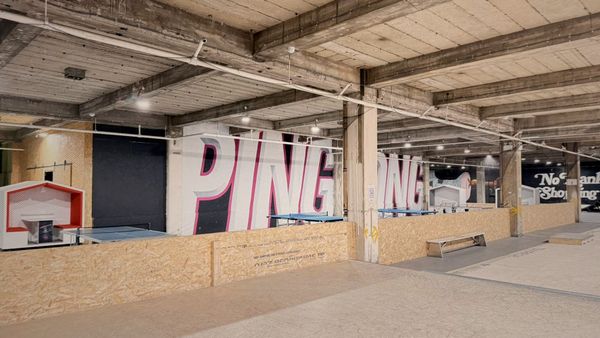
Walk into the old abandoned Debenhams in Bristol today and listen to the noise.
It is the harsh, percussive clatter of urethane skateboard wheels slamming into concrete. It is the heavy bass line of a live band tuning up for a Friday night gig. It is the chaotic, overlapping hum of a Sunday market, where a hundred local traders sell goods inside a hollowed-out monument to mass consumption.
This is Shredenhams. They took a dead retail giant and turned it into an indoor skate park and community hub.
Right in the middle of this massive, echoing, high-stimulus room sits a Nook pod.
Inside the pod, the acoustic reality completely shifts. The noise drops dead. A young skater sits at the built-in desk, treating it like a quiet editing suite to review the clips they just racked up. In the next pod over, a local freelancer is hammering out client emails while a skate session happens three feet away outside the pod.
Later in the week, a local Talk Club will meet right here in the skate park. It is exactly the kind of hyperlocal mental health infrastructure we talked about in last week's newsletter—creating spaces where men can actually talk, built right into the fabric of the neighbourhood.
Our friend David O'Coimin builds these pods. He understands the raw biology of shared space.
"There's a part of your brain that's wired for monitoring around you for threats," David says. "In here, that gets to shut down a little bit. It gets you relaxed and you'll be a bit more open."
That pod is civic infrastructure installed directly into a high-friction environment to facilitate local life.
Third Places Are Real (But We've Been Selling the Wrong Version)
Ray Oldenburg was right.
Third Places—the pubs, libraries, coffeehouses, guild halls—are the heart of a community's social vitality. They're not luxury. They're civic infrastructure.
But the coworking industry hijacked the concept, turning it into an aesthetic.
We convinced ourselves that if we bought the right mid-century modern chairs, curated a lo-fi Spotify playlist, and poured a decent flat white, we were building a Third Place.
We weren't. We were building a brand.
A real Third Place is co-constituted by the people who use it. Researchers Laetitia Mimoun and Adèle Gruen argue that a space is actively shaped by the raw, daily practices of the people inside it.
When independent workers occupy a space, they aren't just renting a seat—they are actively transforming the environment into what Mimoun and Gruen call a 'Productive Third Place.' It is the shared friction, the mitigation of isolation, and the actual social bonds that emerge in the room. It is the infrastructure that endures even when the Wi-Fi cuts out and the coffee machine breaks.
You already know this.
You feel it when you look at the spreadsheet and realise, like Karen at The Residency in Bishop's Stortford, that your commercial electricity bill has tripled in the last four years.
You feel it when you're sitting at the reception desk late at night, trying to figure out how to absorb those rising costs to protect your members, all while staring down the barrel of UK business rates changes that could strip away relief for micro-businesses—what Roland in Kent recently called an "extinction-level event" for our industry.
You feel it when you're plunging a blocked toilet before a tour arrives, or when you have that quiet, deeply awkward conversation in the kitchen with a founding member who is suddenly a month behind on their desk rent because their biggest client folded.
Good vibes do not pay the tripled electricity bill.
Community, as a vague concept, does not keep the lights on when the macroeconomic weather turns hostile.
Infrastructure Is Never Neutral
Robert Moses—the urban planner whose political power Robert A. Caro documented in The Power Broker—built the highways in New York and intentionally built the overpass bridges too low for public buses to pass underneath.
He did it to ensure that poorer citizens, who relied on public transit, couldn't reach the public beaches.
Infrastructure is never neutral. It always dictates who belongs and who is excluded.
When you sign a commercial lease, pull broadband cables into a derelict building, and fight the local council for planning permission, you are making a political infrastructure decision.
You are deciding who gets to work, who gets to connect, and who gets a seat at the table in your postcode.
You are a civic actor.
The Arithmetic of Extraction
If you want to understand why your neighbourhood feels squeezed, and why your margins are so tight, you have to look at the cold arithmetic of modern real estate.
The global, venture-backed workspace models scale by treating citizens as consumers.
When a corporate behemoth opens a massive, shiny glass box in a city centre, they are installing an extraction pump.
The membership fees paid by local freelancers, startups, and micro-businesses don't stay in the local economy. They are aggregated, wired out of the city, and used to inflate portfolio valuations and pay distant shareholders.
When commercial asset prices and rents compound faster than local wages, wealth drains from working neighbourhoods to distant portfolios. Permanently.
But look at the independent operators who are actually doing the work.
Look at Koder, whom we talked about a few weeks ago. He's the first Creative in Residence at Blue Garage in Lewisham, installing a music studio and bringing brand partnerships to local creatives so they don't have to leave their postcode to find greatness.
Look at Joana Carvalho at DINAMO10 in Portugal, running a 15-year-old hyperlocal coworking space that's become the meeting point for operators fighting rural depopulation.
They are building closed economic loops.
When you operate a neighbourhood space, your members walk outside and buy lunch from the independent café next door. They hire the local accountant sitting at the hot desk opposite them. They collaborate on design projects that service the local council.
The corporate model extracts rent. You circulate wealth.
This circulation is the actual, mathematical definition of Social Capital. The measurable trust and shared resources that keep a local economy from collapsing when the national economy falters.
The Two Futures
Jon Alexander posted a clip today from a conversation he hosted in London with Indy Johar and Immy Kaur.
It frames the exact, towering stakes of what independent operators are doing right now.
Jon Alexander framed it plainly:
"There are really only two possible futures ahead of us. We either manage to transform our societies into citizen-led, participatory, sustainable systems before a massive collapse, or we fail, and the collapse arrives."
But either way, the required action is exactly the same.
We have to get stuck into our neighbourhoods. We have to commit to the physical places we live and the people sitting three feet away from us. We have to build local energy systems, local food networks, and local communities that can physically hold us together.
If there is time, this hyperlocal action creates the space for broader political change to take root.
If there isn't time, this local action builds the resilience needed to withstand the impact.
Indy Johar called the neighbourhood a site of freedom.
It is the exact, human scale at which we still possess the agency to work, to build, and to do what we know is right.
You cannot fix the global economy.
But you can fix the room you are standing in.
Assembly is Required - Are You In?
The hardest part of this work is the isolation.
The corporate models rely on you feeling fragmented. They win when you think you're the only person trying to make the maths work on a community-first space. They want you exhausted and disconnected.
We have to gather.
This May, we put the reps in, and we need you in the room.
1. May 6th: European Coworking Day
This is an inch-wide, mile-deep civic practice.
It is a day to boldly demonstrate your physical social value to your city. Open your doors. Host a local lunch. Screen an ACTionism documentary. Show your neighbourhood that you are their civic anchor.
👉 Put your pin on the map here
2. May 19th: Unreasonable Connection LIVE at Space4
Every month, we host "Unreasonable Connection" online to combat the exact isolation I described above.
We do this in the flesh four times a year, and our next in-person gathering is May 19th at Space4 in Finsbury Park.
There are no sponsors. There are no keynotes. There are no pitches.
Independent operators, community builders, and creators sit in small groups of three or four, having actual conversations.
We don't just put you in a room and hope for the best. The reason it's called Unreasonable Connection is that we actively work on connecting everyone who signs up—before, during, and long after the event is over.
👉 Book your seat for the Space4 gathering here
3. June 3rd, 2026: The Coworking Alliance Summit
This is where alliances, communities, and independent operators come together to share, learn, and actually get things done.
Forget imposter syndrome and the "big players"—this is for absolutely anyone building neighbourhood coworking. We need to organise our power and figure out the hard infrastructure of our movement.
👉 Join the Coworking Alliance Summit here
Written by