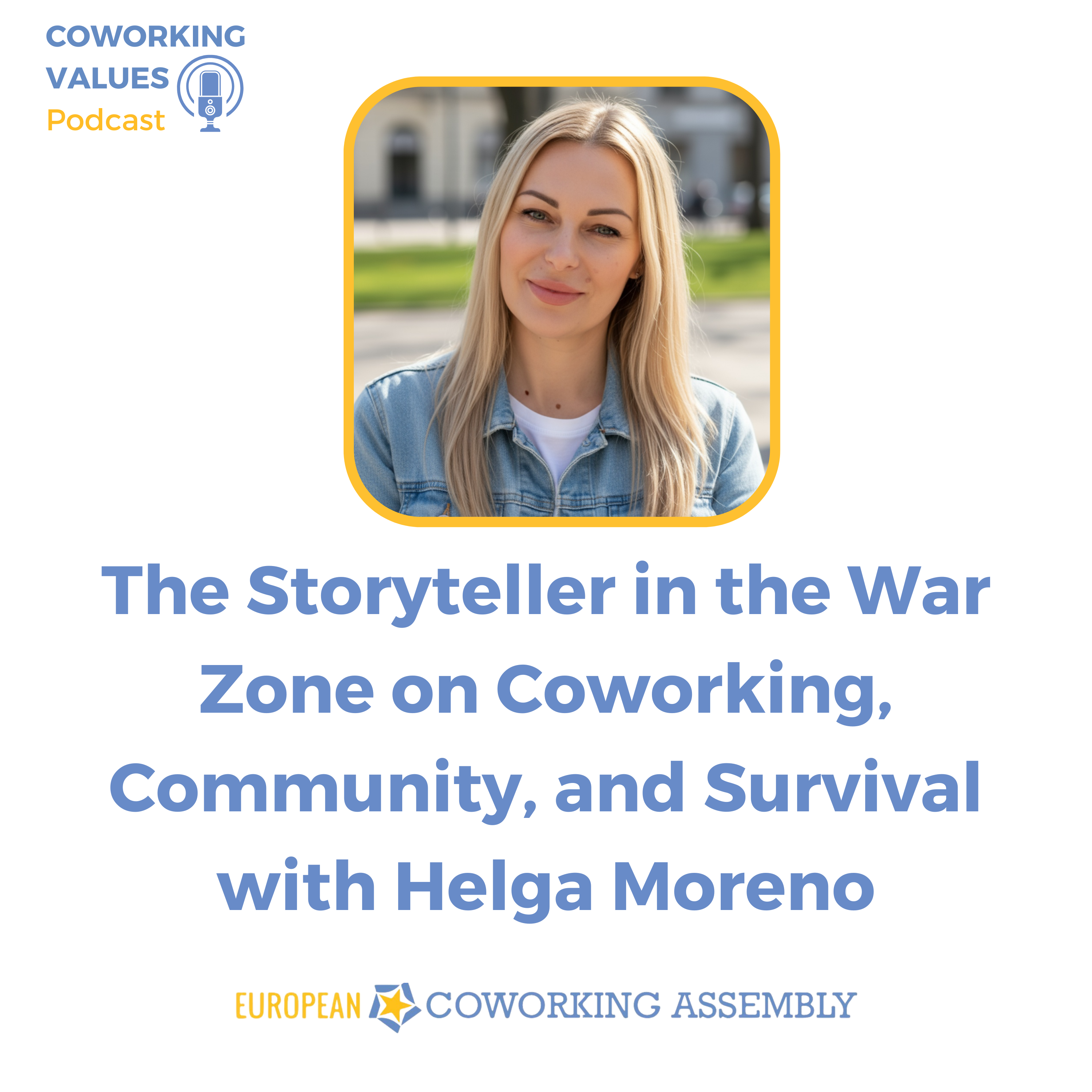
The Storyteller in the War Zone on Coworking, Community, and Survival with Helga Moreno
What happens when the person selling efficiency software lives where electricity is a luxury and bomb shelters are standard amenities?
Episode Summary
“It all started at 5 AM. We had explosions. My husband works for the Red Cross — they evacuate people. We’re always awake, tracking the news and knowing what's happened. I don’t know if somebody was injured tonight, but I’ll find out this evening when he comes home.”
This is how Helga Moreno’s morning began. Not with a standing desk and a flat white. With explosions.
With her husband running towards danger, she walks the dog and opens her laptop to write about member retention strategies for coworking spaces.
Helga is a senior marketer at Spacebring, an English Literature graduate and the author of fairy tales about coworking — including one about cyberspace that feels like it was written in a different lifetime.
She lives in Mykolaiv, southern Ukraine, near Odessa and the Black Sea. The sunny south, as she calls it.
Additionally, a frontline region where drinking water hasn’t run from taps in years, electricity cuts out for hours at a time, and heating remains uncertain as winter approaches.
In February 2022, when Russia invaded Ukraine, Helga and her family made a choice that would define everything that followed: stay together, no matter what. Her husband and son couldn’t leave Ukraine. So she didn’t either.
They’ve lived through displacement to Lviv, the return to Mykolaiv, the daily air raid alerts, the 11 PM blackouts, and the permanent uncertainty that rewires how you think about the future.
But here’s the contradiction that makes this conversation so vital: Helga’s job is to write polished content about optimising coworking spaces — automated invoices, maximised revenue per square foot, reducing churn.
Meanwhile, the coworking spaces in her country proved their value by doing the exact opposite. In February 2022, Ukrainian coworking spaces didn’t optimise.
They opened their doors for free. They became bomb shelters, refugee centres, humanitarian aid hubs. They abandoned the profit motive entirely because survival demanded it.
Helga holds both of those truths at once. She co-founded the Ukrainian Coworking Association, which partnered with CBRE to document the state of the industry under war conditions.
She travels to conferences — two-day bus journeys, flights via Moldova — to experience “normal life,” where the lights stay on after 11 pm. And she comes home to a city where choosing a coworking space means asking: Does it have a generator? Does it have a bomb shelter?
This conversation isn’t about marketing tactics or SaaS metrics. It’s about what coworking actually means when everything transactional falls away. It’s about a storyteller who wrote children’s fantasies about cyberspace, now writing testimony about digital resistance and economic survival.
And it’s about a community that proved — when one of their own needed £1,500 per night for private hospital care to save her son’s life — that community isn’t networking. It’s tangible, life-saving support.
Helga is speaking at two major events: an online conversation with Jeannine van der Linden and Marko Orel on 27th November about displaced Ukrainians and reconstruction, and Coworking Europe in Berlin.
Her conference bio ends with an invitation: “While her focus is on marketing, Helga lives in the south of Ukraine; if you want to know how things are right now, she invites you to come and ask.”
Bernie took her up on it.
Timeline Highlights
- [01:36] “It’s Mykolaiv, near Odessa, near the Black Sea” — Helga introduces herself from the sunny south of Ukraine, a frontline region
- [04:45] “It all started at 5 AM. We had explosions. My husband works for the Red Cross — they evacuate people.”
- [06:24] “We still don’t have drinking water in my city. We have electricity schedules — 2 hours on, 3 hours off”
- [08:02] “We decided we must stay together. My husband and my son couldn’t leave Ukraine. So if I go, I leave my men here in the warzone.”
- [09:13] “I keep my laptop charged all the time. If I’m out of charge or internet, I go to a café. We have one coworking space that still works.”
- [10:38] “Power generator and bomb shelter” — the criteria for choosing a coworking space in Ukraine
- [11:57] “To go to Berlin, I go to Moldova and take a plane. Otherwise, it’s a bus for two nights and two days.”
- [15:56] “We don’t deal with uncertainty. We have to accept it. We can’t plan for years. We’re not buying an apartment because it can be ruined anytime.”
- [18:55] “Every night we have air raid alerts. People in Kyiv sleep in the subway with their kids. It’s really cold already.”
- [20:31] “My part is to analyse the coworking industry during wartime — from completely zero when everything stopped, to thriving spaces now”
- [21:57] “My son was drafted. He lived in a tent in the snow without heating. He got really sick — 40-degree fever for three weeks.”
- [23:55] “The hospital was €1,400–€500 per night. The coworking community did fundraising. We could afford it. My son fully recovered.”
- [27:25] Bernie’s reflection: “How do you juggle going to a conference, blogging about member retention, and rescuing your son like that?”
When the Profit Motive Vanished Overnight
In February 2022, Ukrainian coworking spaces had a choice: optimise revenue or save lives.
They chose lives. Instantly. Without committee meetings or PR consultants.
The Future Hub in Lviv sheltered families fleeing from Kharkiv and Kyiv. Startup Depot hosted over 150 refugees, primarily women and children. B-Working in Kyiv turned its concrete basement into a public bomb shelter during missile attacks.
Helga mentions one coworking space in Mykolaiv that’s still open — chosen not for its coffee quality or meeting room availability, but for its generator and bomb shelter.
This is the contradiction Helga lives inside. Her day job is writing about automated invoices, maximised square footage, and reducing churn.
But the coworking spaces in her country proved their value by doing the exact opposite. They gave everything away for free. They ceased to be businesses and became civic infrastructure.
“We decided we must stay together,” Helga says, describing the family decision in February 2022. Her husband and son couldn’t leave Ukraine. So she didn’t either. It’s a microcosm of what happened across the sector.
The transactional gave way to the existential. Revenue per square foot became irrelevant. What mattered was shelter, warmth, electricity, and community.
Helga worked with the Ukrainian Coworking Association. Their first significant act wasn’t policy work or internal strategy. It was documentation. They partnered with CBRE to gather data on the state of the market under war conditions. It was an act of testimony. Proof of existence. We are still here. This is real.
The global coworking industry debates tactics for reducing churn and optimising meeting room pricing.
Ukraine demonstrated the fundamental value proposition of shared space: the capacity to transform into life-saving infrastructure in a single day.
The Philologist Who Wrote About Cyberspace
Before the war, Helga wrote a children’s fantasy book called Journey into the Net. It was about the hopeful possibilities of cyberspace, the magic of digital connection, and the adventure of navigating the online world.
Now she writes testimony. Documentation. Strategies for survival. Her company, Spacebring, isn’t just selling software anymore — it’s on the front lines of digital resistance, helping spaces operate under conditions most Western operators can’t imagine.
Helga has a master’s degree in English language and literature. She’s a philologist — a lover and student of language, literature, and narrative architecture. She’s authored over five books, curates The Flex Factor podcast, and contributes to Coworker, Coworking Resources, and Coworking Insights. But when people introduce her, they lead with the job title: senior marketer at Spacebring.
Bernie pushes past that. “I’m so glad you’re a writer and not a marketer,” he says. “I think people think I’m a marketer, but really I’m in my café, smoking and stressing over a manuscript.”
Helga laughs. She’s working on a sequel to her first coworking fairy tale. She’s keeping it secret until Coworking Europe, where she’ll present printed copies. It’s a small act of defiance — a refusal to let the war define her entirely.
She’s still the storyteller. Still, the philologist believes in the power of narrative, imagination, and language to build worlds.
But the stories have changed. From fantasy about cyberspace to the harsh necessity of cyber resilience. From children’s adventures to testimony about what it takes to keep a tech sector alive under attack.
It’s the ultimate pivot. And it reveals something essential about Helga: she understands both the magic and the machinery. The human and the transactional. The story and the spreadsheet.
Choosing Coworking Spaces by Generator and Bomb Shelter
“Power generator and bomb shelter.”
That’s Helga’s answer when Bernie asks how she chooses where to work.
In London, Bernie used to stand at Old Street roundabout and debate which coworking space had the best coffee. In Mykolaiv, Helga checks which one has electricity. The parallel universes are almost absurd, except they’re both real.
Helga’s workday is a masterclass in adaptability. She keeps her laptop charged at all times. If the power cuts out or the internet fails, she goes to a café with a generator.
There’s one coworking space left in Mykolaiv that still operates. It’s open because it has the infrastructure to function under siege: backup power, internet via Starlink, and a bomb shelter.
“We still don’t have drinking water in my city,” Helga says. “We bring water to our houses. We have electricity schedules — 2 hours on, 3 hours off. We don’t have heating yet, but I hope we will this winter.”
The casualness of that statement is devastating. I hope we have heating. It’s November. Snow is already falling in parts of Ukraine. And whether Helga’s family can stay warm this winter is uncertain.
But she keeps working. “I’m really grateful I have a good job that I love,” she says. “It helps me preserve my sanity.” Work isn’t a distraction from the war. It’s a structure that holds her together. A reason to keep moving forward. A way to contribute to something larger than survival.
The global coworking industry talks about resilience as a buzzword. Helga lives it as a daily practice. And the infrastructure that makes it possible — generators, Starlink, bomb shelters — isn’t inspirational. It’s expensive, fragile, and exhausting. But it’s what keeps the Ukrainian tech sector alive.
The Two-Day Bus Journey to “Normal Life”
Reaching Coworking Europe in Berlin involves a two-day bus journey. Or a detour through Moldova to catch a flight. Helga chooses Moldova.
“If I don’t go that way, I have to stay on a bus for two nights and two days,” she explains. She tried it once, going to Amsterdam. It was brutal — physically painful, mentally draining. But she keeps going. Because exposure to “normal life” restores something essential.
“It’s so cool to come to Berlin and go out at midnight and see that the electricity is still on,” Helga says. “No restaurants, no cafés, no stores work at that time in Mykolaiv. Everything shuts down at 11 PM because there’s no power.”
The conferences aren’t just professional development. They’re survival tools. Helga returns with inspiration, content ideas, and a renewed sense of possibility.
She reconnects with the global coworking community — the people who fundraised to save her son’s life, who amplify Ukrainian voices, who refuse to let the war become background noise.
“I’m really grateful to Spacebring for sending me to these conferences,” she says. And when she comes home, she doesn’t dread it. “I’m going home,” she says. “I will see my son, my mum, my dog, and my husband. We’ll be happy together. It will be a small celebration.”
The contrast is staggering. From Berlin’s 24-hour electricity to Mykolaiv’s 11 PM blackouts. From conversations about member retention tactics to checking whether her husband survived the night’s Red Cross evacuations.
But Helga holds both. She refuses to let the war erase her identity as a global coworking thought leader. And she refuses to let her professional persona erase the reality of where she lives.
When Community Saved a Life
In late November, shortly after Helga attended Coworking Europe in Sofia, her son was drafted. He was 25 years old. They sent him to a training camp where hundreds of soldiers lived in tents without heating, in the snow, with one person trained in basic medical care for the entire group.
He got sick. A cough that wouldn’t stop. A fever that hit 40 degrees Celsius and stayed there for three weeks. No one could help him. He was dying in a tent in a forest, and Helga had no way to reach him.
“I saw a dream,” Helga says. “My last day in Sofia, I dreamed I tried to call him and a military guy picked up and said my son is dead.”
She started calling hotlines, contacting everyone she could think of. She found out he was gravely ill. Hours away from sepsis. Every organ is impacted by infection.
She got him to a private hospital. Ukrainian soldiers cannot simply go to any hospital — there are bureaucratic and military restrictions. The private hospital could treat him, but it cost €1,400–€500 per night. Helga and her family sold everything. Took out bank loans. Spacebring helped financially.
And then the coworking community mobilised.
Bernie called. Tom from StartDock called. Carlos from Avilés Spaces called. People across Europe began fundraising.
The community that Helga had served for years — through her writing, her conference talks, her advocacy for Ukrainian operators — showed up when it mattered most.
“Due to that help, we could afford the hospital,” Helga says. “My son fully recovered. He even has a girlfriend now.”
It’s the story Helga will tell at the 27th November online event with Jeannine and Marko. Not as inspiration porn. Not as a feel-good community anecdote. But as evidence of what community actually is when you strip away the buzzwords.
“Community is not just about fighting loneliness or sharing information,” Helga says. “Community is real support. Community can save people’s lives.”
What the Global Industry Doesn’t Understand
Helga is speaking at two major events. On 27th November, she’ll join Jeannine van der Linden (European Coworking Assembly) and Marko Orel (Prague University of Economics) for an online conversation about displaced Ukrainians, coworking as aid infrastructure, and reconstruction.
At Coworking Europe in Berlin, she’ll present on a panel about reducing churn. Her conference bio is polished, professional, listing her books and podcast and contributions to the industry. And then it ends with this:
“While her focus is on marketing, Helga lives in the south of Ukraine; if you want to know how things are right now, she invites you to come and ask.”
It’s a line that cuts through every corporate bio ever written. It’s an invitation to testimony. A refusal to let the professional persona erase the lived reality.
Bernie asks what Helga wants the global coworking industry to understand. She doesn’t sugarcoat it.
“People are dying every day in Ukraine,” she says. “Every night, we have air raid alerts. People in Kyiv sleep in the subway with their kids. It’s really cold already. We need to keep this problem top of mind.”
At one conference, someone asked Helga how things were in Ukraine. “You probably don’t have shelling anymore,” they said. “You look so fresh. You look good. It doesn’t look like you came from a warzone.”
The exhaustion in Helga’s voice when she recounts that moment is palpable. The work of existing as a professional while carrying a warzone inside you is invisible labour.
The global industry sees the polished output — blog posts, podcasts, and conference talks.
They don’t see the 5 a.m. explosions, the electricity schedules, or the fact that Helga’s family still doesn’t know if they’ll have heating this winter.
“We don’t deal with uncertainty,” Helga says. “We have to accept it. We can’t plan for years. We’re not buying an apartment because it can be ruined anytime.”
And yet she keeps building. Keeps writing. Keeps showing up. Not in spite of the war, but because of it. Because the act of documenting, of connecting, of contributing to the global conversation is itself a form of resistance.
✅ Coworking Trends Survey 2025
The Coworking Values Podcast is keen to support Carsten Foertsch and Deskmag - The Coworking Magazine Coworking Trends Survey - the longest-running global study tracking the evolution of coworking and flex spaces.
If you’re a coworking community builder or operator, take 5–10 minutes to share how your space is doing this year. Your input helps shape the most accurate industry snapshot out there.
Help make sure voices from all types of spaces - big and small, rural and urban - are heard.
Links & Resources
Helga Moreno’s Work
- Spacebring Blog — Helga’s content on coworking operations and growth
- Helga’s LinkedIn — Follow her updates, reports, and Ukrainian coworking industry insights.
- SpaceBring Flex Factor podcast with (THE) Marc Navarro
- THAT Photo we talked about at the end!
Upcoming Events
- 🇺🇦 27th November 2025: Coworking Spaces and Displaced Ukrainians: From Providing Aid to Reconstruction — Online event with Jeannine van der Linden, Helga Moreno, and Marko Orel
- Coworking Europe 2025 — Berlin (Helga will be presenting on the “Reducing Churn” panel)
- Unreasonable Connection: Going Live — London gathering of 150+ coworking community builders - join the co-creation/wait list.
- Unreasonable Connection online on November 19th
- Workspace Design Show — February 2026 trade show and conference in London
Bernie’s Projects
- Email Course: 5 Biggest Mistakes Coworking Community Builders Make (And How to Avoid Them)
- Coworking Values Podcast LinkedIn
- LinkedIn Coworking Group — 8,000+ member community - follow this podcast there.
- Bernie’s LinkedIn — Connect directly
One More Thing
Coworking brings communities together, helping people find and share their voices.
Each episode of the Coworking Values Podcast explores Accessibility, Community, Openness, Collaboration, and Sustainability — values that shape the spaces where we gather, work, and grow.
If this resonates with you, rate, follow, and share the podcast. Your support helps others discover how coworking enriches lives, builds careers, and strengthens communities.
Community is the key 🔑
Written by
What's Next?
They Built Infrastructure for the Energy Money Can't Capture
LinkedIn Show Notes #35 from the Coworking Values Podcast Bullpen. 🎙️ Listen to these stories and hundreds of others on the Coworking Values Podcast. Three community builders. Three continents. One pattern: They stopped selling memberships and started building movements that run on relationships, not transactions. This week from the Coworking Values Podcast Bullpen: We've been tracking how coworking spaces can become laboratories for post-capitalist organising. Not in theory—in practice. W
They Come for the Promise. They Stay for the Hospitality. with Dr. JJ Peterson
"They come for the promise. They stay for the hospitality." — Dr. JJ Peterson Episode Summary JJ Peterson has spent eleven years inside the StoryBrand universe. He co-authored Marketing Made Simple with Donald Miller. He helped Will Guidara write the certification for Unreasonable Hospitality. He hosts the Badass Softie podcast — for leaders who are unapologetically driven but want to lead with their hearts. He is flying to London in June to teach at the first workshop in the world to b
Why AI Can't Feel the Room: Practical Operations with Carlos Almansa
"The AI cannot feel the space. It can't feel the dynamics or the vibe. But it can free up time for you to talk to your members, to have a coffee with them, to understand and to read people." — Carlos Almansa Ballesteros Episode Summary Most conversations about AI in coworking are either evangelical or dismissive. Carlos Almansa Ballesteros, co-founder of Nexudus and author of the Coworkings AI newsletter, isn't interested in either. He's been building software for this industry for 13
The Golden Thread: Why Unreasonable Hospitality Needs a Story First with Sonya & Julie
Why your coworking space needs a Story before it can practise hospitality "Marketing makes these promises and service delivers that. So for us, StoryBrand and unreasonable hospitality, really work together hand in glove. And StoryBrand is really about thinking about how you communicate that you care to your customers. And the unreasonable hospitality side of things is how you prove it." — Sonya Whittam Sonya Whittam and Julie Firth run Story22, a customer-centric marketing agency base
You're Never Broke If You Got Ideas: How Koder Brings Music to the Neighbourhood
"Ideas are currency, you know. And you're never broke if you got ideas... Everything we are looking at around us came from an idea. So for me, they are, it is a currency within itself." — Koder Koder runs Undeniable Studios, a music production conglomerate built from youth clubs, pirate radio, and 10,000 hours of free studio time in Brockley. He's now the first Creative in Residence at Blue Garage in Lewisham, where he's installing a commercial music studio, planning his Circle the Ends
Start With the Building, Miss the Person — It Happened Again This Week
I spent this week watching the same argument break out in different places, with different people, in completely different conversations. None of them planned it. * Caleb Parker published a manifesto for high street coworking. * Suzanne Murdock sent her monthly newsletter from The Hub Newry. * Parisa Wright kept resharing her Hope Hub episode. And * Ann-Marie Kinlock and Anna Chuicharoen finally opened KindHaus in Hackney after three years of hurdles, setbacks, and proving that a space wher
Start Cooking. The Recipe Will Follow.
We're moving everything up a gear. At the last Unreasonable Connection Live in Lewisham, you told us the groups were too random and the curation could be tighter. You were right. 75% of you left with more momentum than you arrived with. The room worked. The curation didn't. The people in the room, the conversations that happen, and how those conversations are curated—it all matters deeply. That's why on May 19th, Tilley Harris and the team from Akou are collaborating with us to facilitate