
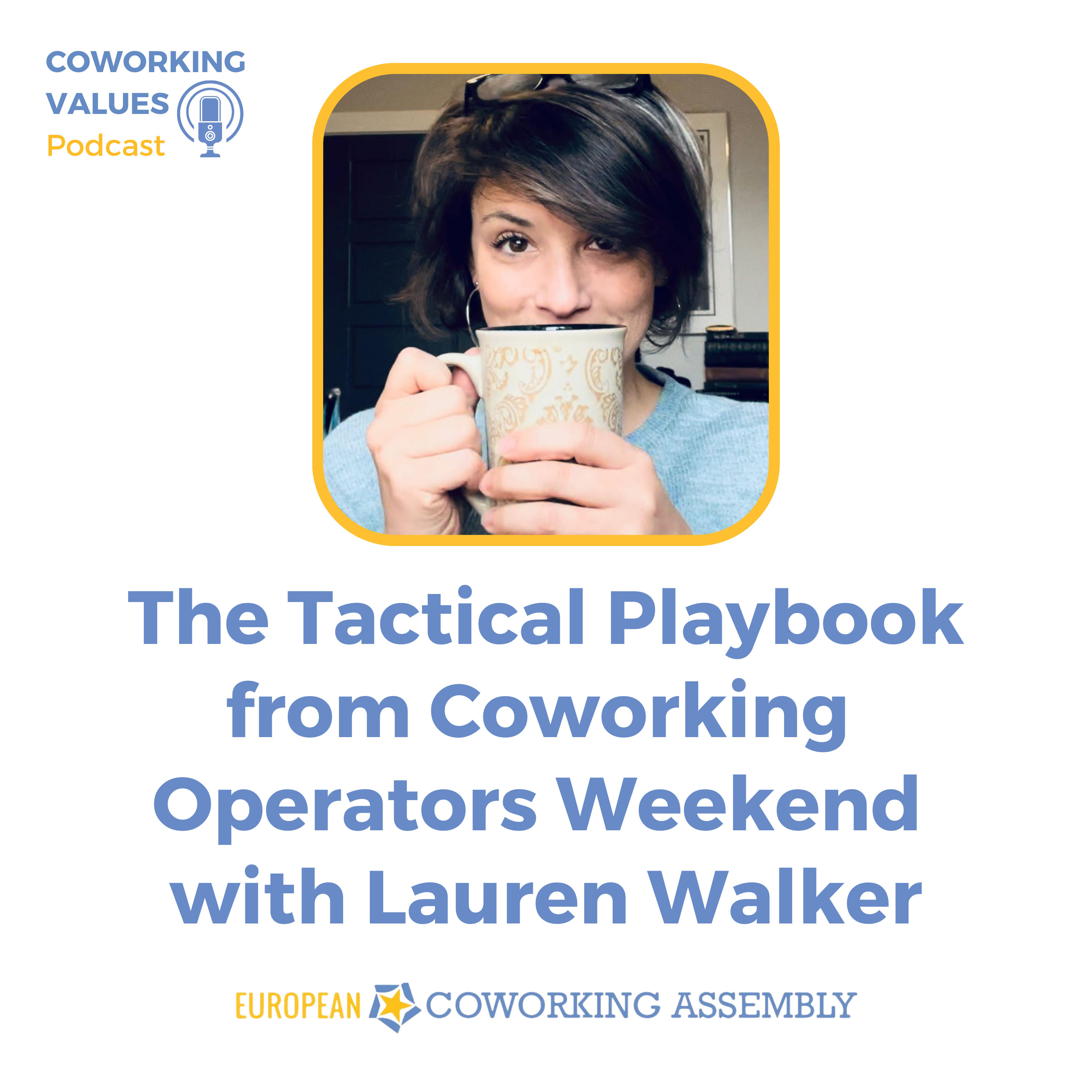
The Tactical Playbook from Coworking Operators Weekend with Lauren Walker
On the tactical frameworks from Coworking Operators Weekend, the circus metaphor that explains marketing, and why operators need each other.
“One of the attendees spoke about their local government saying that they could not show favour to specific business and therefore couldn’t collaborate with the coworking space. One of the panellists said, We’ll create a downtown alliance. They can work with an alliance.”
—Lauren Walker
Episode Summary
Lauren Walker is a storyteller who’s spent 25 years behind the scenes.
Reader’s Digest in the 1990s, where she learned direct marketing when things were still on paper. A couple of dot-com startups during the boom. Thirteen years at IBM, writing deep technical marketing before becoming the editor of IBM.com’s homepage.
She’s been working remotely since 2005. Twenty years of distributed work before it became the default.
Now she’s CMO at Coworks, a coworking space software company. And in February 2026, she helped organise the Coworking Operators Weekend in Raleigh—a small, focused gathering of 40 operators and managers at Raleigh Founded.
The event started in LA in 2025. Jerome Chang and Jackie Latragna created it with one principle: small, no bells and whistles, just operators talking. Sean Brown, CEO of Coworks, attended and loved it. Jerome asked if Coworks wanted to bring it to the East Coast. They said yes.
Lauren describes the energy simply: “It was folks recognising game. It was folks saying, I do what you do, you do what I do, but how do you do it?”
What made it work was what it wasn’t. No vendor presentations. No polished keynotes. Just operators sharing what they’d learned by doing the work.
There’s something else worth naming here, because Lauren shared it publicly after the event.
She has brain cancer. She’s in remission, but she lives with a tumour on her cerebellum. The radiation treatment left visible effects—her face is droopy, her eye doesn’t blink, she walks with an unusual gait.
She’d been hiding. Camera positioned to show her left side on calls. AI-generated headshot. Avoiding in-person events despite wanting to be there.
Her anxiety about the Operators Weekend wasn’t about the logistics or the agenda. It was about explaining her face.
But the people she told were warm and understanding. No one ran. She showed up anyway.
That matters. Not because it’s inspirational theatre, but because it shows what these events actually are: spaces where operators can be honest about what’s hard without performing strength they don’t feel.
Bernie and Lauren talk through the tactical lessons from the weekend—the downtown alliance hack, the circus metaphor for marketing, the AI panel’s three questions, and what FLOC is doing about career paths in coworking.
This episode is for operators who need their peers more than they need another conference.
Timeline Highlights
[01:27] Lauren on being a marketer: “I’m not really known for anything because I’m a marketer. I have to be behind the scenes. But that is what I’m known for. I’m a content marketer. I’m a storyteller.”
[02:55] On 20 years of remote work: “IBM... they kicked us out in 2005. They said, Work from home. I have been working remote for 20 years.”
[05:25] The origin of COW: “Let’s have a small event. Let’s not plan this. Let’s not have bells and whistles. Let’s just get together and talk.”
[06:42] Game recognising game: “These are the people doing the work. These are not the consultants. These are not the vendors.”
[08:25] On articulating value to cities: “It’s being able to discuss the economic impact that you are having on that local area.”
[09:41] The downtown alliance solution: “One of the panellists said, We’ll create a downtown alliance. They can work with an alliance.”
[10:39] Proctor’s tactical hack: “Just create a coworking day. Go to your government and say, This is going to be Raleigh coworking Day.”
[11:51] On impact reports: “What goes into what’s called an impact report, and then how do you quantify the value you bring to your city?”
[13:05] The 3-5 year drop-off: “She’s really identified this drop-off after the first 3-5 years... we’re missing a pipeline of growth.”
[14:26] Role title confusion: “Sometimes they’re hiring for a community manager, but what they really need is an operations coordinator.”
[16:45] Samantha Reel’s AI questions: “What are you spending the most time doing? What are you ignoring that’s high value? And what is messy and should be cleaned up?”
[17:35] Taylor Mason on training AI: “Everything that you put into it, you’ll get out of it. So if you don’t train your AI... you’re going to get something very generic.”
[20:04] The real AI fear: “There was a concern like, is this going to change the makeup of our membership?”
[23:26] The circus metaphor begins: “If you have a circus and you went looking for the right town to be in, that is market research.”
[25:24] Marketing advice: “What’s the goal? What do you want to achieve?... work backward from that.”
[26:19] Channel strategy: “Where is your audience? What channel do they use?... And go there”
The Downtown Alliance Hack
Here’s the problem operators keep hitting.
You want to work with your city. You want them to understand the economic value you’re creating—the businesses you’re launching, the foot traffic you’re bringing downtown, the parking revenue, the local spending.
But when you approach your local government, they say: “We can’t show favour to a specific business.”
Dead end.
One operator at the Coworking Operators Weekend raised exactly this. Their city wouldn’t collaborate because working with one coworking space would be preferential treatment.
A panellist solved it in one sentence: “We’ll create a downtown alliance. They can work with an alliance.”
Lauren explains what that means: “Work with the local coffee shop, work with the local printer, work with folks that are on this business corridor and create an alliance, and then your city can work with that alliance.”
It’s not a coworking space asking for support. It’s a coalition of local businesses presenting a unified economic case.
The city can’t work with you alone. But they can work with an entity that represents multiple stakeholders.
This is already happening in the US. Lauren mentions the Denver Alliance, the Atlanta Alliance. City-based alliances, interest-based alliances. The infrastructure exists.
For UK operators navigating the business rates crisis, this is the playbook. You’re not asking for relief for your space. You’re asking on behalf of a corridor, a district, a coalition of independents who are all absorbing the same systemic pressure.
That’s a political entity. That’s something a council can work with.
The Impact Report You’re Not Writing
Lauren talks about the “impact report” like it’s obvious, but most operators aren’t doing it.
“What goes into what’s called an impact report, and then how do you quantify the value you bring to your city? Collect this data, look at this data, and then present it.”
What data?
- The number of businesses you’re launching.
- The number of people coming downtown for lunch because your members are there.
- The number of people using the parking deck.
- The total local spend your members generate in the surrounding area.
This isn’t marketing fluff. This is economic evidence.
Cities care about footfall. They care about business formation. They care about parking revenue because that funds other services. They care about vitality in the city centre.
If you can show them the numbers—not anecdotes, numbers—you become infrastructure in their eyes, not just another tenant.
Lauren uses Raleigh as the example. “Raleigh, North Carolina, does a great job of connecting to their coworking spaces and understanding the startup needs of these businesses and why the coworking community matters.”
That didn’t happen by accident. Someone collected the data. Someone presented it. Someone made the case.
You can do the same. But you have to write the report first.
The Circus Metaphor That Explains Everything
Bernie says in his intro: “It’s one of the best things I’ve ever heard.”
Lauren uses it to explain why marketing feels so overwhelming.
“When people say, Well, I want to do marketing, I think, Okay, what part of marketing do you want to do?”
Then she breaks it down using the circus:
Market research: You’re looking for the right town to bring your circus to.
Advertising: You put up a sign that says, “Circus Coming to Town This Saturday.”
Promotion: You put that sign on the back of an elephant and march it through town.
Publicity: The elephant accidentally tramples the mayor’s car.
Public relations: The mayor gives an interview to the local news and says, “Oh, isn’t that funny?”
Market segmentation: You march the elephant past elementary schools and neighbourhoods with young families.
Sales: People come to your circus and buy tickets.
Marketing: You’re the person who arranged all of it.
“It’s a huge... The tent metaphor works. It’s a big tent. There’s a lot of parts to it, and it’s all about what you want out of it as to what you’re going to do.”
When someone says, “I need to do marketing,” they’re really saying, “I need to do all of those things.” That’s why it’s paralysing.
Lauren’s advice is simple: “What’s the goal? What do you want to achieve? Specifically, what do you want to achieve? Do you want to increase the followers on Instagram? Do you want to bring in more day pass users? Do you want to have more events hosted in the space?”
Work backward from that goal. Don’t try to run the whole circus. Just run the part that gets you to the goal.
And then: “You’ll say a thousand different things once, as opposed to one thing a thousand different times.”
That’s the other mistake. Trying to say everything to everyone instead of saying one clear thing repeatedly until it lands.
The 3-5 Year Drop-Off Nobody’s Talking About
Sam Shea from FLOC (Future Leaders of Coworking) identified something uncomfortable.
People come into coworking, work for 3-5 years, and then leave the industry.
Why?
“The skill set combined with the right attitude, is really hard to find and afford. But what are those? What are the skill sets you need for someone walking in the door versus what are you going to teach them?”
There’s no clear career path. No one comes out of university thinking, “I want to be a community manager at a coworking space.”
Lauren puts it plainly: “Nobody comes out of college and thinks, I want to be a community manager where a coworking space sits. But they might think, Okay, I want to work with people. I want to work with startups. I want to be in a dynamic environment.”
The other problem: inconsistent role titles.
“Sometimes they’re hiring for a community manager, but what they really need is an operations coordinator. Or an event planner is also doing membership sales. These are two different skill sets. Why is this one person wearing so many hats?”
Bernie nails it: “There’s more than one person I know who is around 40, and they just know how to do everything... But they would never have started out as a career, building a career as a community manager.”
These are senior people with disparate experience who’ve figured it out by doing it. But there’s no pipeline to create more of them.
That’s what FLOC is trying to build: “A real path to get people to that level.”
Standardised role descriptions. Clear growth trajectories. Recognition that this is a profession, not just a job you fall into.
The Three AI Questions That Actually Matter
The AI panel at COW was led by Samantha Reel and Taylor Mason.
Samantha asked three questions that cut through the noise:
- What are you spending the most time doing?
- What are you ignoring that’s high value?
- What is messy and should be cleaned up?
AI can help with all three.
But Taylor’s point was critical: “Everything that you put into it, you’ll get out of it. So if you don’t train your AI, if you don’t provide background information, you’re going to get something very generic.”
Lauren calls AI “spicy auto-complete.” It’s not thinking. It’s processing information. You need to feed it the right information about your brand, your business, your voice.
Bernie adds his rule: “Don’t ask it to do something you don’t know how to do yourself.”
If you’ve never written show notes, AI can’t write them for you. If you’ve written hundreds of them, AI can speed up the process because you know what to look for.
Lauren agrees: “If you are doing something over and over and over, you can automate that. It’s also a great thought partner of, I’m thinking about this. This is what I know. What else can I do to explore options?”
But the real fear in the room wasn’t about using AI for operations.
It was about what happens to members.
“There was a concern like, is this going to change the makeup of our membership?”
If AI disrupts the freelancers and startups working in your space—graphic designers, copywriters, developers doing work that’s about to be automated—do you still have a business?
That question hung in the room. No one had the answer. But naming it matters.
Channel Strategy: Where Is Your Audience?
Bernie asks about social media. He sees operators trying to be on every platform at once.
Lauren’s answer is sharp: “Where is your audience? What channel do they use? Who do they trust and go there first.”
She recommends SparkToro, an audience research platform by Rand Fishkin. “You’re able to say, Here’s who I’m looking for. Where are they going? And go there.”
Don’t spread yourself thin across Instagram, LinkedIn, X, Threads, and Bluesky hoping something sticks.
Find out where your specific audience actually is. Then go all in on that channel.
Bernie admits: “If I ran a coworking space, I would go all in on Instagram because I love taking photos... but I wouldn’t do Facebook. I hate Facebook.”
Lauren’s response: “But what if you found out your members are all on Facebook?”
Then you hire someone who doesn’t hate Facebook. Or you accept that you’re choosing personal preference over business effectiveness.
The other insight: platforms die.
Bernie reminisces about Twitter, when you could tweet “B2 Camp beers in [pub name]” and 20 people would appear from nowhere. “I don’t know where you’d be able to do that nowadays.”
Lauren: “You’d have to be very careful and really understand.”
The infrastructure for spontaneous, location-based gathering via social media doesn’t exist anymore. Not in the same way.
That changes how coworking spaces build community. You can’t rely on the platform to do the work. You have to build the connections directly.
When Operators Show Up For Each Other
The Coworking Operators Weekend wasn’t structured like a conference.
Lauren describes it: “We had an unstructured section called the Unconference. People were able to suggest topics they want to talk about... Everyone in that room was an expert on something.”
That’s the format Bernie is bringing to London with Unreasonable Connection. Peer-led. Everyone contributing. No one performing.
The value isn’t in the panels. It’s in the lunch conversations. The side discussions. The moment someone solves your problem in one sentence because they’ve already lived through it.
Lauren mentions one other thing in passing, but it matters.
She was anxious about showing up. Not because of the logistics or the agenda. Because of her face.
The radiation treatment for her brain tumour left visible effects. She’s been hiding—camera angled to show her unaffected side, AI-generated headshot, avoiding in-person events.
But the people she told were warm. Understanding. No one made it awkward.
That’s what these events actually are. Not networking. Not business development. Just a room where you can show up as you are and the people in the room don’t make you explain yourself.
When Lauren says “boots on the ground,” she’s not just talking about operational focus. She’s talking about people who know what it’s like to carry something heavy and keep showing up anyway.
That’s the real value of the weekend. Not the frameworks or the tactics—though those matter. The recognition that you’re not alone in this.
The Proctor Tactic: Just Create a Coworking Day
Proctor—described as “one of the OGs of coworking”—offered a brilliantly simple tactic during the city partnership panel.
“Just create a coworking day. Go to your government and say, This is going to be Raleigh Coworking Day. They’re like, Oh, sure. It gets all publicity and other businesses talk about it.”
That’s it. No grants required. No complex partnerships. Just ask your local government to proclaim a day.
They’ll say yes because it costs them nothing and makes them look supportive of local business.
You get publicity. You get legitimacy. You get a reason to coordinate with other spaces in your city.
For operators in Europe, there’s already European Coworking Day (6th May). But there’s nothing stopping you from creating a city-specific one as well.
Raleigh Coworking Day. Glasgow Coworking Day. Bristol Coworking Day.
It’s a foot in the door. It’s a reason to start the conversation with your council or mayor’s office.
And once you’re in the conversation, you can present the impact report. You can propose the downtown alliance. You can start building the relationship that turns your space from “random tenant” into “civic infrastructure.”
Links & Resources
Lauren Walker’s Work
- Lauren Walker on LinkedIn
- Coworks - Coworking space management software
- Coworks Newsletter - Operator insights and industry spotlights
Coworking Operators Weekend
- Co-organised by Jerome Chang, Jackie Latragna, and the Coworks team
- Held at Raleigh Founded, Raleigh, North Carolina (February 2026)
- 40 operators and managers, peer-led format
Tools & Resources Mentioned
- SparkToro - Audience research platform by Rand Fishkin
- “Lost and Founder” by Rand Fishkin - Book on startup burnout and sustainable growth
Career Development
- FLOC (Future Leaders of Coworking) - Creating career paths and professional development in coworking
Related Events & Communities
- European Coworking Day - 6th May
- Unreasonable Connection - London Coworking Assembly Forum 19th May 2026
- London Coworking Assembly
- LinkedIn Coworking Group
One More Thing
Coworking brings communities together, helping people find and share their voices.
Each episode of the Coworking Values Podcast explores Accessibility, Community, Openness, Collaboration, and Sustainability—values that shape the spaces where we gather, work, and grow.
If this resonates with you, rate, follow, and share the podcast. Your support helps others discover how coworking enriches lives, builds careers, and strengthens communities.
Community is the key 🔑
Written by