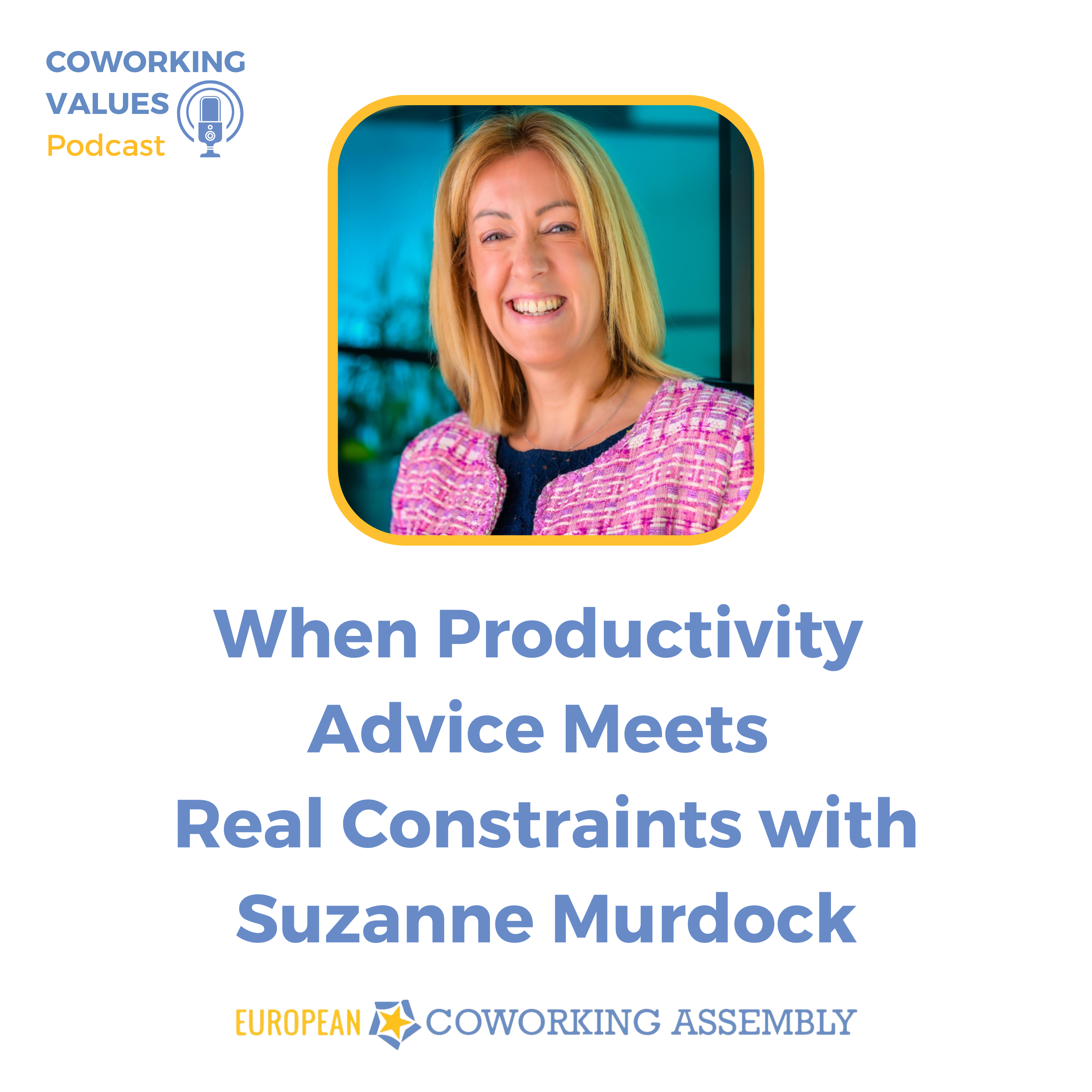
When Productivity Advice Meets Real Constraints with Suzanne Murdock
What happens when productivity advice meets ADHD, childcare, and community management?
Episode Summary
“It became the first seed of building the Hub Newry... a lived example of building a business with minimal capacities in terms of time, energy, childcare, and that emotional bandwidth that comes with it.”
Unreasonable Connection Going Live! London, February 2026.
🎟️ Tickets go on sale in January 2026.
The entire day is co-created by the coworking community builders on the co-creation waitlist.
Picture this: 2009.
The world economy has just collapsed.
You’ve left the high-pressure banking towers of London for a portacabin in Newry, Northern Ireland.
A toddler screaming in the background.
Your house isn’t built.
Your business is barely breathing.
You’re completely isolated in a border town that’s still processing thirty years of conflict.
This is where Suzanne Murdock built The Hub Newry—not from a business plan, but from desperate necessity.
Thirteen years later, she’s running one of Northern Ireland’s most successful coworking networks.
More importantly, she’s become the person operators turn to when they’re drowning.
When they’re holding everyone else’s problems, whilst their own systems fall apart.
This conversation cuts through the productivity theatre that plagues small business advice.
Suzanne doesn’t care about your morning routine or your notion templates.
She cares about understanding your actual energy.
Your real constraints.
Designing structures that work with your life instead of against it.
Bernie shares his recent ADHD diagnosis—a revelation that explained why conventional productivity advice never stuck.
Suzanne responds with the coaching insight that changes everything: “The problem isn’t the problem.”
Your speaking anxiety isn’t about public speaking.
Your overwhelm isn’t about time management.
Your burnout isn’t about working too hard.
For community managers drowning in everyone else’s needs, this episode is a lifeline.
For operators trying to scale whilst maintaining their sanity, it’s a roadmap.
For anyone who’s ever felt like productivity systems were designed for someone else’s brain, it’s validation.
Timeline Highlights
[00:05] Bernie announces two critical 2026 dates: Unreasonable Connection in London (end of February) and European Coworking Day (May)
[01:57] Suzanne’s origin story: fleeing London banking burnout for Northern Ireland isolation
[03:26] The portacabin moment that sparked The Hub Newry: “minimal capacities in terms of time, energy, childcare”
[06:16] Two years of explaining coworking to a market that didn’t understand it yet: “We spent a good two years trying to navigate that and script it”
[07:39] Bernie on the underrated value of structure: “It’s an underrated resource of having this structure in your work day when you’re running your own thing”
[08:39] Why coworking matters for new entrepreneurs: “There are so many unknowns out there. When other people surround you... It’s so helpful and rich.”
[13:59] The productivity trap: “It’s just assumed as entrepreneurs or small business owners that you can work 24 hours a day... it doesn’t work like that in real life”
[16:45] Bernie’s ADHD revelation: “Saying, Read David Allen, get things done, and it will all work, has never... You can’t just pull something out of a hat.”
[17:38] Suzanne on understanding yourself first: “Until you understand those elements, I think it’s very hard to get those structural things right”
[20:30] The importance of champions: “It really keeps coming back to really knowing yourself and having champions around you.”
[22:40] The coaching revelation: “A lot of people don’t know what their problem is... Listening is a huge part of it.”
[27:28] Community manager burnout: “That pot can sometimes feel very empty... we need champions around us... It can be quite a lonely place.”
[29:53] Setting boundaries with members: “They need to understand that they have to reach out sometimes as well... it goes two ways”
The Accidental Operator
Suzanne never intended to run a coworking space.
She intended to survive.
After leaving the financial sector in London in 2009, she found herself in a portacabin on a construction site.
Trying to run a business whilst raising a toddler.
In a town where she knew nobody.
The isolation was crushing.
Not just emotionally—economically.
Without a support network, without casual conversations, without the energy that comes from being around other people working on their own things, productivity was impossible.
The Hub Newry started because Suzanne and Patrick needed an office that wasn’t a freezing portacabin.
They renovated the first floor of an old pub.
Made it too big for just them.
Started letting desks to other isolated freelancers.
They didn’t know the term “coworking.”
They were solving a cash flow problem and a loneliness problem simultaneously.
This accidental beginning shapes everything about how The Hub operates today.
It wasn’t built on venture capital or growth targets.
It was built on the lived experience of what happens when you try to make something meaningful whilst juggling real-life constraints that business advice pretends don’t exist.
The Problem Isn’t the Problem
The most powerful insight in this conversation comes when Bernie admits his struggle with productivity systems.
Suzanne responds with coaching wisdom: “A lot of people don’t know what their problem is.”
Your speaking anxiety isn’t about speaking skills.
It’s about finding a format that gives you energy rather than drains it.
Suzanne discovered this when she started her podcast—terrified of public speaking but energised by one-to-one conversation.
Your time management problems aren’t about time.
They’re about understanding when your energy is highest.
Designing your day around that reality instead of fighting it.
Your team communication issues aren’t about communication.
They’re about setting boundaries that protect your capacity to hold space for everyone else.
This is why conventional productivity advice fails.
It treats symptoms, not root causes.
It assumes everyone’s brain works the same way.
Bernie’s ADHD diagnosis explained why Getting Things Done never stuck—his brain doesn’t work that way.
Zone of Genius Meets Real Life
Suzanne references Gay Hendricks’ concept of “zone of genius”—the intersection of what energises you and what you’re uniquely good at.
But she grounds it in reality.
Your zone of genius doesn’t matter if you don’t understand your actual constraints.
If you’ve got childcare responsibilities, health challenges, or financial pressures, your ideal day needs to work with those realities.
Not despite them.
The breakthrough comes when you stop trying to fit your life into productivity systems designed for someone else.
Start designing systems that fit your actual life.
This means understanding your energy patterns.
Your limiting factors.
Your support network before you build your schedule.
It means asking different questions:
Not “How can I be more productive?”
But “What structure supports my energy instead of depleting it?”
Community Managers in the Lonely Middle
The conversation exposes a hidden crisis in coworking: community manager burnout.
You’re the person everyone turns to.
Equipment problems, business advice, emotional support—it all lands on your desk.
You’re expected to hold space for everyone whilst somehow also running a viable business.
The emotional labour is immense and largely invisible.
Suzanne’s insight: “That pot can sometimes feel very empty.”
You can’t pour from an empty vessel.
Community managers need champions, boundaries, and systems that prevent them from absorbing every problem in the building.
The solution isn’t just self-care advice.
It’s structural.
Straightforward onboarding that explains what members can expect and what’s expected of them.
Systems that distribute support across the community instead of funnelling everything through the manager.
Recognition that holding space is skilled emotional work, not just part of the job.
The Borderland Economy
The Hub Newry operates in a unique environment—a border town between Northern Ireland and the Republic of Ireland.
Complex political history.
Economic challenges.
But this context reveals something universal about regional coworking.
Small towns and border regions often get treated as peripheries—places where talent leaves rather than stays.
Coworking can reverse that dynamic.
Creating infrastructure that allows people to access global opportunities whilst staying rooted in local communities.
Suzanne’s ResMove project takes this further.
Using coworking to integrate migrants and refugees into local economies.
It’s not just about desk space—it’s about creating pathways to economic participation and community belonging.
Structure That Supports
The title of this episode comes from Suzanne’s philosophy: “Structure that supports, not suffocates.”
Most business advice assumes structure means restriction—systems that force you into predetermined patterns.
Suzanne argues for the opposite.
Structure that amplifies your natural energy.
Supports your real constraints.
This means starting with self-knowledge.
Understanding your energy patterns, your peak times, and your recovery needs.
Then build systems that work with those realities rather than against them.
It means recognising that sustainable business growth requires sustainable personal systems.
You can’t scale something that’s burning you out.
It means designing your space, your schedules, and your relationships to support the long-term vision.
Instead of just solving today’s crisis.
Champions and Community
Perhaps the most critical insight in this conversation: “We need champions around us.”
Running a community space is inherently isolating.
You’re responsible for everyone else’s connections, whilst often lacking your own support network.
The irony is profound—you’re creating community for others whilst experiencing loneliness yourself.
Suzanne’s solution is intentional relationship building.
Not networking.
Genuine champions.
People who notice when you’re struggling and actively support your success.
This includes other operators, mentors, peers, and even members who understand their role in the ecosystem.
The Unreasonable Connection events Bernie mentions serve this function.
Creating spaces for operators to support each other instead of just learning from experts.
Links & Resources
Suzanne’s Work
- The Hub Newry: Coworking space and community in Northern Ireland
- Suzanne on LinkedIn
- Powering Productivity Podcast: Real-life examples for microbusiness owners and coworking operators
- RES-MOVE Website: EU-funded initiative supporting migrant entrepreneurs through coworking
Projects & Community
- European Coworking Day
- London Coworking Assembly
- European Coworking Assembly
- The annual Coworking Trends Survey is live - it’s more important than ever.
- Unreasonable Connection Going Live! London, February 2026.
Bernie’s Projects
- RSVP for ACTionism, the documentary at Urban MBA 19 November | 3 PM- 7 PM
- LinkedIn Coworking Group: 8,000+ member community
- Coworking Values Podcast LinkedIn: Showcase page
- Workspace Design Show: February trade show and conference in London
- Unreasonable Connection Events: Monthly online gatherings for coworking operators
- Bernie’s LinkedIn: Connect directly
Referenced Resources
- Gay Hendricks’ Zone of Genius concept
- David Allen’s Getting Things Done methodology (mentioned as an example of non-universal systems)
One More Thing
Coworking brings communities together, helping people find and share their voices.
Each episode of the Coworking Values Podcast explores Accessibility, Community, Openness, Collaboration, and Sustainability—values that shape the spaces where we gather, work, and grow.
If this resonates with you, rate, follow, and share the podcast.
Your support helps others discover how coworking enriches lives, builds careers, and strengthens communities.
Community is the key 🔑
Written by
What's Next?
They Come for the Promise. They Stay for the Hospitality. with Dr. JJ Peterson
"They come for the promise. They stay for the hospitality." — Dr. JJ Peterson Episode Summary JJ Peterson has spent eleven years inside the StoryBrand universe. He co-authored Marketing Made Simple with Donald Miller. He helped Will Guidara write the certification for Unreasonable Hospitality. He hosts the Badass Softie podcast — for leaders who are unapologetically driven but want to lead with their hearts. He is flying to London in June to teach at the first workshop in the world to b
Why AI Can't Feel the Room: Practical Operations with Carlos Almansa
"The AI cannot feel the space. It can't feel the dynamics or the vibe. But it can free up time for you to talk to your members, to have a coffee with them, to understand and to read people." — Carlos Almansa Ballesteros Episode Summary Most conversations about AI in coworking are either evangelical or dismissive. Carlos Almansa Ballesteros, co-founder of Nexudus and author of the Coworkings AI newsletter, isn't interested in either. He's been building software for this industry for 13
The Golden Thread: Why Unreasonable Hospitality Needs a Story First with Sonya & Julie
Why your coworking space needs a Story before it can practise hospitality "Marketing makes these promises and service delivers that. So for us, StoryBrand and unreasonable hospitality, really work together hand in glove. And StoryBrand is really about thinking about how you communicate that you care to your customers. And the unreasonable hospitality side of things is how you prove it." — Sonya Whittam Sonya Whittam and Julie Firth run Story22, a customer-centric marketing agency base
You're Never Broke If You Got Ideas: How Koder Brings Music to the Neighbourhood
"Ideas are currency, you know. And you're never broke if you got ideas... Everything we are looking at around us came from an idea. So for me, they are, it is a currency within itself." — Koder Koder runs Undeniable Studios, a music production conglomerate built from youth clubs, pirate radio, and 10,000 hours of free studio time in Brockley. He's now the first Creative in Residence at Blue Garage in Lewisham, where he's installing a commercial music studio, planning his Circle the Ends
Start With the Building, Miss the Person — It Happened Again This Week
I spent this week watching the same argument break out in different places, with different people, in completely different conversations. None of them planned it. * Caleb Parker published a manifesto for high street coworking. * Suzanne Murdock sent her monthly newsletter from The Hub Newry. * Parisa Wright kept resharing her Hope Hub episode. And * Ann-Marie Kinlock and Anna Chuicharoen finally opened KindHaus in Hackney after three years of hurdles, setbacks, and proving that a space wher
Start Cooking. The Recipe Will Follow.
We're moving everything up a gear. At the last Unreasonable Connection Live in Lewisham, you told us the groups were too random and the curation could be tighter. You were right. 75% of you left with more momentum than you arrived with. The room worked. The curation didn't. The people in the room, the conversations that happen, and how those conversations are curated—it all matters deeply. That's why on May 19th, Tilley Harris and the team from Akou are collaborating with us to facilitate