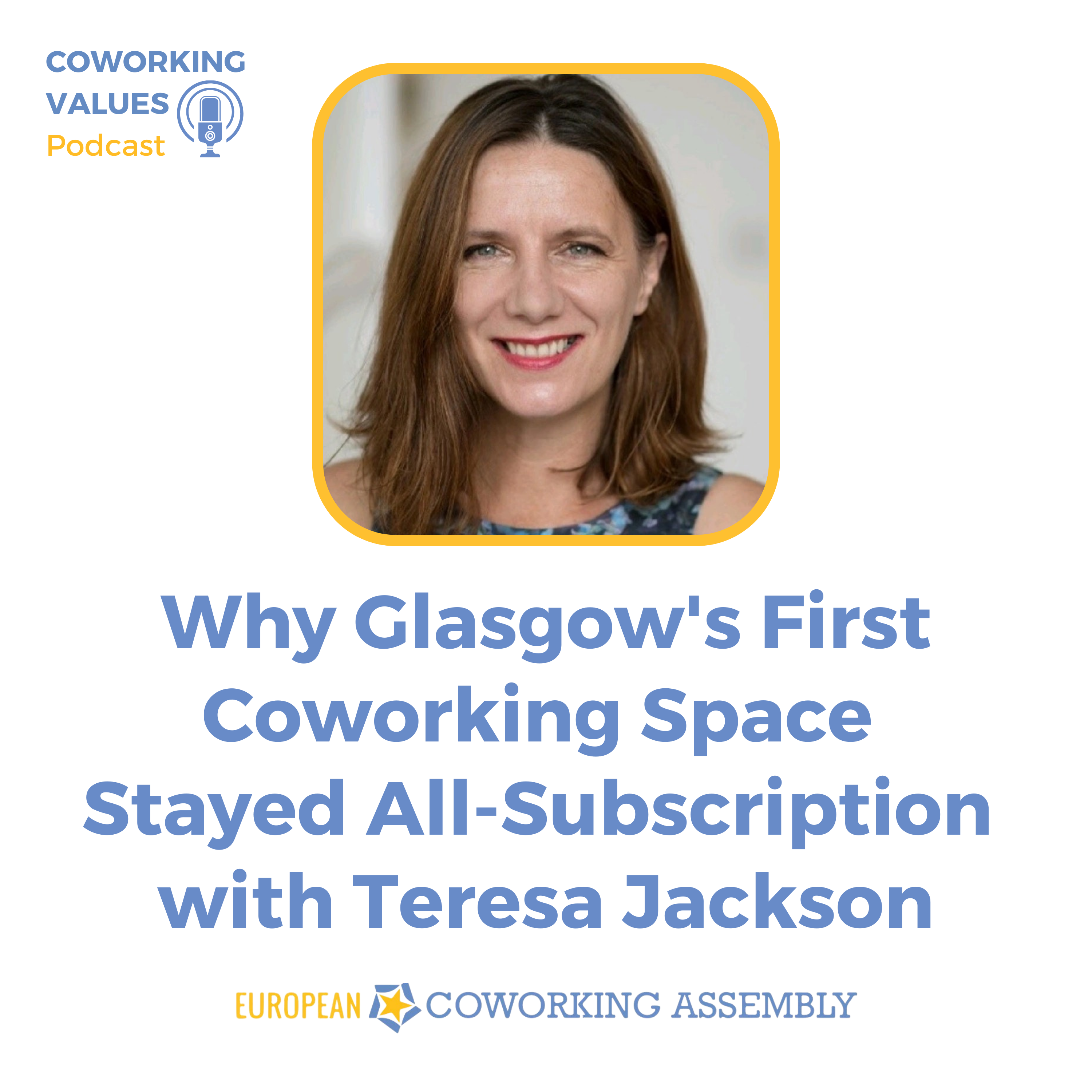
Why Glasgow's First Coworking Space Stayed All-Subscription with Teresa Jackson
On accidental landlords, absorbing risk so members don't have to, and the monthly model that never changed
“I found myself with a building, a smaller building than the one I’m in now, with the bills to pay, and was a bit like, Oh, dear, I’m going to have to do something about this.”
—Teresa Jackson
The journey continues - May 19th
On May 19th at Space4, the Unreasonable Connection Goes Live! The London Coworking Assembly Forum is back for part two.
A one-day working session for the people running London’s most vital neighbourhood spaces and the public sector allies working to help them thrive.
Episode Summary
Teresa Jackson didn’t set out to become a coworking pioneer.
She was working from a flat in Glasgow’s city centre, bouncing between her dining table and a sofa three feet away. You know that feeling—laptop balanced on your knees, no separation between work and life, the walls closing in a bit more each day.
She’d been running a networking organisation called 4 Networking—23 groups across Scotland in the first year—and knew plenty of freelancers and small business owners in the same boat.
So she asked a few of them: what if we rented an office together?
A few people said yes. Then she signed the lease on an attic space on John Street. No lift. Tiny kitchen. A proper commitment.
Then, as often happens when it’s time to actually pay, some of those people vanished into the sunset.
She was left holding the keys to a building she couldn’t afford alone.
That moment—being stuck with the bills and no plan—is where Collabor8te actually began.
Teresa applied the membership model she knew from networking to the space. Monthly subscription. No long-term commitment. Book what you need when you need it. She started with a 32-hour membership, then added a 12-hour “now and then” option when people said they liked the idea but weren’t sure they’d use it that much.
That was 2014. By 2016, they’d moved to 22 Montrose Street—a Victorian sandstone building in the Merchant City with 40 desks, 9 meeting rooms, and room for about 100 people at any one time.
Today, Collabor8te has 350 members. It’s still all subscription. Still no dedicated desks. Still monthly, flexible, all-inclusive.
Bernie and Teresa talk through what it actually means to run a space like this—where members can cancel with a month’s notice, but you’re locked into a long-term lease.
They discuss the difference between networking (transactional, two hours of business development) and coworking (ambient learning from just being in the room).
They get into Teresa’s B Corp journey, which started as a lockdown project and ended with a governance structure that legally prevents the space from being sold to private equity.
And they talk about the 4-day work week Teresa introduced for her staff, and how that works when your business is meant to be open and welcoming all the time.
This episode is for anyone who’s ever signed a lease and then realised they had no idea what they were doing.
Timeline Highlights
[01:18] Teresa on what she’d like to be known for: “Providing the most welcoming coworking space that is possible to... in the world.”
[02:09] The accidental start: “I got into coworking by a complete accident.”
[03:09] When commitment gets real: “I found myself with a building... with the bills to pay, and was a bit like, Oh, dear, I’m going to have to do something about this”
[03:46] The model that never changed: “It’s always been monthly. It’s always been all-inclusive memberships.”
[05:11] Bernie on whether Teresa questions her model: “Do you see other people doing different memberships and go, Oh, my God, am I doing this right?”
[06:00] Teresa on why their model works: “I think where we are based in the city centre, that we’re all subscription, we do buck the trend.”
[06:49] On attracting the right people: “We attract a certain type of person because of what we do here... you have to want to share.”
[07:27] Glasgow’s first: “It was the first coworking space in Glasgow.”
[08:40] How people come for community now: “Now I think people are drawn to, I want to be with other people. I don’t want to be sitting at home on my own all the time.”
[10:19] On the “hijacking” of coworking: “Everyone thinks they can open a coworking space these days. It’s just always nice and easy. But... it’s a big risk.”
[13:15] Teresa on the accidental nature of it: “If I hadn’t found myself in that situation, would I have done it? I don’t know.”
[16:54] Natural networking: “You aren’t just networking with people while you’re making a coffee in the kitchen... you get to know your fellow coworkers and become friends.”
[18:18] The B Corp project: “We wanted a project. We were a bit bored... this would be a good challenge.”
[22:20] What B Corp revealed: “We learned lots of things. One of the main things, I think, was we had to write things down.”
[24:18] The 4-day week and other changes: “We introduced some things... private health care... cycle to work scheme... a four-day working week.”
The Widow-Maker Lease
Let’s be clear about what Teresa signed herself up for.
A commercial lease in Glasgow’s Merchant City on a Victorian sandstone building is likely a 10-year Full Repairing and Insuring lease. That means every crack in the facade, every leak in the roof, every drain that backs up—that’s on her. Not the landlord. Her.
If the Victorian roof at 22 Montrose Street fails, Teresa pays to fix it. If the sandstone needs repointing, Teresa pays. If the boiler dies in January, Teresa pays.
This isn’t a month-to-month WeWork membership. This is a decade-long liability that could bankrupt you if the building turns against you.
And who are her customers? People paying £200 a month who can cancel with 30 days’ notice.
Teresa absorbs 100% of the risk. Her members carry none.
“I found myself with a building... with the bills to pay, and was a bit like, Oh, dear, I’m going to have to do something about this.”
That “Oh, dear” is doing a lot of work. It’s the voice of someone who’s just realised they’re standing on the edge of a financial cliff, and the only way forward is to build a bridge while walking across it.
Most people in that situation would panic and try to lock members into long-term contracts. Annual commitments. Upfront payments. Anything to create certainty.
Teresa did the opposite. She made it easier to leave.
Monthly memberships. Cancel anytime. No questions asked.
Why?
Because she understood something fundamental: you can’t build community by trapping people.
The subscription model works because it builds trust rather than extracting commitment. Members don’t stay because they’re locked in. They stay because they don’t want to leave.
That’s a completely different kind of certainty. And it only works if you’re willing to carry the risk yourself.
The Glasgow Texture
Montrose Street sits in the Merchant City, the heart of old Glasgow money. The buildings here are Victorian sandstone—the kind that turns golden in rare Scottish sunlight and looks like they’re brooding the rest of the time.
This neighbourhood used to belong to the Tobacco Lords, the merchants who built Glasgow’s wealth on transatlantic trade. The warehouses that once stored tobacco now store something else: human capital, ideas, the quiet hum of people working on things that might or might not succeed.
Teresa’s building has weight. Thick walls. High ceilings. The kind of space that makes you feel like you’re part of something older than yourself.
It’s not a glass-walled startup incubator dropped into the neighbourhood unannounced. It belongs here. That matters.
When Teresa talks about attracting “a certain type of person,” she’s not just talking about freelancers who like flexibility. She’s talking about people who recognise the difference between a coworking space that’s embedded in a place and one that’s just renting square footage.
Glasgow isn’t London. It doesn’t have the same frictionless money. The people working at Collabor8te are slogging it out—trying to figure out whether to use ChatGPT or Claude, whether to send the invoice before or after the work, and whether WordPress is worth the headache.
They need somewhere solid. Somewhere that isn’t going to disappear if the VC funding dries up.
Teresa built that. Not on purpose. But she built it.
The System Teresa’s Actually Operating
Let’s name what Teresa is doing, because she doesn’t quite name it herself.
Economist Gary Stevenson’s central argument is this: if you don’t own assets, you’re losing. Wages go up slowly. Asset prices—property, mostly—go up fast. The gap widens. Wealth consolidates.
Most freelancers in Glasgow earn wages, not build assets. They can’t afford to buy commercial property. They can’t take on a 10-year FRI lease. They’re locked out of the asset class that actually generates wealth.
So what does Teresa do?
She takes on the asset risk herself. She signs the widow-maker lease. She carries the liability for the Victorian roof, the sandstone, and the drains. And then she gives her members access to the infrastructure they couldn’t afford to own.
Monthly. Flexible. Low-friction.
This isn’t charity. It’s not even radical. It’s just civic infrastructure operating outside the council.
Teresa is providing the third space that Glasgow’s freelance economy needs to function. She’s doing what the city can’t or won’t do: creating affordable, accessible workspace for people who don’t have deep pockets or investor backing.
By staying all-inclusive, Teresa ensures that the barrier to entry stays low. You don’t need six months’ rent upfront. You don’t need a guarantor. You just need to be able to pay this month.
That’s wealth redistribution at the street level. It’s not redistributing money. It’s redistributing access to infrastructure.
And the reason it works—the reason Teresa hasn’t gone bust in 12 years—is because she’s not extracting maximum value. She’s accepting a lower margin in exchange for a more stable, loyal membership base.
The corporate chains can’t compete with that. They have shareholders. They have growth targets. They need to extract.
Teresa just needs to cover the lease and pay her staff.
That’s the moat. That’s why Glasgow’s first coworking space is still here when the others have come and gone.
Networking Isn’t Coworking (But It’s Close)
Both Teresa and Bernie ran networking groups before they got into coworking.
Bernie describes his experience: going to networking meetings, doing the intros—”I’m Alan the accountant, Bob the builder, Claire the computer fixer”—and then everyone would sit around afterwards in the café, laptops out, working together without even knowing it.
Teresa nods: “But you were coworking.”
The difference, they agree, is the performance.
Networking is two hours of business development. You’ve got your game face on. You’re there to make connections, get leads, and swap cards.
Coworking is sitting in a room with people doing the same thing you’re doing. You overhear their phone calls. You notice when someone’s stuck on a problem you’ve already solved. You learn by proximity.
Teresa calls it “natural networking.” You’re not networking while you’re making a coffee in the kitchen. You’re just making a coffee. But you end up in a conversation. You become friends. Business partnerships form. “There’s been lots of really strong friendships created here, business partnerships created here.”
There’s no office politics because these aren’t your employees. They’re not your team. They’re people in parallel, doing different things, but present in the same space.
Bernie makes the point: when you’re in a networking meeting, you’re performing. When you’re in a coworking space, you’re just... there. And that’s when the real learning happens.
“I learned so much being in a room with other people because... I just learned so much from hearing how Dave across the room did a sales call.”
The ambient learning. The micro-insights. The stuff you’d never sign up for a course to learn, but you absorb just by being in the room.
You hear how someone structures a proposal. You notice which app they’re using. You catch the way they handle a difficult client on the phone. You learn whether they invoice before or after the work, whether they’re struggling with the same platform you are, and whether they’ve cracked a problem you’re still stuck on.
That’s what Teresa built. Not networking. Something quieter, less transactional, more human.
The B Corp Audit as a Mirror
Teresa and her team started the B Corp certification process during lockdown.
“Obviously, lockdown was a very challenging time,” she says. They survived—55% down on revenue, but survived—thanks to members who kept paying even when they couldn’t use the space.
Things were still quiet in the summer of 2021. They wanted a project. Teresa came across B Corp.
“I hadn’t necessarily even thought of going all the way through with it,” she admits. “But we just thought this would be a good challenge because, again, it’s not something new. The stuff we got, we were doing a lot of it already. But I just thought it would test us to see how good we were.”
They scored 94.8. That’s high.
For context, most businesses score around 50. Collabor8te’s score was driven by governance (mission lock), workers (Living Wage, 4-day week), environment (building retrofits), and community (local supply chain).
The mission lock is the most interesting bit. Teresa amended Collabor8te’s Articles of Association to legally require directors to consider the impact of decisions on all stakeholders, not just shareholders.
It’s a poison pill for private equity. If someone wanted to buy Collabor8te, strip its assets, raise prices, and cut costs, they’d be legally blocked by the company’s own constitution.
“It’s a lovely thing to have,” Teresa says, “just evidence that we care, but we always did care, which is now we’ve got a label.”
What did they actually learn from the process?
“We had to write things down. We’re like, Yeah, we do that, but we don’t have that written down in the policy.”
The B Corp audit didn’t change what they believed. It forced them to document what they already did. That’s useful. When you scale, when you hire, when someone new joins, the culture can’t just live in your head. It has to be written down.
The 4-day work week came out of the process. Teresa added private health care. A cycle-to-work scheme. Small things that signal: we mean this.
The 4-Day Week in a 7-Day Business
Bernie asks the question every operator is thinking: “How does that actually work?”
Coworking spaces are service businesses. Members expect the space to be available. They expect the coffee to be hot and the Wi-Fi to work. If you’re only staffing four days a week, what happens on day five?
Teresa doesn’t give the full operational breakdown in the conversation, but the fact that it works tells you something about how Collabor8te is designed.
The space doesn’t rely on constant human oversight. The systems work. Members book their own desks and meeting rooms. The doors open. The kitchen is stocked. The infrastructure runs without someone standing over it.
That’s where Teresa’s background in CRM and tech pays off. She’s a “Legend” status expert in Nexudus, the software that powers the space.
Most operators use maybe 20% of what Nexudus can do. Teresa uses 100%. She’s automated the friction points—invoicing, onboarding, access control—so her staff can focus on the high-value human interactions.
A 4-day workweek only works if you’ve designed your business not to require constant intervention.
It’s also a signal to the market. Teresa’s saying: we’re not a burnout factory. We don’t expect our staff to be “always on.” We value rest and efficiency over performative busyness.
That filters into the space's culture. If the staff isn’t grinding, the members don’t feel pressure to perform hustle culture either.
The Export Model: Next Level Coworking
Teresa doesn’t just run Collabor8te. She runs Next Level Coworking, a consultancy that helps other operators set up and optimise Nexudus.
Setup fee: £450+. CRM boards: £295+. Custom websites: £750+. Monthly support: £95/month.
It’s a hedge. If the Glasgow market crashes, if the lease becomes untenable, if the model stops working, Teresa has a location-independent revenue stream.
More importantly, it’s intellectual property. She’s spent 12 years figuring out how to run a flexible, subscription-based coworking space. That knowledge is an asset. She’s packaging it and selling it to operators in London, Brisbane, Berlin—anywhere someone’s trying to figure out how to make Nexudus actually work for them.
Bernie doesn’t quite ask it, but the question hangs in the air: is this an admission that the margins on physical space are too thin to survive on alone?
Teresa doesn’t answer that directly, but the fact that she built Next Level Coworking suggests she’s thought about it.
The smartest operators diversify. They don’t rely on one revenue stream. They don’t assume the lease will always make sense.
Teresa learned that lesson the hard way, back in 2014, when she signed a lease and half her members disappeared.
She’s not making that mistake again.
The Word “Coworking” Doesn’t Belong to You Anymore
Teresa wrote a piece years ago about coworking being “hijacked.”
Bernie brings it up. “You wrote an article which was coworking has been hijacked. Do you still feel that?”
Teresa’s answer is pragmatic: “I think it has been a bit hijacked. Everybody is coworking now, aren’t they? A lot of people say, I’m coworking. I was like, Are they really coworking? Because they’ve opened a little bit in the corner with some seats.”
She’s not precious about it. She’s not gatekeeping who gets to call themselves a coworking space.
But she is naming the problem: when everyone uses the word, the word stops meaning anything.
The big shiny offices with deep pockets can call themselves coworking. The corporate chains can say they’re community-focused. But they’re not taking the risk Teresa took. They’re not absorbing the existential dread of a 10-year FRI lease while offering month-to-month flexibility.
“It’s not the same if you have got deep pockets and a big shiny building and investors and all this thing,” Teresa says. “It’s not the same.”
She’s right.
The word “coworking” used to mean something specific: independent operators taking personal financial risk to build spaces where freelancers and small business owners could afford to work without working alone.
Now it just means “hot desks and Wi-Fi.”
That’s fine. Language evolves. But it does make it harder for the Teresa Jacksons of the world to explain what they’re actually doing.
When she says “we’re all about being welcoming, being inclusive,” she’s not talking about diversity tick-boxes or corporate values statements. She’s talking about keeping the barrier to entry low enough that people who can’t afford long-term commitments can still access infrastructure.
That’s the real hijacking. Not that other people use the word. That the word no longer distinguishes between operators absorbing risk for their communities and property companies maximising yield.
Links & Resources
Teresa Jackson’s Work
- Collabor8te - 22 Montrose Street, Merchant City, Glasgow
- Next Level Coworking - Consultancy for Nexudus setup and optimisation
- Teresa Jackson on LinkedIn
- Next Level Coworking podcast with Nexudus - (Link to follow!)
Related Spaces & Organisations
- Nexudus - Coworking space management software
- B Corporation UK - Certification and governance framework
Projects & Community 2026
- Unreasonable Connection Live! London Coworking Assembly Forum May 19th
- RGCS Symposium Berlin 5th and 6th March
- European Coworking Day: 6th May
- Coworking Alliance Summit 3rd June
- London Coworking Assembly
- European Coworking Assembly
- LinkedIn Coworking Group
Bernie’s Projects
One More Thing
Coworking brings communities together, helping people find and share their voices.
Each episode of the Coworking Values Podcast explores Accessibility, Community, Openness, Collaboration, and Sustainability—values that shape the spaces where we gather, work, and grow.
If this resonates with you, rate, follow, and share the podcast. Your support helps others discover how coworking enriches lives, builds careers, and strengthens communities.
Community is the key 🔑
Written by
What's Next?
You're Not Running a 'Real' Coworking Space—The Lie Independent Operators Tell Themselves
February 24th. Blue Garage, Lewisham. The room's full. Coworking operators, local authority people, housing associations, and artists. 60 people in an industrial makerspace with concrete floors and fabrication equipment in the background. The kind of space where real work happens, not the kind you photograph for Instagram. The conversations are good. Sharp. People are asking the right questions—How do we make coworking spaces profitable? What's our role in the future of work w
They Come for the Promise. They Stay for the Hospitality. with Dr. JJ Peterson
"They come for the promise. They stay for the hospitality." — Dr. JJ Peterson Episode Summary JJ Peterson has spent eleven years inside the StoryBrand universe. He co-authored Marketing Made Simple with Donald Miller. He helped Will Guidara write the certification for Unreasonable Hospitality. He hosts the Badass Softie podcast — for leaders who are unapologetically driven but want to lead with their hearts. He is flying to London in June to teach at the first workshop in the world to b
Why AI Can't Feel the Room: Practical Operations with Carlos Almansa
"The AI cannot feel the space. It can't feel the dynamics or the vibe. But it can free up time for you to talk to your members, to have a coffee with them, to understand and to read people." — Carlos Almansa Ballesteros Episode Summary Most conversations about AI in coworking are either evangelical or dismissive. Carlos Almansa Ballesteros, co-founder of Nexudus and author of the Coworkings AI newsletter, isn't interested in either. He's been building software for this industry for 13
The Golden Thread: Why Unreasonable Hospitality Needs a Story First with Sonya & Julie
Why your coworking space needs a Story before it can practise hospitality "Marketing makes these promises and service delivers that. So for us, StoryBrand and unreasonable hospitality, really work together hand in glove. And StoryBrand is really about thinking about how you communicate that you care to your customers. And the unreasonable hospitality side of things is how you prove it." — Sonya Whittam Sonya Whittam and Julie Firth run Story22, a customer-centric marketing agency base
You're Never Broke If You Got Ideas: How Koder Brings Music to the Neighbourhood
"Ideas are currency, you know. And you're never broke if you got ideas... Everything we are looking at around us came from an idea. So for me, they are, it is a currency within itself." — Koder Koder runs Undeniable Studios, a music production conglomerate built from youth clubs, pirate radio, and 10,000 hours of free studio time in Brockley. He's now the first Creative in Residence at Blue Garage in Lewisham, where he's installing a commercial music studio, planning his Circle the Ends

Start With the Building, Miss the Person — It Happened Again This Week
I spent this week watching the same argument break out in different places, with different people, in completely different conversations. None of them planned it. * Caleb Parker published a manifesto for high street coworking. * Suzanne Murdock sent her monthly newsletter from The Hub Newry. * Parisa Wright kept resharing her Hope Hub episode. And * Ann-Marie Kinlock and Anna Chuicharoen finally opened KindHaus in Hackney after three years of hurdles, setbacks, and proving that a space wher
Start Cooking. The Recipe Will Follow.
We're moving everything up a gear. At the last Unreasonable Connection Live in Lewisham, you told us the groups were too random and the curation could be tighter. You were right. 75% of you left with more momentum than you arrived with. The room worked. The curation didn't. The people in the room, the conversations that happen, and how those conversations are curated—it all matters deeply. That's why on May 19th, Tilley Harris and the team from Akou are collaborating with us to facilitate