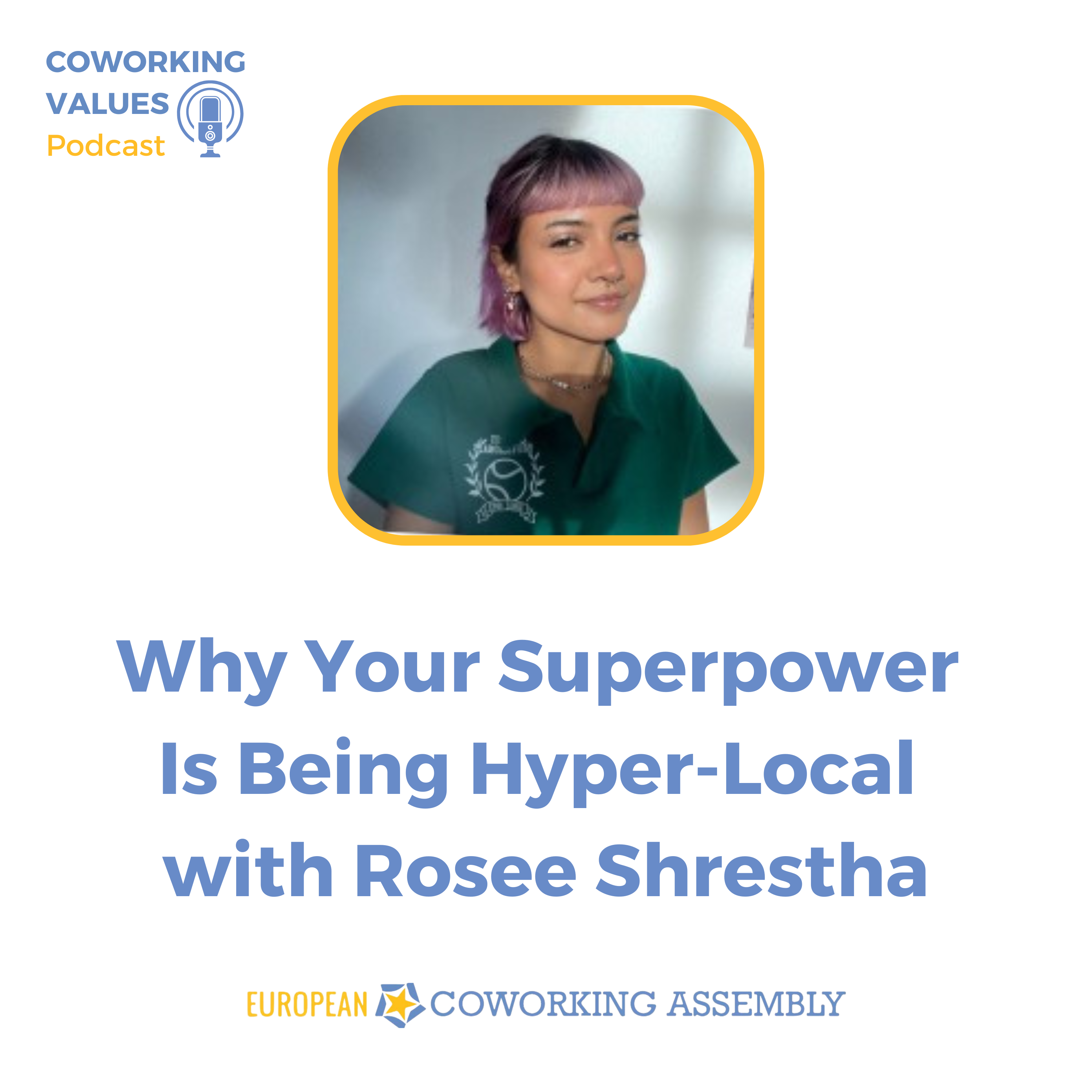
Why Your Superpower Is Being Hyper-Local with Rosee Shrestha
On being seen, organic community, and what inclusion actually means
“Inclusivity basically doesn’t mean that you have to include everybody. It’s just making sure that the space that you’re offering is where people can feel safe... it’s about who feels comfortable staying or speaking up or knowing that whatever opinions they have to give will be heard.”
Rosee Shrestha
Tired of running yourself into the ground?
Then stop running alone.
On February 24th, the London Coworking Assembly presents Unreasonable Connection Goes Live!—a one-day working session for the people running London’s most vital neighbourhood spaces and the public sector allies working to help them thrive.
It’s a day to share the load, find real solutions, and build a new playbook, together.
The best version of your space is being specific about who it’s for.
Being for everyone is a recipe for building somewhere nobody belongs.
Rosee Shrestha writes and creates content at Cobot, where she documents what actually works in coworking. Through her newsletter and interviews with operators across Europe, she’s noticed a pattern. The spaces that thrive aren’t casting the widest net. They’re being specific about who they serve—because that’s the only moat they have.
In an industry where the rent keeps climbing and corporate chains can outspend you on marketing, your community is the one thing they can’t replicate.
Bernie and Rosee unpack her recent piece featuring perspectives from Ashley, Silia, and Hector on what’s shaping coworking in 2026.
The thread connecting all their insights? Hyper-local spaces that know exactly who they’re for.
Ashley talks about returning to first principles—community hubs that serve multiple purposes, not just desk rental. Hector describes members choosing an ecosystem that fits into their daily lives, not just a place to sit. Rosee shares what she learned from Selina at Werkhain in Berlin about what it means to be “seen” in a space without anyone forcing interaction on you.
Bernie brings his own observations from FENTO coworking near Vigo, where Camino pilgrims walk past speaking German, Dutch, French, and English—and from a hostel café in Kathmandu where travellers and locals found each other without strategic community programming.
This episode is for operators tired of competing with everyone for nobody in particular.
Timeline Highlights
[01:35] Rosee on what she wants to be known for: “Write in ways that it feels honest and helpful for every operator or just anybody who wants to learn about the industry”
[02:29] The hyper-local thread: “One thing that was in common between every perspective... you really were betting on hyper local coworking spaces”
[03:37] On Ashley’s first principles: “The essence of coworking was just having a hub where people can come together instead of having to work alone at home”
[04:47] The buzzword confession: “Meaningful human connection... it does sound like a buzzword a little bit. But when it comes to coworking, I definitely feel like it’s true”
[05:49] Bernie on foundations shaping communities: “How you build the foundation of your community in the beginning will help shape what happens later on”
[06:15] The Urban MBA example: “Community is basically the Caribbean kitchen at Urban MBA or people taking care of Elena Giroli when she had to be away”
[07:08] Hector’s ecosystem insight: “Work just now happens across so many different settings... does it really fit into everything that I try to do”
[08:42] On Werkhain in Berlin: “It didn’t feel like a coworking spaceship that had landed in the neighbourhood unannounced”
[09:30] What being “seen” actually means: “Having these daily interactions... being supported without really forcing interaction”
[11:06] Bernie on coworking’s grounding effect: “You’re sitting in a room with other people doing the same thing. It’s really grounding”
[12:30] The “for everyone” trap: “Inclusivity also not saying we are open to everybody. It’s just about making this safe space for people, like-minded people”
[16:23] The hostel in Kathmandu: “There was so much cultural exchange going on... one person brings somebody there, then it’s like oh, it’s open for everybody”
[19:56] On travellers with intent: “There’s this energy you get from people travelling with intent”
What “First Principles” Actually Means
Ashley’s phrase stayed in the conversation: getting back to first principles.
Rosee frames it simply: “The essence of that is based around the connection between each other, like how you form the community in a space.”
It’s not nostalgia. It’s recognition that AI and remote work have stripped away so much human contact that the original premise of coworking—gathering with others instead of working alone—matters more than it did five years ago.
When everything else becomes commoditised, the irreducible core remains. People need to see other people. Not through screens. Not in managed corporate environments. In spaces where they can sit with their own thoughts while knowing they’re not alone.
Bernie nails what this actually feels like: sitting in a coworking space knowing you’re not the only one “slogging it out, trying to work out how WordPress works and whether I use ChatGPT for this or Claude for this, or do I send my invoice now and then do the work or do the work and then send the invoice.”
The spaces getting this right aren’t trying to be WeWork. They’re becoming what Rosee calls “multi-purpose community hubs”—places where the coworking is almost incidental to the gathering.
Why “For Everyone” Creates Nobody’s Space
Bernie pushed Rosee on language that matters.
She used the word “tolerant” when discussing inclusion. Bernie picked it up immediately: “If you said to me, you’re going to have to tolerate three women in your coworking space today, I’d be like, I’m not really… that makes me feel like I’m putting up with them.”
Rosee clarified what she actually meant: “It’s about just making this safe space for people, like-minded people who can just be there for each other instead of having to tolerate each other.”
Inclusion doesn’t mean inviting everyone. It means being clear about who your space is for, then making sure those people feel genuinely welcomed—not tolerated. A space for gamers includes gamers. A space for climate activists includes climate activists. A space that supports caregivers considers childcare. A space designed for neurodivergent members considers sensory needs.
Rosee mentions this in her recent article on neurodivergence—”just creating a space where you can actually recognise those people.”
When someone says “our space is for everyone,” they’re really saying “we haven’t thought about who we’re actually serving.”
The Ecosystem Fit
Hector’s contribution reframes how members evaluate spaces.
It’s not: “Is this a nice place to work?”
It’s: “Does this fit into my actual life?”
Rosee explains: “Work just now happens across so many different settings, like home, coworking spaces. Instead of being like this is my main office, does it really fit into everything that I try to do.”
When billing is confusing, when booking is painful, when the systems feel unreliable, members don’t just get annoyed—they lose trust. As Rosee puts it: “When the system at the coworking space doesn’t feel so reliable, it’s easy to lose that trust a little bit. People do tend to disengage.”
Members are evaluating your space against every other option: home, cafés, libraries, other coworking spaces, client offices. If you make their life harder rather than easier, you lose.
Being Seen Without Being Forced
Rosee learned something from visiting Werkhain in Berlin—a space that transformed a former gym into a fully booked hub. What struck her was how they were “definitely well known in the local area” and hosted community events that drew visitors, not just members.
Being “seen” doesn’t mean constant interaction. It doesn’t mean organised networking events or mandatory icebreakers.
Rosee puts it simply: “It’s about knowing... just being supported without really forcing interaction. That is what being seen to me means.”
The magic isn’t in the programming. It’s in shared presence.
The best spaces create conditions for connection without mandating it.
The Kathmandu Café
Rosee’s story about working at a hostel in Kathmandu offers something useful about organic community.
A hostel with a café and bar. Backpackers passing through. Local young people discovering it. No strategic community programming.
“One person brings somebody there,” Rosee explained. “Then it’s like, Oh, it’s open for everybody. We can all go in and then meet other people as well. Then bigger groups of Nepal people start coming in, and then the tourists are always coming because it’s a hostel.”
She went there wanting to learn German before moving to Berlin. She ended up in a cultural exchange with a traveller wanting to learn Nepali.
Bernie connected this to FENTO coworking near Vigo, where Camino pilgrims walk past speaking German, Dutch, French, and English. And to Patricia’s coworking and co-living space on the Camino between Vigo and Santiago, where digital nomads mix with locals.
The pattern: spaces that welcome movement naturally develop community. Not because someone planned it, but because the conditions were right.
Travellers With Intent
Bernie made a sharp distinction near the end.
There’s a difference between people travelling with purpose—Camino pilgrims, backpackers seeking cultural exchange, digital nomads building lives abroad—and tourists seeking cheap consumption.
“There’s a difference between the people we’re talking about because if you’re doing the Camino, you’re essentially backpacking... versus, which I used to be, someone who’s gone to Ibiza to drink as many pints of cheap lager as they can in 48 hours, that travelling is not as intentional.”
This applies directly to coworking membership.
Some members join with intent: to build something, to connect meaningfully, to contribute. Others are looking for the cheapest desk with the best wifi.
Knowing which audience you’re attracting—and being honest about which you’re designed for—determines everything about your space’s culture. You can’t build a community of citizens from customers hunting deals.
The Caribbean Kitchen Test
Bernie and Rosee keep coming back to a simple test for whether community is real.
Bernie names it: “Community is basically the Caribbean kitchen at Urban MBA or people taking care of Elena Giroli when she had to be away for some time and just knowing that you’re missing that connection when they’re not present.”
Not events on a calendar. Not member counts. Whether people notice when someone’s gone. Whether the kitchen has a specific smell. Whether there’s a story attached to the space that members tell each other.
If you can’t point to something that specific, you might have a workspace. You probably don’t have a community.
Links & Resources
Rosee Shrestha’s Work
Spaces Mentioned
- Werkhain in Berlin
- Urban MBA
- FENTO coworking near Vigo
- Quinta da Quinhas Coworking on the Camino de Santiago
Projects & Community 2026
- Coworking Operators Weekend Feb 6th
- Unreasonable Connection Live! London Coworking Assembly Forum Feb 24th
- Workspace Design Show London 25th / 26th Feb
- Coworking Alliance Summit 4th March
- RGCS Symposium Berlin 5th and 6th March
- European Coworking Day: 6th May
- London Coworking Assembly
- European Coworking Assembly
- LinkedIn Coworking Group
Bernie’s Projects
One More Thing
Coworking brings communities together, helping people find and share their voices.
Each episode of the Coworking Values Podcast explores Accessibility, Community, Openness, Collaboration, and Sustainability—values that shape the spaces where we gather, work, and grow.
If this resonates with you, rate, follow, and share the podcast. Your support helps others discover how coworking enriches lives, builds careers, and strengthens communities.
Community is the key 🔑
Written by
What's Next?
They Come for the Promise. They Stay for the Hospitality. with Dr. JJ Peterson
"They come for the promise. They stay for the hospitality." — Dr. JJ Peterson Episode Summary JJ Peterson has spent eleven years inside the StoryBrand universe. He co-authored Marketing Made Simple with Donald Miller. He helped Will Guidara write the certification for Unreasonable Hospitality. He hosts the Badass Softie podcast — for leaders who are unapologetically driven but want to lead with their hearts. He is flying to London in June to teach at the first workshop in the world to b
Why AI Can't Feel the Room: Practical Operations with Carlos Almansa
"The AI cannot feel the space. It can't feel the dynamics or the vibe. But it can free up time for you to talk to your members, to have a coffee with them, to understand and to read people." — Carlos Almansa Ballesteros Episode Summary Most conversations about AI in coworking are either evangelical or dismissive. Carlos Almansa Ballesteros, co-founder of Nexudus and author of the Coworkings AI newsletter, isn't interested in either. He's been building software for this industry for 13
The Golden Thread: Why Unreasonable Hospitality Needs a Story First with Sonya & Julie
Why your coworking space needs a Story before it can practise hospitality "Marketing makes these promises and service delivers that. So for us, StoryBrand and unreasonable hospitality, really work together hand in glove. And StoryBrand is really about thinking about how you communicate that you care to your customers. And the unreasonable hospitality side of things is how you prove it." — Sonya Whittam Sonya Whittam and Julie Firth run Story22, a customer-centric marketing agency base
You're Never Broke If You Got Ideas: How Koder Brings Music to the Neighbourhood
"Ideas are currency, you know. And you're never broke if you got ideas... Everything we are looking at around us came from an idea. So for me, they are, it is a currency within itself." — Koder Koder runs Undeniable Studios, a music production conglomerate built from youth clubs, pirate radio, and 10,000 hours of free studio time in Brockley. He's now the first Creative in Residence at Blue Garage in Lewisham, where he's installing a commercial music studio, planning his Circle the Ends
Start With the Building, Miss the Person — It Happened Again This Week
I spent this week watching the same argument break out in different places, with different people, in completely different conversations. None of them planned it. * Caleb Parker published a manifesto for high street coworking. * Suzanne Murdock sent her monthly newsletter from The Hub Newry. * Parisa Wright kept resharing her Hope Hub episode. And * Ann-Marie Kinlock and Anna Chuicharoen finally opened KindHaus in Hackney after three years of hurdles, setbacks, and proving that a space wher
Start Cooking. The Recipe Will Follow.
We're moving everything up a gear. At the last Unreasonable Connection Live in Lewisham, you told us the groups were too random and the curation could be tighter. You were right. 75% of you left with more momentum than you arrived with. The room worked. The curation didn't. The people in the room, the conversations that happen, and how those conversations are curated—it all matters deeply. That's why on May 19th, Tilley Harris and the team from Akou are collaborating with us to facilitate