
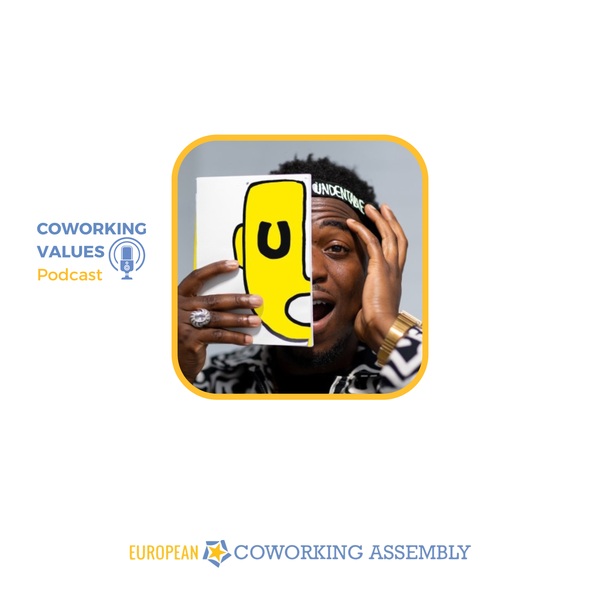
You're Never Broke If You Got Ideas: How Koder Brings Music to the Neighbourhood

"Ideas are currency, you know. And you're never broke if you got ideas... Everything we are looking at around us came from an idea. So for me, they are, it is a currency within itself."
— Koder
Koder runs Undeniable Studios, a music production conglomerate built from youth clubs, pirate radio, and 10,000 hours of free studio time in Brockley.
He's now the first Creative in Residence at Blue Garage in Lewisham, where he's installing a commercial music studio, planning his Circle the Ends tour, and bringing brand partnerships to local creatives.
The partnership model is simple: the coworking space provides infrastructure and network access. Koder brings cultural programming, creative energy, and a proven track record of "fostering local greatness."
This conversation unpacks how Koder built an independent music career without major label backing, what he learned from Miguel (co-founder of WeWork) about the tension between community and revenue, and why creative infrastructure in the neighbourhood matters for young people who can't afford to travel into town.
Bernie met Koder at Unreasonable Connection on 24th February. The conversation kept circling back to one theme: barriers to entry.
Who feels welcome in a coworking space? Who gets access to creative infrastructure? Who has to leave their neighbourhood to find the room, the equipment, and the people who believe in their work?
Koder's philosophy is stark: "You're never broke if you got ideas."
But ideas need space to develop. They need microphones, mixers, and rooms where you can close the door and record without your mum shouting upstairs. They need Uncle Dennis types—local mentors who teach you how to use a DAW without charging £500 for a course.
This episode is for operators who want to turn a corner of their space into a studio, a rehearsal room, or a cultural residency. It's for operators who know their neighbourhood has talent but don't know how to give that talent access.
Koder's built the model. He's willing to replicate it. The question is whether your space is ready to move from desk rental to creative infrastructure.
Timeline Highlights
01:43 – Koder introduces himself: "I'm known for my ability to put my memories and my experiences on record, make music essentially. And I'm also known for being a connector of people."
02:24 – The Undeniable ecosystem: started as Undeniable Records in 2017, expanded into Undeniable Studios, then Undeniable Films. "It's a conglomerate... the arm that I would say is the most active at the moment... is Undeniable Studios."
03:31 – Early career: youth clubs in the ends, building local buzz, girls playing his songs on old Nokias at the back of the bus. "It was before social media... sometimes I'll be travelling around Lewisham, people be playing my songs on bus, singing the words, and they didn't even know it was me."
04:56 – Learning in real time: "The reason I can say words like conglomerate... it's not because I've done a business course... I was taking risks... betting on myself... and I was coming across people that was like, actually, what you're doing should all sit under one thing called a conglomerate."
06:48 – Uncle Dennis's front-room studio in Brockley: "When he found out that I was into music, he taught me the basics of how to record myself and how to use a mixer... my journey of self-sufficiency kind of started with... my Uncle Dennis."
08:41 – What he was listening to at 14: Craig David, So Solid Crew, S Club 7, Wiley, early Dizzee Rascal. "I was a very UK garage or super pop kid... I didn't really have a hip-hop upbringing."
11:19 – At 20: started Indigo Child Records with his friend Age. Artists like Nadia Rose and Sam Tompkins came through that era. "We didn't understand the business of things, but we just knew how we wanted to feel and the flexibility we wanted."
14:52 – The guest list rule: "If you wanted a free ticket or you was on the guest list, the rule was you had to bring someone who'd never heard of Koder before."
16:42 – Missing the stage: "That's why this year I'm gonna hit the road again on my Circle the Ends tour... I miss being out there and touching the people and just feeling that energy of being on stage."
21:54 – What he learned from Miguel (WeWork co-founder): "The importance of community in a space... but the danger of what happens when things are very community-centric and revenue's prioritised... finding that balance is key."
28:10 – The philosophy: "Ideas are currency. You're never broke if you got ideas... the ability to back and bring an idea to life is a form of currency."
32:08 – Creatives in Residence at Blue Garage: "We're gonna put a music studio in Blue Garage... also planning the Circle the Ends tour in the space... the merch, the signage, and all of the physical products... will be made there."
34:58 – Fostering local greatness: "My drive and my commitment is for other coworking spaces that are forward-thinking... if I'm able to set up an Undeniable Studios in different coworking spaces, then they can also start to attract that creativity."
Lesson 1: Ideas Are Currency (But They Need a Room)
Koder's entire career is built on a single premise: ideas are currency, and you're never broke if you've got them.
But ideas aren't enough on their own. They need infrastructure.
When Koder was 10, he formed Hazard Crew with his cousins. They burned blank CDs, designed artwork, and shopped them around the family. They didn't know what "marketing" meant. They just knew they had something they wanted people to hear.
By 14, he was recording himself using his Uncle Dennis's front-room studio in Brockley. Uncle Dennis taught him how to use a mixer, a microphone, and a DAW (digital audio workstation). "My Uncle Dennis gave me them early skills and early lessons and took time out... he had a lot of patience... to teach me, not knowing what I was going to become today."
That patience matters. Uncle Dennis didn't charge him. Didn't gate-keep the equipment. Didn't require proof of commitment or potential. He just taught his nephew how to record.
By 20, Koder had started Indigo Child Records. By his mid-twenties, he was headlining Sickabit—one of the most important up-and-coming music showcases in London. People like Stormzy came through those early lineups.
None of this required a major label. It required rooms. Microphones. Mixers. Blank CDs. Uncle Dennis types.
Fast forward to now: Undeniable Studios gives away 10,000 hours of free studio time in Brockley. The space functions as a music studio, a coworking space, and delivery infrastructure for youth-related projects with brands like Universal.
Koder realised early on that different people see the same room differently. "I see this as a music studio, but a corporate brand... sees this as a space that they can deliver programmes. The person down the road... they do work on their laptop. They see it as a coworking space."
The room adapts to the user. That's the model.
For coworking operators, the lesson is this: creative infrastructure doesn't require massive capital investment. It requires one small room, some equipment, and a willingness to let people use it on their terms.
If Koder can give away 10,000 hours in Brockley and build a sustainable business model around it, you can give away 100 hours in your neighbourhood.
Lesson 2: Uncle Dennis and the Front-Room Studio
Uncle Dennis is the hero of this story, even though he doesn't know it.
He had a studio in his front room. He lived around the corner from Koder in Brockley. When he found out his nephew was into music, he taught him the basics: how to record, how to use a mixer, how to navigate Cubase or Nuendo.
Koder was 13, maybe 14. Uncle Dennis had no idea what Koder would become. He just had patience.
Before Uncle Dennis, Koder's studio setup was a Windows microphone shaped like a tadpole, placed next to a speaker. The beat would play through the speaker, and he'd rap into the mic positioned so it could pick up both the beat and his voice. "That was just what I thought music studios was."
Uncle Dennis showed him what a real studio looked like. Not a commercial facility. Not a major label setup. A front room. A mixer. A microphone. A DAW. That's all it took.
"My Uncle Dennis gave me them early skills... I've got older, so I might be his age that he was at when he was teaching me this stuff. So he had a lot of patience... to have patience to kind of teach me, not knowing what I was going to become today."
The front-room studio is the prototype for every creative infrastructure project that followed. It's the DNA of Undeniable Studios in Brockley. It's the blueprint for the Blue Garage residency. It's the reason Koder believes in fostering local greatness.
For coworking operators, the Uncle Dennis model is this: mentor locally, teach freely, and don't demand proof of potential.
You don't need to know if someone will "make it." You just need to give them access to the room and the equipment. Some will. Some won't. The ones who do will remember who gave them the keys.
Lesson 3: The Blue Garage Partnership (Creatives in Residence)
The Creatives in Residence programme at Blue Garage is a commercial partnership, not a charity project.
Koder and Louis (a fashion creative) are the first residents. The deal: use the Blue Garage space and network to create commercially viable products.
Here's what Koder's doing:
Installing a music studio.
Undeniable Studios is setting up shop inside Blue Garage. It'll be open for commercial use—members can book it, local artists can book it, brands can book it for activations.
Planning the Circle the Ends tour.
All the physical products—merch, signage, everything—will be made at Blue Garage. "Everything could be made at Blue Garage, will be made there."
Bringing brand partnerships.
Koder comes from brand partnerships. He's already in conversations with a "big artist" about a collaboration during the residency. He can connect Blue Garage residents to his network—Adidas, New Balance, whoever's in his rolodex. "Say for example, there's a fashion designer who designs shoes, being able to go to my network... and say, hey, you can actually prototype product here."
Cultural programming.
Events. Performances. Brand activations. The kind of programming that makes people say, "What's happening at Blue Garage?" instead of "Where's Blue Garage?"
The economic model is reciprocal. Blue Garage provides space and network. Koder provides creative output, brand access, and visibility. Both sides win.
Michael and Alan (who run Blue Garage) are backing the programme because they trust Koder and Louis. "They just get in there trusting us."
For coworking operators, the Creatives in Residence model solves a common problem: how do you bring cultural programming to your space without becoming an events manager?
You partner with someone who's already doing the work. You give them space and access. They bring the energy, the audience, and the commercial viability.
Koder's pitch to other coworking spaces is explicit: "If I'm able to set up an Undeniable Studios in different coworking spaces, then they can also start to attract that creativity in that way, like musical creativity, artistic creativity."
The infrastructure can replicate. The model's proven. You just need to give him the room.
Lesson 4: Barriers to Entry (Who Feels Welcome?)
There's a moment in the conversation where Bernie and Koder talk about WeWork.
Koder's mentor is Miguel, co-founder of WeWork. Miguel taught him about the tension between community and revenue, the danger of scaling too quickly, and the importance of focusing on the MVP (minimum viable product) before expanding into Undeniable Everything.
But there's something else Miguel couldn't teach him: how to make sure people like the young Koder—running around Lewisham with an MP3 player full of illegally downloaded Craig David tracks—feel welcome.
Koder's honest about this: "Before I did meet [Miguel], I didn't see myself being in a WeWork... But then when I met him, I was like, oh, we're clicking differently. Of course I could be there, but actually I wanna start my own type of situation."
Koder's an explorer. Curiosity took him into WeWork. But most people aren't explorers.
"Not everyone's as curious. Some people need it more front-facing, like, this is for creatives from XYZ... sometimes people do need it spelled out."
He's talking about signalling. Who feels like a space is for them?
When Koder walked past Blue Garage before he knew what it was, nothing about the exterior said "this is for you." But when he went inside and found touchpoints—fashion, tech, other creatives—it clicked. "People just need to know this place exists... people from my world need to know this place exists, because if they do, they're gonna come in and utilise it."
Bernie made the economic point explicit: "You would probably have got into Blue Garage, but you wouldn't have got into a WeWork and you're denied access on economic grounds."
Your membership fee is a barrier. If it's £400/month, you've priced out the 17-year-old with the MP3 player and the dreams. If your website looks like a corporate flex space, they won't even click. If your space is only accessible by crossing Zone 1 London, they can't afford the Tube fare.
Koder's point about Urban MBA lands here. "A lot of people in Urban MBA would not get into a coworking space because they wouldn't even know that it was for them because of the way it's positioned and communicated."
For coworking operators, the barriers to entry audit looks like this:
Economic: Can a 17-year-old afford this?
Geographic: Can they get here from their neighbourhood?
Cultural: Does the website/branding signal "this is for you"?
Psychological: Do they feel welcome when they walk in, or do they feel like an intruder?
Blue Garage passed the test for Koder. Would your space?
Lesson 5: Fostering Local Greatness (The Replication Model)
Koder uses one phrase repeatedly when describing what he does: "fostering local greatness."
He's done it in Brockley through Undeniable Studios. He's done it in Shoreditch. Now he's doing it in Lewisham through Blue Garage.
The model is proven. The question is whether other coworking spaces are ready to adopt it.
Here's what replication looks like:
Identify a local creative with a track record.
Koder's not a beginner. He's built Undeniable Studios. He's given away 10,000 hours of studio time. He's worked with Universal, with brands, with major artists. He's a product of the model he's trying to replicate. Find someone like that in your area—a musician, a fashion designer, a filmmaker—who's already doing the work but needs infrastructure.
Give them space and access.
Blue Garage gave Koder and Louis space to install a studio and plan a tour. They didn't micromanage. They didn't demand a business plan. They trusted the creatives to create. "Michael's backing and Alan's backing... they just get in there trusting us."
Understand the revenue model.
The studio will be commercially available. Brands will pay for activations. Tour merch will sell. The residency is a business partnership, not a subsidy. "It's partnerships, it's a commercial studio, and it's creating commercial product there."
Leverage their network.
Koder brings brand partnerships. He can connect Blue Garage residents to Adidas, New Balance, and other brands in his network. "You can get in on IP as well, because if stuff's being made in your space, there is situations where you could co-own IP, or you can just have a different arm of your business."
Use them as a signal.
Koder and Louis are "flagship creatives." Their presence signals to other creatives in Lewisham that Blue Garage is for them. "Having us as kind of like flagship creatives in the space is gonna invite other creatives to wanna use the space as well."
Koder's pitch to other operators is explicit: "For other coworking spaces that are forward-thinking in a way of like looking how they could maximise certain parts of their space commercially or creatively, like having conversations."
He's willing to set up Undeniable Studios in different coworking spaces. The infrastructure can travel. The model can scale.
But it only works if the operator understands that creative infrastructure isn't a "nice-to-have" CSR project. It's a business model that attracts a different demographic, generates different revenue streams, and fundamentally changes who walks through your door.
Bernie's observation at the end of the podcast sums it up: "It's very cool to say that we did that."
Founders and Coders was born at Space4. Your neighbourhood creative might be the next one. But only if you give them the room.
Links & Resources
Koder's Work
Undeniable Studios – Music production, creative residencies, fostering local greatness
Instagram/Social: @BigKodez (B-I-G-K-O-D-E-Z)
Koder on LinkedIn
Spaces & Projects Mentioned
Blue Garage – Lewisham coworking space hosting Creatives in Residence programme
Space4 – Islington's first affordable workspace (Outlandish Co-op), home of Founders and Coders
Urban MBA – Community-led education and workspace programmeMusic & Culture References
Craig David, So Solid Crew, S Club 7, Kiss 100 (Logan Sama Show), Wiley, Pay As You Go Crew, Dizzee Rascal, Stormzy
Sickabit – Up-and-coming music showcase platform
I Love Live, Vibes With Us – Live music showcase venues
Related Events & Communities
European Coworking Day – 6th May
Unreasonable Connection – London Coworking Assembly Forum, 19th May 2026
London Coworking Assembly
Coworking Alliance Summit
Bernie's Projects
Berniejmitchell.com
Connect with Bernie on LinkedIn
One More Thing
Koder said he wouldn't have walked into a WeWork before meeting Miguel.
I've run spaces where a 17-year-old with an MP3 player full of Craig David tracks wouldn't have walked in either. We weren't trying to exclude them. The pricing, the branding, the Herman Miller chairs in the glass-fronted lobby—it all screamed: "tech founders with investor backing." We just never asked who we were pricing out.
Your £400/month membership fee is more than some people's mum's weekly food shop.
Koder's model works because the infrastructure comes first. Founders and Coders was born at Space4. The room came before anyone knew it would succeed. Koder's willing to replicate Undeniable Studios in other coworking spaces. The model's proven.
Most operators won't do it. They'll say they can't afford to give up the desk rental revenue. They'll say their members wouldn't understand.
Then someone else will do it in the space down the road, and you'll watch their Instagram fill up with energy you can't manufacture with branded tote bags and free coffee.
Community is the key 🔑
Written by