
You're Not Running a 'Real' Coworking Space—The Lie Independent Operators Tell Themselves

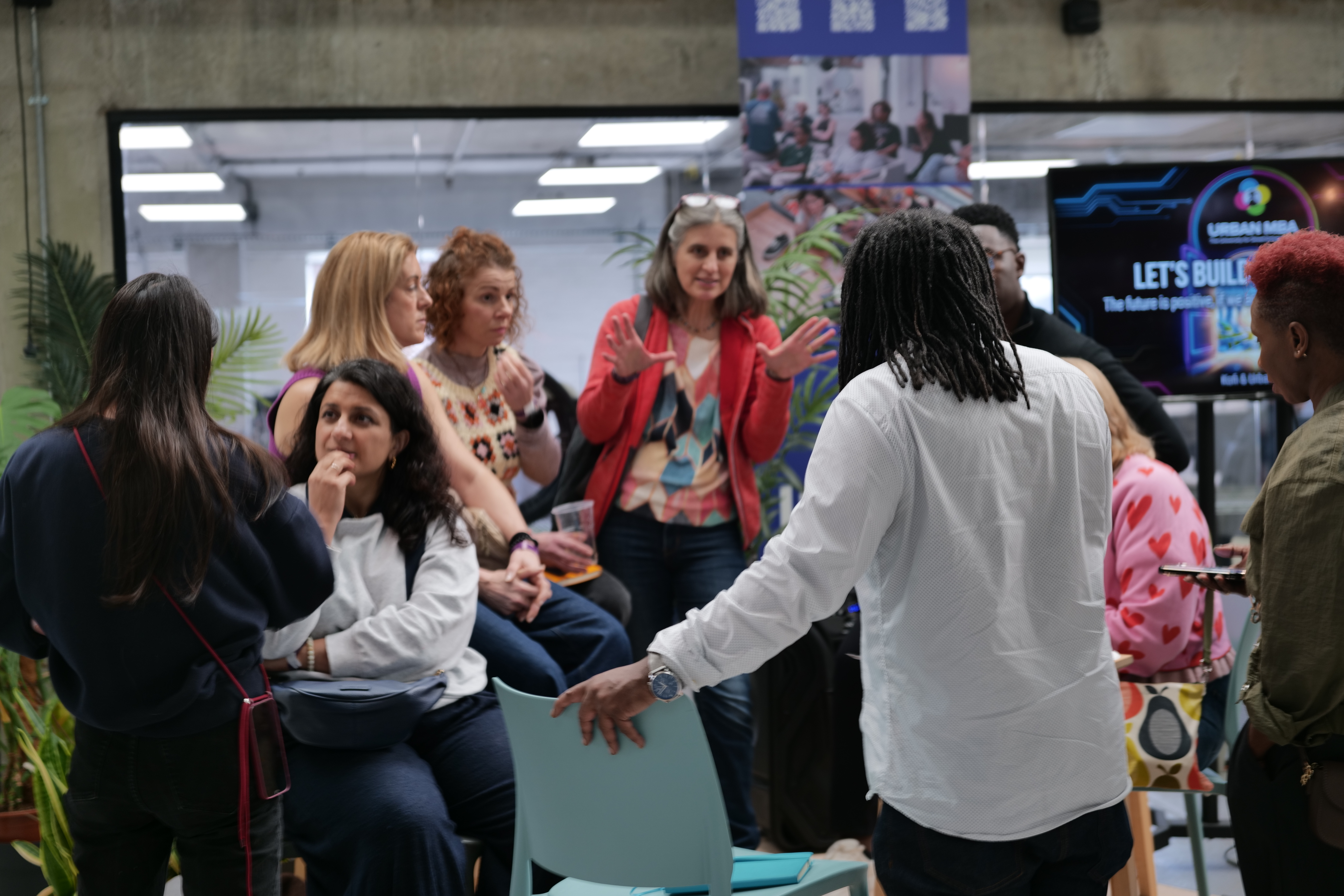
February 24th. Blue Garage, Lewisham.
The room's full. Coworking operators, local authority people, housing associations, and artists. 60 people in an industrial makerspace with concrete floors and fabrication equipment in the background.
The kind of space where real work happens, not the kind you photograph for Instagram.
The conversations are good. Sharp. People are asking the right questions—How do we make coworking spaces profitable? What's our role in the future of work when AI is taking jobs? How do we stop feeling invisible?
And I stood there thinking: this isn't quite it yet.
Not because it's bad. Because I've done enough of these to know what it looks like when a room catches fire properly. When the questions turn into something you can't Google. When people stop performing and start talking like human beings.
We're close. But there's still a gap.
Every independent coworking space operator I know carries a version of this feeling.
You're running 20 desks, fifty desks, or even a hundred. You've built something real—a community, a local business, people who show up because your space matters to them.
And you're constantly aware of the distance between what you've built and what you can see in your head.
Between the event that was good and the event that could be extraordinary.
Between the membership base you have and the one you're working toward.
Most people call this imposter syndrome.
It isn't.
The Gap isn't failure. It's proof your taste is working.
Ira Glass figured this out decades ago, talking about creative work, and it applies to every single person building something they care about.
Here's what he said: You get into this work because you have good taste. You know what good looks like. But for the first few years, your work isn't that good. It has ambition, but it's falling short.
And because your taste is still sharp, you can see the gap. You know it's disappointing.
That gap—between the taste that got you into this and the work you're currently doing—is why most people quit.
But Glass said the gap isn't the problem. The gap is proof that your taste is working.
You're not broken. You're developing.
And the only way through is volume. Do a hundred events. Have a hundred difficult conversations with members. Cycle through a hundred memberships.
You close the gap by doing the reps, not by waiting until you feel ready.
We run Unreasonable Connection four times a year. Every single time, we close the gap a bit more. Not because we've cracked some formula. Because we keep showing up and doing it again.
The wrong measure
I've been working in coworking since 2010. Sixteen years.
In that time, I've met hundreds of people who have found a building, built a community, and created a genuine local business. And they still don't think they're running a real coworking space.
They underplay the effort it takes. The ingenuity. The sheer bloody-minded persistence required to keep a neighbourhood space alive.
A neighbourhood café that is the actual heart of its street—regulars, good coffee, the place people meet before they do anything else—and the owner says, "I'm not a real café because I'm not Starbucks."
That's not humility. That's the wrong measure.
A coworking space with fifty desks, a tight community, members who've been there for years, and the operator says, "I'm not a real coworking space."
Compared to what? WeWork?
After the top three or four brands—WeWork with around two hundred locations, Regus with a thousand, Premier with one-twenty—everyone else drops to fewer than four locations.
Over 51% of coworking spaces in London are owned by operators with one to five locations (based on 2025 industry reports and my own analysis).
That's not the "small" part of the market. That's the actual market.
You've become invisible to each other
Ten large brands have the budget and teams to be visible everywhere online. You see them at every conference. You see their content, their PR, their polished websites.
And you assume that's what the industry looks like.
What you don't see is the five hundred spaces just like yours. Marketing locally. Connecting locally. No PR budget. No content team. Doing the work quietly and well.
You've become invisible to each other.
And when you can't see the others, the gap starts to feel like a failure rather than progress.
The diagnostic
There's a way to tell the difference between the Gap and an actual self-worth problem.
The Gap sounds like: "When we get this sorted."
Active. Moving. Building toward something.
A self-worth problem sounds like: "I'm not good enough."
Static. Stuck.
One needs reps. One needs a different kind of conversation.
If you're in the first category—and I'd bet most of you are—the answer isn't to wait until you feel ready. The answer is to do more of what you're already doing and let the volume do the work.
When I look back at the first Unreasonable Connection event in February, I can see what was missing. But I couldn't have seen it without doing it. And the May event will be better because of February.
That's how the gap closes. Not all at once. A bit at a time. By showing up and doing it again.
Find the others
Jon Alexander has joined us twice for Q&As at London Coworking Assembly events.
Jon Alexander has joined us twice for Q&As at London Coworking Assembly events. Both times, people kept asking the same question: How do I do this when I get home? How do I actually do everything we're talking about in this room when I'm back in my neighbourhood, in my community? His answer landed in the room like a hammer. "Find the others." Not: get an expert to come speak in your neighbourhood. Find the people who are already doing the work. Join with them. Learn together.That's what Unreasonable Connection is built for.
Not to fix you. You're not broken.
To show you the others. Because the moment you realise you're not the only one running a fifty-desk space, wondering if you're doing it right, the gap stops feeling like failure and starts feeling like the work.
Unreasonable Connection
Monthly online
-
Free RSVP here
-
One hour
-
Small groups of three to four people
-
Private rooms, no recording
-
A question to open things up, then you talk
-
No guest speakers, no panels
-
Just human beings talking to other human beings
-
Running every month for over a year
Quarterly live and in person
-
Next one: May 19th at Space4, Finsbury Park
-
09:30am to 3:30pm
-
Same spirit, in person, all day
-
Get your ticket here (£99 - £150)
If you've been running your space feeling like the only one doing it this way, you're not.
Come and find the others.
The distance between your vision and your space right now is not failure. It's the work.
Written by