Ten years of coworking journalism. One pint a month.
Citizen-funded journalism for the people building civic infrastructure, one coworking space at a time.
The trade-off is straightforward.
When you're funded by the people you're writing for, you don't have to find readers for your writing. You can find writing for your readers.
For ten years, the London Coworking Assembly has been civic journalism about coworking as civic infrastructure. We've run over 1,000 events, workshops, and meetups. We've recorded 250+ podcast interviews with space owners, operators, community builders, academics, and policy people. We've published hundreds of pieces about what works, what fails, and what the industry refuses to see about itself.
We've covered money trauma, wealth inequality, racism, homophobia, menopause, neurodiversity, mental health, childlessness, war zones.
The people doing this work—particularly owner-managed spaces under 150 members—are building something that doesn't fit in a spreadsheet. Our job is to articulate what they already know but can't always say.
The Coworking Values Podcast is named after the coworking values for a reason. Collaboration. Openness. Community. Accessibility. Sustainability.
The conversations that come out of those values aren't commercially comfortable. They're not designed to be. They're designed to be true.
This has been bootstrapped for a decade, with a bit of sponsorship here and there, mostly people helping out. It's never been a commercial venture. It punches above its weight. It's consistent, dependable. There's a track record.
Last month, we took the whole thing reader-funded.
This is what people actually listened to in 2025.
Not brand partnerships. Not enterprise strategies. Money trauma, burnout, and people filling gaps the state left open.
Williamz Omope appeared twice in the top 12. He runs job clubs in East London coworking spaces because job centres can't keep up. He brings NHS workers in to do health checks because the health service is overwhelmed. Two of your most-listened-to episodes are the same man, filling gaps the state keeps leaving open.
You chose episodes about mums who stopped waiting for permission to integrate childcare and work. About community managers burning out doing eight jobs. About coworking spaces in war zones, helping refugees land safely, stopping brain drain.
We didn't curate that list. You did. Those twelve episodes rose to the top out of thousands of listens across the archive because that's what matters to you.
The world is burning. The key to fixing everything is all of us. That's what the "co" in coworking is about. Mutual aid. What happens when the systems that were supposed to catch people don't.
This isn't a marketing decision. It's peer-to-peer sustainability.
The consumer story says: pay for the thing, get the logo, receive the report. That's a transaction. It works fine for what it's designed for.
This is a citizen ask. Different category entirely.
When 48 people put in £100 a year, the whole thing runs independently.
That's £4,800 a year—£400 a month—to cover the core costs. Website hosting (Ghost). Podcast hosting (Transistor). Editing tools (Descript). The workspace tools (Eden) that make it easier to communicate Unreasonable Connection, which in turn makes the live events easier to run because we're already talking to our communities all the time.
Everything else we produce—the podcast, the research, the writing, the Unreasonable Connection live events—runs on the same model.
No ads masquerading as content. No corporations making weird attempts to influence the editorial line. No pay-to-play. No cliques or coworking super clubs.
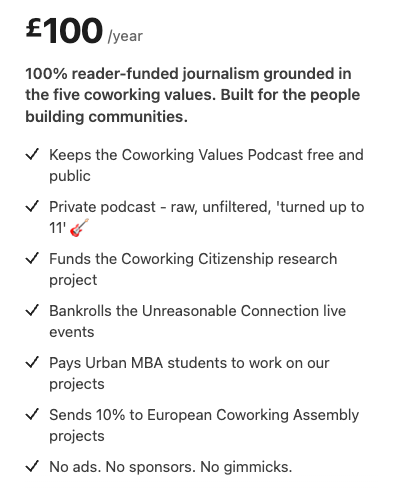
What your £100 a year funds:
Keeps the Coworking Values Podcast free and public. 250+ interviews with space owners, operators, and the academics and policy people who get it. No paywalls. No locked episodes. Everyone gets access.
Private podcast—raw, unfiltered, 'turned up to 11.' The stories and conversations we can't put out publicly. The real talk. Subscribers only.
Funds the Coworking Citizenship research project. Long-term research into how independent coworking spaces function as civic infrastructure. The kind of work that doesn't attract grants because it doesn't fit the usual categories.
Supports the Unreasonable Connection live events. Gatherings where space owners and operators meet, connect, and collaborate. You know the format. You've been to them.
Sends 10% to the European Coworking Assembly. The London Coworking Assembly and the Coworking Values Podcast are projects of the European Coworking Assembly.
We send 10% of the funds to the ECA to support their work with projects like ResMove, which helps refugees land safely through coworking, and rural coworking initiatives that keep brain drain from emptying villages.
What becomes possible when you join in.
Once we pass that threshold of 48 people, there's budget space to start projects with Urban MBA students. Real work. Real pay. Training the next generation of people who understand that community is infrastructure.
We've had a long-standing relationship with Urban MBA for years now. A lot of people reading this page already know them. When more people back the work, we can create more media around the value of coworking.
We can fund more research. We can send more money to the European Coworking Assembly, which in turn funds projects like ResMove and the rural coworking work that stops villages from emptying out.
This is what's possible when 48 people decide to join in.
Who's already backing the work:
Everyone backing the work is a coworking space owner or community builder. People inside the industry, putting money behind the story being told properly.
- Karen Tait - Residence Coworking Bishop's - Stortford
- Jason Smith - Gather Round - Bristol.
- Teresa Jackson - Collabor8te Glasgow
- Peter Block - Author of Community: The Art of Belonging.
- Freddie Fforde - Patch - UK wide
- Yann Heurtaux - La Serre Lausanne.
- Anne-Marie Murphy - Baseworx
- Samuel Warren - technologywithin
- Igor Dzhebyan-Benjamin - Spacebring
- Carlos Almansa Ballesteros - Nexudus
- Ewan Buck - Contingent Works Bromley
- Hector Kolonas - Syncaroo
These are the people who know what a coworking space actually does. They know the value doesn't show up in a spreadsheet. They know the work matters.
Jon Alexander, author of Citizens, has done two events with us so far. A number of coworking spaces have hosted ACTionism screenings. The people who get it are already here.
The people who have needed the most explanation are those who run companies that supply the coworking industry. This feels like a marketing strategy to them, because that's the category they're used to. Sponsorships. Logos. Reports with your name on them.
This isn't that.
This is not a sponsorship. You don't get a logo on the homepage. You don't get editorial influence. You don't get preferential treatment.
What you get is this: the London Coworking Assembly keeps existing.
Why reader-funded matters.
When you're funded by the people you're writing for, you don't have to pretend the industry is doing better than it is. You don't have to soften the critique. You don't have to avoid naming what's broken.
- You can write about the coworking space that got priced out by its own success.
- You can write about the racism and homophobia that still happens in spaces that claim to be inclusive.
- You can write about the loneliness epidemic as an economic output of rent extraction, not just a mental health problem.
- You can tell the truth.
That's what reader funding buys. Not a logo. Not a booth at a conference. The ability to follow the conversation wherever it needs to go.
For anyone in a tech company, hardware company, or firm that supplies coworking spaces:
£100 a year. One pint a month in a London pub.
That keeps independent journalism about independent coworking alive.
For coworking space owners and operators:
Those of you who have taken part in events and made connections in the London coworking community know what this is worth.
You know the stories we tell are the stories that need telling. You know the work matters because you're doing it every day.
This is how it keeps going.
The citizen story is already here.
It's happening. It's been happening for ten years.
- The independent coworking spaces that function as welcome centres, not transaction points.
- The operators who open their doors with no eligibility criteria and trust that the right people will show up.
- The local authorities who finally understand that place-based investment beats people-based investment, and that you need both skills and somewhere to go.
- The policy people, the academics, the community organisers who see coworking spaces as civic infrastructure and are trying to make the case inside systems that don't have a category for it yet.
The consumer story says: pay for the thing, get the service, move on.
The citizen story says: back the work, keep it independent, build the future together.
We are at the end of the consumer story. The citizenship story is alive and kicking.