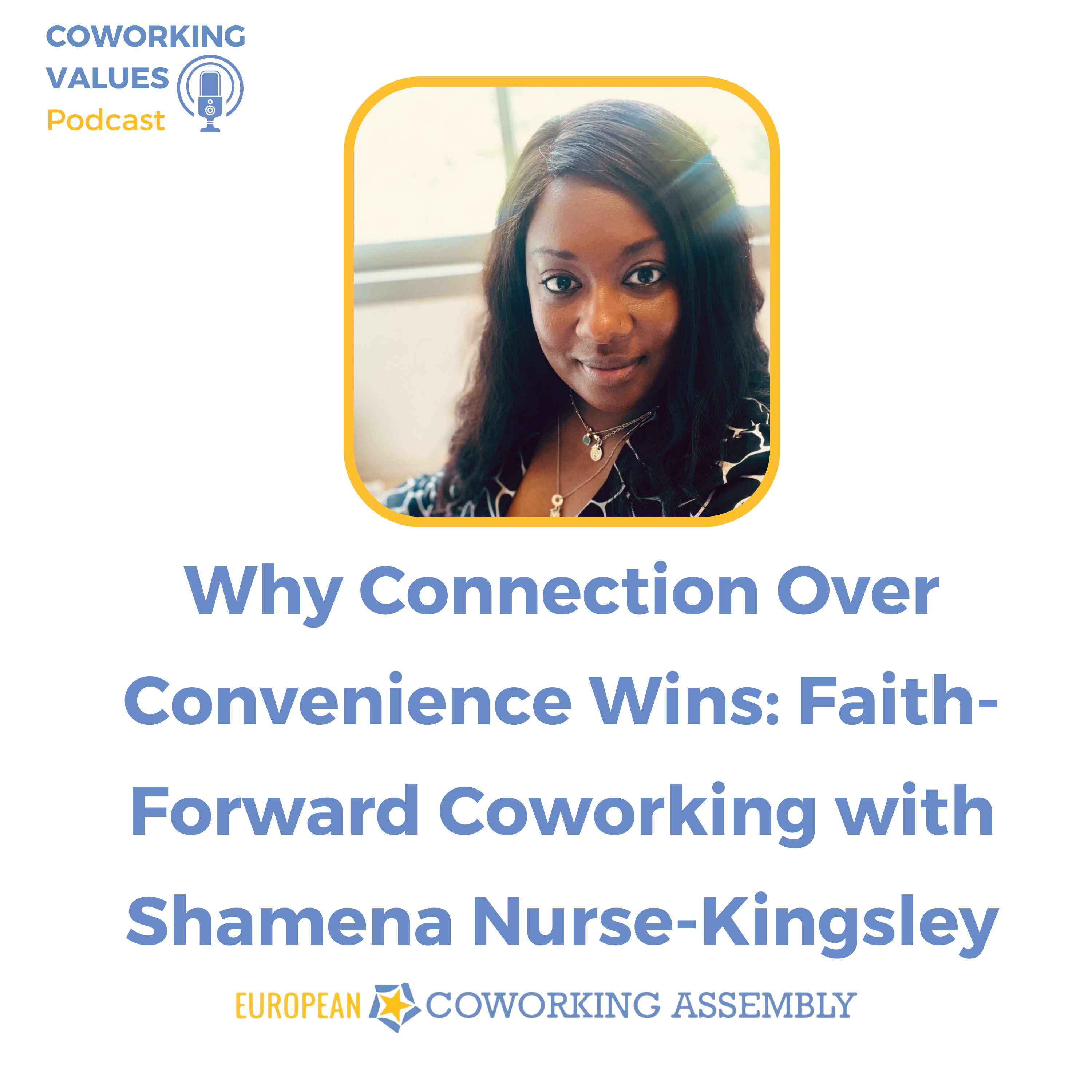
Why Connection Over Convenience Wins: Faith-Forward Coworking with Shamena Nurse-Kingsley
Why being specific beats being neutral in a city of 160,000 people
The panic hits when winter arrives, and you can’t be bothered to leave the house.
When it’s easier to dial into the Zoom call than get in the car. When streaming feels more sensible than showing up.
When convenience wins and connection loses.
Shamena Nurse-Kingsley runs Cowo & Crèche in Alexandria, Virginia—a faith-forward, family-focused coworking space that hosts Celebration Church DC every Sunday morning.
She’s a US Air Force veteran and former federal employee who’s built what she unapologetically calls a “Kingdom business.”
In a city of 159,102 people, she’s got 50 coworking seats and capacity for 338 at events.
Her response when Bernie asks about the numbers: “I like my odds.”
This conversation cuts to the heart of what independent operators are avoiding: that convenience is killing community. Trying to appeal to everyone makes you invisible. Those values-driven spaces cut through the noise better than generic flexibility ever will.
Bernie brings his own experience growing up in church communities—the barbecues after Mass, the football teams, the youth clubs—where connection happened not because it was convenient, but because people showed up.
Shamena talks about partnership agreements that blend grace with structure, about hosting Muslim groups for Iftar celebrations, about baptism pools and production equipment. About why “people are good” and why showing up in person still matters even when the screen would be easier.
This is for operators who’ve watched members drift towards the convenience of home. Who wonders if community still matters. Who needs permission to lean harder into their values rather than softer?
Timeline Highlights
[01:35] Shamena “I am being known for my very unapologetic, faith-forward space”
[02:56] Alexandria has 159,102 people—Shamena likes her odds with 50 coworking seats
[04:51] “It’s Club Jesus. Every single Sunday, it’s absolutely Club Jesus here!”
[06:09] How partnership agreements work: assets, lighting, production, grace, and structure
[11:30] Shamena’s story: flying to Paris to see Messi play, then he moves to Miami
[13:34] “There’s this sense of relief. You can hear the music, you can get a hug.”
[15:16] The elephant in the room: “Connection is more important than convenience”
[17:04] “Winter is coming. It is cold here. It’s going to be like 50 degrees.”
[19:28] The critical question: is the faith organisation a partner or a client?
[21:23] The baptism pool situation—where grace meets logistics
[22:45] A Muslim group calls to host Iftar: “Yes, sure. Come on in.”
[24:02] “People are good. I’m still a believer, Bernie, that people are good”
[26:03] “Bernie is palm tree shady”—the banter that proves real friendship
The Elephant Everyone’s Avoiding
No one wants to say it out loud: convenience is killing community.
Shamena names it without hesitation. “I think no one wants to step on people’s toes, right? No one wants to say, speak out against remote work because everyone’s like, it’s so convenient.”
Remote work is convenient. Streaming church is convenient. Staying in bed on a Sunday morning, in your pyjamas, with your Bible and the television, is convenient.
But convenient isn’t the same as connected.
“We’ve just put so much emphasis now on our convenience and self, and my own convenience and my own comfort. And now, connection is going down, down, down that list.”
This isn’t anti-remote-work. Shamena built Cowo & Crèche partly because remote work created impossible situations for working parents—she didn’t want YouTube raising her children whilst she worked. The problem isn’t flexibility. It’s when convenience becomes the only metric that matters.
Bernie recognises this tension immediately: “We talk about connection and community more than ever, and maybe that’s just because we’re in the coworking industry.”
But talking about connection and actually creating the conditions for it are entirely different things.
The operators who thrive won’t be the ones offering the most convenient option. They’ll be the ones creating experiences worth the inconvenience of showing up.
Partnership vs Client: Structure Behind the Grace
Here’s what most operators miss when working with faith organisations: the distinction between partnership and client relationships matters.
“Is this a partnership with the faith-based organisation, or are they a client? That’s a good starting point.”
For Cowo & Crèche, Celebration Church DC (pastored by Anthony Vaughn and Brenda Vaughn) isn’t just renting space on Sundays.
They’re in a genuine partnership—sharing assets, production equipment, and lighting. The church has invested in permanent infrastructure that benefits the space all week.
But partnership doesn’t mean woolly boundaries.
“We do have our SOPs. We do have partnership agreements. You should lock those things in and let it be tight. But also knowing that, listen, we’re going to have a baptism here coming up on Sunday. There’s a whole baptism pool situation.”
This is what Shamena calls “Kingdom business”—grace layered with structure and systems. She’s got 25 years of experience in budgeting and logistics and two master’s degrees. “By no means am I just here riding on a Jesus high with no structure, right?”
The emails about mop situations and towel logistics for baptism pools. The evening setup time is not charged at market rate because it’s a partnership, not a transaction. The clear understanding that business remains business even when relationships run deeper.
Grace and structure. Both are held in tension.
The 160,000-Person Opportunity
Bernie asks the question every operator should ask: “How many people live in Alexandria?”
Shamena Googles it mid-conversation: “In the city of Alexandria, as of 2024, there are 159,102 people. In my space, I have 11,597 square feet, and the fire marshal tells me that I can have 338 people in here.”
Her response: “I like my odds.”
This is the mathematics of the niche. In a city of 160,000 people, you don’t need to appeal to everyone. You need to become the obvious choice for your people.
Bernie makes the point sharper: “There’s actually more coworking seats in London than there are people... There’s always more people than there are seats, and people are always trying to be the same.”
Everyone’s competing to be vanilla. To be neutral. To offend nobody and appeal to everybody.
Shamena’s doing the opposite. Faith-forward. Family-focused. Veteran-owned. Unapologetic.
The question isn’t whether your values will turn some people away. They will. The question is whether they’ll make you magnetic to the right people.
When the Building Becomes a Congregation
Every Sunday morning, Cowo & Crèche transforms.
“It’s Club Jesus. Every single Sunday, it’s absolutely Club Jesus here.”
Shamena and her husband don’t pastor the church—they host it. They’re part of the congregation. They’ve woven their business and their faith community together in ways that blur the boundaries in generative ways.
Bernie names what this really is: “It’s like hosting a party every weekend, guaranteed in your coworking space.”
People come through the doors after a hard week and feel relief.
- They hear music.
- They get hugs.
- They feel at home.
- They’re part of something that doesn’t kick them out on a time clock.
Bernie recognises this from his own upbringing: “My mum was a teacher and she was a catechist all her life. We were always at church... We went for the community vibe, and there happened to be a religious ceremony along the way.”
Churches, temples, mosques—faith spaces—originally grew up at the centre of communities. Towns built around them.
They were infrastructure for gathering, mutual aid, celebration, grief, and belonging.
Then something happened. Attendance shifted. Convenience won. Streaming became easier than showing up.
Now faith organisations are looking for ways to reconnect with their communities. Not by making religion more palatable, but by remembering they were always supposed to be about more than Sunday morning ceremony.
Coworking operators with spaces sitting empty on weekends should pay attention.
The Inclusion Question That Actually Matters
Shamena’s space is explicitly faith-forward. But that doesn’t mean it’s exclusive.
“Early in the year, I had a Muslim group call. They wanted a place to host Iftar on a Friday that was big for the community. And I’m like, yes, sure. Come on in.”
She continues: “Even if you don’t necessarily believe the faith journey that I’m on or you don’t ascribe to it, that doesn’t exclude you. Once it’s not extremely antithetical to what we believe. And what I believe is that people are good.”
This is the nuance operators miss when they try to be everything to everyone. Shamena’s crystal clear about her values. But her values include hospitality, community, and the belief that people are fundamentally good.
You can be specific without being exclusionary. You can have a clear identity without building walls.
The Muslim community hosting Iftar at a Christian-partnered space isn’t a contradiction. It’s proof that values-driven spaces can hold more complexity than a generic “flexible workspace” ever could.
The Messi Test for Real Community
Shamena tells a story about her husband, who never misses a Barcelona match.
“There was nothing like seeing his face when I surprised him with tickets to go see a match.” She flew them to Paris for a weekend to see Messi play at PSG. Then Messi moved to Miami. “We need tickets to Miami, which would have been cheap.”
The point lands: “You can be at home, and you can watch a match, and we have this wonderful big screen TV, and it could be HD and all of the things. But there’s nothing like being there in person with the crowd, with other spectators. That’s community.”
She connects it to church immediately: “There is the convenience that you can stream, and you can come online, or you can listen to church on a podcast. But when you come in here, you feel it. It’s the pulse.”
The technology can deliver content. It cannot deliver presence.
Bernie shares his own story—organising a mass for 5,000 people as part of a youth project, experiencing everyone singing together. He also references Brené Brown writing about Liverpool fans in Australia all singing “You’ll Never Walk Alone.”
These moments change you. The screen doesn’t.
This is the promise every coworking space makes and most fail to deliver: that being there matters. That proximity creates something the Zoom room cannot.
The operators who survive won’t be the ones with the best WiFi. They’ll be the ones who understand why someone would drive through snow and traffic on a Sunday morning when they could stream from bed.
✅ Coworking Trends Survey 2025
The Coworking Values Podcast is keen to support Carsten Foertsch and Deskmag - The Coworking Magazine Coworking Trends Survey - the longest-running global study tracking the evolution of coworking and flex spaces.
If you’re a coworking community builder or operator, take 5–10 minutes to share how your space is doing this year. Your input helps shape the most accurate industry snapshot out there.
➡️ Take the survey now
Help make sure voices from all types of spaces - big and small, rural and urban - are heard.
Links & Resources
Shamena Nurse-Kingsley’s Work
- Cowo & Crèche Website
- Connect with Shamena on LinkedIn
- Cowo & Crèche on LinkedIn
- Cowo & Crèche on Instagram
- Cowo & Crèche on Facebook
Previous Coworking Values Podcast Episodes
- A Safe Place to Land: Coworking Through Life’s Uncertainty with Shamena Nurse-Kingsley
- How ACTionism Screenings Help Members Go From Solo Mission to “I’ve Got a Crew” with Ellie Meredith
Bernie’s Projects
- AI for Coworking Quiz: Free assessment tool for coworking spaces
- Bernie’s LinkedIn: Connect directly
Community Resources
- London Coworking Assembly website
- Unreasonable Connection Going Live! Link in the podcast email.
- Coworking Values Podcast (LinkedIn page)
- LinkedIn Coworking Group: 8,000+ member community
- Request an ACTionism Film Screening
- Workspace Design Show: February 2026, Business Design Centre, London
🧠 One More Thing
Coworking brings communities together, helping people find and share their voices.
Each episode of the Coworking Values Podcast explores Accessibility, Community, Openness, Collaboration, and Sustainability—values that shape the spaces where we gather, work, and grow.
If this resonates with you, rate, follow, and share the podcast. Your support helps others discover how coworking enriches lives, builds careers, and strengthens communities.
Community is the key 🔑
Written by
What's Next?
They Host Church, Stop Brain Drain, and Won't Put Their Film on Netflix—And They're Winning
LinkedIn Show Notes #34 from the Coworking Values Podcast Bullpen. 🎙️ Listen to these stories and hundreds of others on the Coworking Values Podcast. Three different community builders. Two continents. One pattern: They stopped optimising for scale and started building for depth. And the people who needed them showed up. This week from the Coworking Values Podcast Bullpen: We've been tracking why some spaces feel like communities and others feel like expensive libraries with good Wi-Fi. T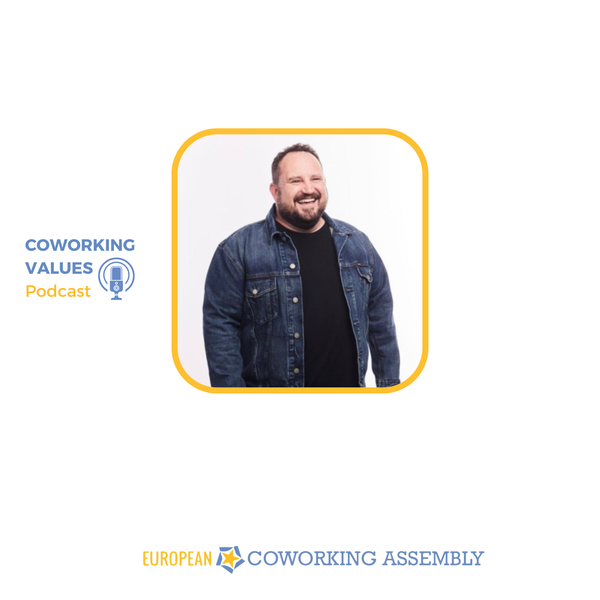
They Come for the Promise. They Stay for the Hospitality. with Dr. JJ Peterson
"They come for the promise. They stay for the hospitality." — Dr. JJ Peterson Episode Summary JJ Peterson has spent eleven years inside the StoryBrand universe. He co-authored Marketing Made Simple with Donald Miller. He helped Will Guidara write the certification for Unreasonable Hospitality. He hosts the Badass Softie podcast — for leaders who are unapologetically driven but want to lead with their hearts. He is flying to London in June to teach at the first workshop in the world to b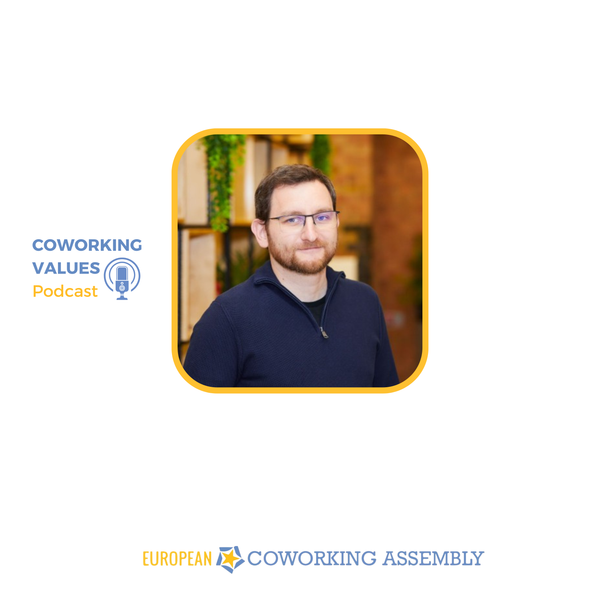
Why AI Can't Feel the Room: Practical Operations with Carlos Almansa
"The AI cannot feel the space. It can't feel the dynamics or the vibe. But it can free up time for you to talk to your members, to have a coffee with them, to understand and to read people." — Carlos Almansa Ballesteros Episode Summary Most conversations about AI in coworking are either evangelical or dismissive. Carlos Almansa Ballesteros, co-founder of Nexudus and author of the Coworkings AI newsletter, isn't interested in either. He's been building software for this industry for 13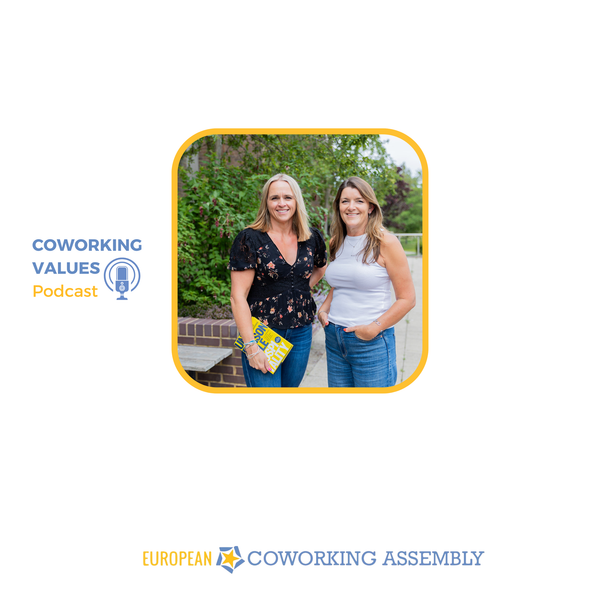
The Golden Thread: Why Unreasonable Hospitality Needs a Story First with Sonya & Julie
Why your coworking space needs a Story before it can practise hospitality "Marketing makes these promises and service delivers that. So for us, StoryBrand and unreasonable hospitality, really work together hand in glove. And StoryBrand is really about thinking about how you communicate that you care to your customers. And the unreasonable hospitality side of things is how you prove it." — Sonya Whittam Sonya Whittam and Julie Firth run Story22, a customer-centric marketing agency base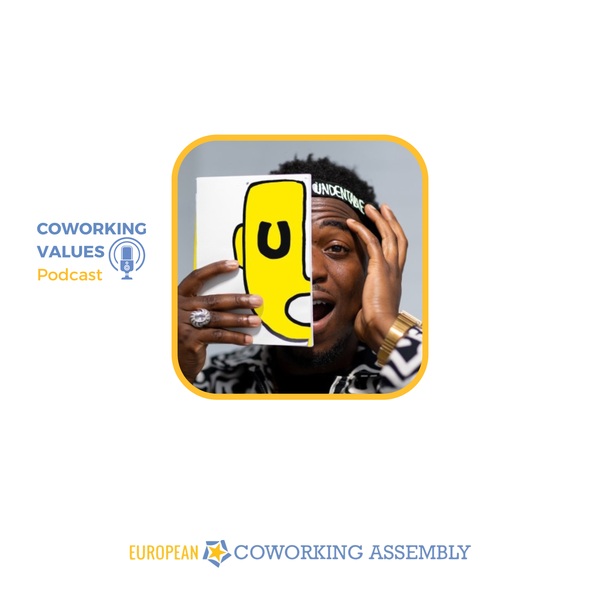
You're Never Broke If You Got Ideas: How Koder Brings Music to the Neighbourhood
"Ideas are currency, you know. And you're never broke if you got ideas... Everything we are looking at around us came from an idea. So for me, they are, it is a currency within itself." — Koder Koder runs Undeniable Studios, a music production conglomerate built from youth clubs, pirate radio, and 10,000 hours of free studio time in Brockley. He's now the first Creative in Residence at Blue Garage in Lewisham, where he's installing a commercial music studio, planning his Circle the Ends
Start With the Building, Miss the Person — It Happened Again This Week
I spent this week watching the same argument break out in different places, with different people, in completely different conversations. None of them planned it. * Caleb Parker published a manifesto for high street coworking. * Suzanne Murdock sent her monthly newsletter from The Hub Newry. * Parisa Wright kept resharing her Hope Hub episode. And * Ann-Marie Kinlock and Anna Chuicharoen finally opened KindHaus in Hackney after three years of hurdles, setbacks, and proving that a space wher
Start Cooking. The Recipe Will Follow.
We're moving everything up a gear. At the last Unreasonable Connection Live in Lewisham, you told us the groups were too random and the curation could be tighter. You were right. 75% of you left with more momentum than you arrived with. The room worked. The curation didn't. The people in the room, the conversations that happen, and how those conversations are curated—it all matters deeply. That's why on May 19th, Tilley Harris and the team from Akou are collaborating with us to facilitate