You know you do this work. You just can't prove it in a council meeting.

I recorded a podcast today with Felicia Fai.
A lot of you will have met her at Blue Garage during the last Unreasonable Connection. Felicia is an academic at the University of Bath, and the research she recently co-authored adds the economic scaffolding to what we do.
Her team studied 161 spaces across 74 regions of the UK to prove what you already know. Local authorities look at your coworking space and see office space.
Desks. Square footage. Revenue per desk. Occupancy rates. That is the entire picture they have of what you do.
- They don't see the member who learned to build an app because they sat next to a developer for six months.
- They don't see the single parent who started a business because your flexible desk was the only professional space they could afford.
- They don't see the three firms that grew from one person to two because your space gave them a room to meet clients they couldn't invite to their kitchen table.
Felicia and her colleagues break this invisible work down into six types of capital.
Economic, human, social, cultural, institutional, and physical. When she listed them today, I saw every independent space I've visited in the last 15 years. You know you do this work.
You just can't prove it in a council meeting.
And most weeks, you don't have anyone to talk to about it. You run the space. You manage the members. You chase the invoices. You host the events. You fix the wifi. And at the end of the day, there is nobody sitting across from you who understands what any of that actually takes.
Felicia draws a hard line between information and knowledge.
Formal business courses give you information. You sit through a six-week crash course, maybe the local authority runs an event with someone who came sixth in the TV show Dragons' Den to tell you how to pitch, and then you are on your own. There is no support afterwards.
Knowledge comes from applying information every day inside a community.
I sat next to a developer called Nils for two years. He would look at my screen, take pity on me, and ask what I was trying to do. He'd press one button and save me hours.
That is what your coworking space does by osmosis, and nobody is measuring it.
Ireland already figured this out
Connected Hubs is their national network of spaces across rural and coastal areas. I asked Anne Marie from Baseworx for an example of this in action, and she sent me this clip.
It is Stephen Carolan and Aisling Moroney from the Western Development Commission addressing a Joint Oireachtas Committee on Social Protection, Rural and Community Development.
They are directly briefing the government on the economic role of remote and blended work in these hubs, and the politicians are actually listening.
👉 Look at the way the Western Development Commission support European Coworking Day.
The population of the Republic of Ireland is 5.4 million. Greater London alone is pushing 10 million.
Ireland built a national civic infrastructure. We are still spinning.
The research proves one thing: in left-behind regions, independent coworking spaces are proxies for the universities and training centres that don't exist there. They are essential civic infrastructure.
95.3% of UK private sector businesses are micro-businesses or sole traders
That is 5.4 million of us. Your coworking space is one of them. Your members are the rest.
We are micro-businesses holding the roof up for other micro-businesses.
Right now, most of us are doing that work completely alone.
May 19th, Space4, Finsbury Park
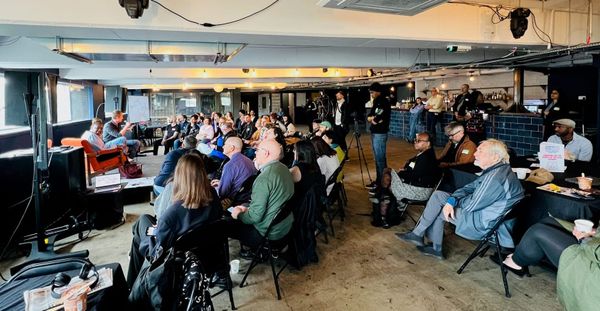
On May 19th at Space4 in Finsbury Park, we are running the next Unreasonable Connection. This is the follow-up from Blue Garage in February.
We are building this as a quarterly rhythm. You don't need to come to every one. But each time we meet, the room gets sharper. The connections carry over. You can show up when you are ready and find the others.
The entire day is a collaboration between the London Coworking Assembly, Maddy and Natasha at Space4, Kofi and the team at Urban MBA, and Akou.
Tilley and the team at Akou are co-facilitating the day. No keynotes. No panels. No one standing on a stage telling you what the future of work looks like.
- You don't have to pitch.
- You don't have to have answers ready.
- You don't have to be further along than anyone else.
The facilitation is designed so you can show up as yourself and do the thinking you haven't had time to do.
You arrive, pick the specific friction you are facing right now, and move into a curated group of peers who actually run spaces. The groups mix in the afternoon. The day closes with quiet reflection and one thing you commit to when you get back.
The main session runs from 9:30 AM to 3:30 PM so you can make the school run or catch the train home. If you have time to stay, we are moving to a second location nearby.
We don't do pre-set agendas.
Tilley and I are building the exact topics and activities around the people who walk through the door. The day is shaped entirely by the specific frictions you bring with you. That isn't a gap in our planning — that is the whole point.
The room is yours if you want it.
Unreasonable Connection Live!
May 19th 09:30 - 15:30 Space4, Finsbury Park
Welcome Gate, Baseworx, Nexudus, Coworks and Cobot are 'enablers' for Unreasonable Connection they all fund supporter tickets to make the event accessible and inclusive for everyone. 💚
FlexSA Conference and Business Rates
Today our friend Caleb did his weekly Friday Five on UK Business Rates with Jane Sartin from FlexSA.
 Caleb Parker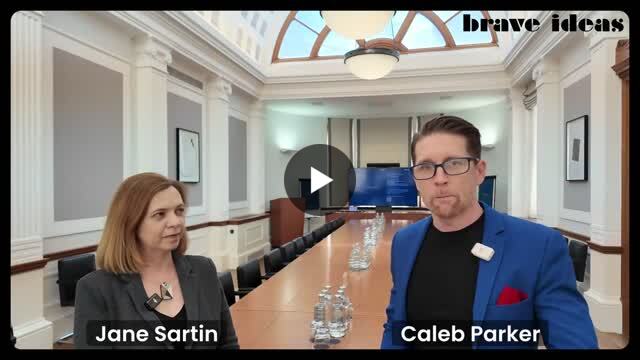
Caleb and Jane update about UK Business Rates
Last year Jane shared the business rates crisis and what every workspace operator needs to do now on the Coworking Values Podcast — and still needs our support to get our MPs aware.
- Download - FlexSA ‘Engaging Your MP on Business Rates and Flexible Workspaces’
- Write to Your MP — Enter your postcode, get your MP’s details
Then on the 12th May at the FlexSA Conference I'll host a panel with Karen Tait, Tom Ball and Adam Sandford on "Embedding Flexible Workspace in Local Communities."
Contacting your MP about business rates and showing up for your local economy are the same act. One proves the other.
Written by
What's Next?
They Come for the Promise. They Stay for the Hospitality. with Dr. JJ Peterson
"They come for the promise. They stay for the hospitality." — Dr. JJ Peterson Episode Summary JJ Peterson has spent eleven years inside the StoryBrand universe. He co-authored Marketing Made Simple with Donald Miller. He helped Will Guidara write the certification for Unreasonable Hospitality. He hosts the Badass Softie podcast — for leaders who are unapologetically driven but want to lead with their hearts. He is flying to London in June to teach at the first workshop in the world to b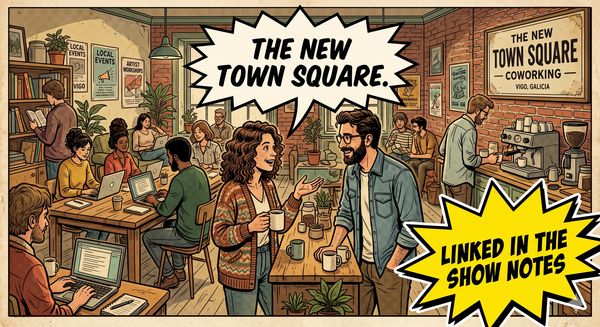
Your Coworking Space Is a Conversation, Not an Office
LinkedIn Show Notes #51 from the Coworking Values Podcast Bullpen. 🎙️ Listen to these stories and hundreds of others on the Coworking Values Podcast Hannah Mojica's train was cancelled on the way to a fireside chat she was supposed to be leading — on member retention. Standing on the platform, she bumped into Mike Lawrence, a FOUNDRY member. They ended up in a coffee shop and just talked. Operations, the CEO role, what it actually takes to build a team that can run without you. Hannah calle
Start With the Building, Miss the Person — It Happened Again This Week
I spent this week watching the same argument break out in different places, with different people, in completely different conversations. None of them planned it. * Caleb Parker published a manifesto for high street coworking. * Suzanne Murdock sent her monthly newsletter from The Hub Newry. * Parisa Wright kept resharing her Hope Hub episode. And * Ann-Marie Kinlock and Anna Chuicharoen finally opened KindHaus in Hackney after three years of hurdles, setbacks, and proving that a space wher
Start Cooking. The Recipe Will Follow.
We're moving everything up a gear. At the last Unreasonable Connection Live in Lewisham, you told us the groups were too random and the curation could be tighter. You were right. 75% of you left with more momentum than you arrived with. The room worked. The curation didn't. The people in the room, the conversations that happen, and how those conversations are curated—it all matters deeply. That's why on May 19th, Tilley Harris and the team from Akou are collaborating with us to facilitate