
At 30,000 Feet the Rules Work. At Ground Level They Don't.

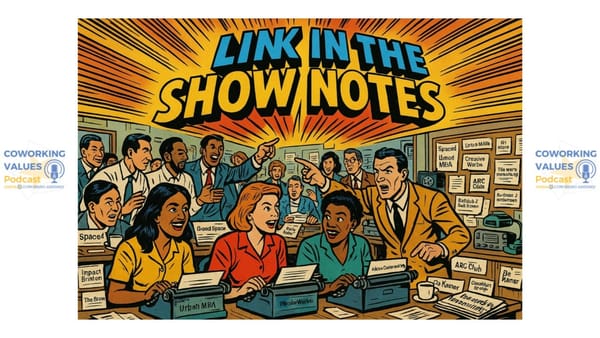
LinkedIn Show Notes #36 from the Coworking Values Podcast Bullpen.
🎙️ Listen to these stories and hundreds of others on the
Coworking Values PodcastAt 30,000 feet, physics works. Checklists save lives. You follow the rules, you survive.At ground level, the checklists are rigged depending on who you are.
This week from the Coworking Values Podcast Bullpen: We've been tracking how three people landed in broken human systems and built their own cockpits.
Where marginalised people write the rules instead of just following them. Not inclusion theatre—actual liberation infrastructure. Here's what they built when they stopped being polite about systemic violence.
The Assignment
The Syrian man was a university swimming champion.
The Swedish bureaucracy saw a "refugee." A case file. A problem to process.
Mikael Johansson asked one question: "What do you do in your spare time?"
That same week, the swimming club hired him as a coach.
This is what happens when you ask about assets instead of deficits.
Loubna Messaoudiwas a pilot. Cockpits run on physics. Then she landed in Berlin's TV production world and discovered the human checklists are rigged depending on who you are.
Kofi Oppongwas homeless at 17. Thirty years later, he's teaching AI skills to over-50s in Ali's Caribbean group while building battle labs for young people the education system already wrote off.
Mikael Johanssonguides refugees through Sweden's 400-strong network of associations. While his own government wages economic war against the people he serves.
None of them apologises for being specific about who they serve.
None of them measures success by how comfortable privileged people feel in their space.
All of them learned the same thing: when systems are designed to exclude you, build your own.
The Injustice We're Tracking
Here's what's broken: Too many coworking spaces perform inclusion while systematically excluding the people who need community most.
97.5% of coworking spaces are founded by white, middle-class men for other white, middle-class people with money.
People of Coworkingman-els are still the normat industry conferences even in 2025.)
This isn't accidental. This is how extraction economics works.
But as wealth inequality in the UK and Europe gets more visible, the middle class is getting hollowed out, and this is why the coworking industry needs to wake up and pay attention - but that's another article.
The Swedish government just jumped the work visa salary requirements from 13,000 SEK to 27,360 SEK per month. That's not immigration policy—that's economic warfare designed to make survival impossible for anyone who isn't already wealthy.
Meanwhile, coworking spaces put rainbow stickers on walls and call it inclusion.
The badges are there. The diversity statements are on websites. The good intentions are everywhere.
But the infrastructure still serves the people with capital while keeping everyone else out.
This violence gets dressed up as "market forces" and "business sustainability."
Call it what it is: systematic exclusion with better branding.
The market won't fix this. The state won't fix this.
People do.
🇩🇪 Loubna Messaoudi: The Battle Lab
Loubna was a pilot.
A cockpit at 30,000 feet is pure physics. Checklists. Hard rules. Follow them, you live. Ignore them, you die.
Then she landed in Berlin's TV production world. Nine years watching how the human checklists work differently depending on what you look like.
That's where she learned the system isn't broken. It's working exactly as designed.
BIWOC* Risingisn't a coworking space. It's a battle lab for people the system wants dead.
The name itself tells the story of the work. Started as "BIWOC" (Black Indigenous Women of Colour). But the lab ran an experiment and found a flaw—the name excluded trans, inter, and non-binary people of colour.
"It was a painful journey," Loubna explains. "We had a lot of discussions with some of our members, who is allowed to be there, who not and why... and to be honest, some we lost in that process."
This is what real liberation work looks like. Not rainbow flags and good feelings. Losing people when you evolve to serve people better.
"I think it's a painful, long journey to unlearn things and to change your structure. And sometimes you're not getting the reward from outside."
The space runs on wealth redistribution disguised as membership. €0 to €50 sliding scale.
The €50 members subsidise the €0 members. Every member co-writes the Code of Conduct. The broke member has the same power as the rich one.
"By inviting other people to the decision making table does not mean you lose power. It's about power sharing."
Her sharpest insight cuts straight to the economics of extraction: "Marginalised people should never be asked to contribute with free labour... otherwise you are just exploiting them for your benefits."
That tech founder buying you coffee to "pick your brain" about diversity?
Loubna's got the invoice: you're stealing labour and calling it networking.
The space exists because 99% of coworking spaces are founded by "white, cis heterosexual men" who "automatically address the needs of other white heterosexual men from the middle or upper middle class."
Not because they're evil. Because that's how systems work when you don't actively design them to work differently.
So she built a different system. Where marginalised people aren't consultants for other people's inclusion projects.
They're the architects of their own liberation.
Citizens: Your Voice or Their Version
Coworking Trends SurveyCarsten FoertschDeskmag - The Coworking Magazineis live - it's more important than ever.
Most of us will accidentally scroll past it.
That's what happens every year. Independent operators—the ones actually building community—are too busy running spaces to complete surveys.
Meanwhile, corporate chains have entire teams dedicated to data collection.
So guess whose story gets told?
This is one of the few industry studies that actually includes independent voices—when we participate.
Currently, the story of coworking is being written by those with the largest marketing budgets. WeWork's version. IWG's metrics. Corporate real estate thinking.
But there are more independent coworking spaces than corporate brands. Way more. The spaces that understand coworking as civic infrastructure, not just flexible office solutions.
If we don't appear in the data, our version of coworking won't exist in the conversations that shape our industry's future.
Your 5-10 minutes change whose voice gets heard.
Take the Coworing Trends Survey now🇬🇧 Kofi Oppong: The Community Infrastructure Builder
Kofi was homeless at 17 in East Ham.
Kicked out by parents. Everything he owned in a bag. The city was cold. The lesson was survival.
Thirty years later, he has turned that street education into Urban MBA—a hybrid charity and for-profit organisation that teaches skills not offered by any university.
The 4,680 sq ft space in Hackney exists because the state abandoned its responsibility. Over 1,200 youth centres in the UK have closed since 2010. Urban MBA is filling the void left by the infrastructure that the UK government destroyed.
"Our primary goal is education to the communities that are worstly underserved, people who can't go to university."
The space hosts Ali's Caribbean group. Over-50s eating together, laughing, learning AI while surrounded by VR headsets and 3D printers.
But this isn't about gadgets. It's about power.
"The way these people need to learn to use AI is to write letters to the local authority," Kofi explains. "It gives them more power in their position in society because the people furthest from the tech get hit the hardest."
When everything goes digital and you can't navigate the system, you disappear.
When you can use AI to write formal complaints, you fight back.
The curriculum is bluntly practical. Six-week, 12-week, and one-year courses teaching goal setting, mindset, business planning, and market research to 18-25 year olds from marginalised communities.
Over 600 students supported. More than 60 entrepreneurs cultivated. Over £200,000 in funding secured by alumni.
"You can't just teach somebody something and leave them," Kofi says. "A lot of the entrepreneurs we have, we've been mentoring them for over ten years."
The promise of "unlimited mentoring support" in a world of zero-hour contracts is a radical act.
It's the exact opposite of the gig economy's "you're on your own" brutality.
Kofi's honesty about the sector is refreshing: "There is an unwritten code that social enterprises and charities should all work together. But that doesn't work at all... if I find twenty organisations that are teaching entrepreneurship, it becomes a competition."
He's built a dual structure—charity plus for-profit—that hedges against a funding system he knows is biased against Black founders.
"As a black person my challenge has always been trying to get funding. For my organisation, it has been a nightmare."
The space operates as community infrastructure for people the market abandoned and the state wrote off.
Not because Kofi's a saint. Because he knows what it's like to be written off.
And he refuses to let another generation face the streets alone.
Jon AlexanderUrban MBAACTionismRSVP here
.
🇸🇪 Mikael Johansson: The Tugboat in the Storm
Mikael calls himself a "boundary-spanning organisation" leader.
That's diplomatic language for operating a tugboat in a hurricane his own government created.
He runs Malmö Ideella, the umbrella for 300-400 nonprofit associations in Sweden's most diverse city. 185 nationalities. One integration challenge.
While he's building bridges, the Swedish government is burning them.
They just increased work visa requirements from 13,000 SEK to 27,360 SEK per month—economic warfare disguised as immigration policy.
Simultaneously, it is slashing funding for civil society organisations. The very nonprofits that form Mikael's network.
His tugboat operates in a storm designed to sink it.
The Syrian swimming champion had been stuck in bureaucratic red tape for months. The state saw a "refugee." A case file. A cost to manage.
Mikael's Föreningslots project asked a different question: "What do you do in your spare time?"
Swimming. University champion. Youth coach.
The swimming club hired him that same week.
"It is probably easier for a person who comes new to your country to get a better contact with people that are connected to associations, organisations, than to the municipality."
The associations don't interrogate trauma. They ask about skills.
"We are the bridge that can make the trust between the system and the association become more vivid."
This is asset-based integration. Not CV-first. Community-first.
The name "Föreningslots" means "tugboat guiding bigger boats into harbour."
But the harbour Mikael's guiding people toward—Sweden's 400-strong association network—is under active attack from his own national government.
They're defunding the lifeboats while creating policies that guarantee more people will need them.
Mikael's response isn't protest. It's practical.
The RES-MOVE project connects migrants to coworking spaces across Europe using the same principle.
"We are helping both the migrants to get a bigger network and get more contacts through the Coworking spaces, but we will also help the Coworking spaces to be more inclusive."
The refugee isn't broken and needing services. They're a skilled person looking for community.
"If we could help them get more contacts that have more contacts themselves, so the person gets a bigger network, then we have done even more than maybe a lot of governmental bodies are doing."
The model works because it treats people as assets, not deficits.
While the Swedish state builds economic walls, Mikael builds social bridges.
One swimming lesson at a time.
The Pattern: Infrastructure for People the System Forgot
Loubna's intersectional laboratory. Kofi's community infrastructure. Mikael's integration bridge.
None of these optimise for the comfort of privileged people.
They optimise for the liberation of marginalised ones.
They're building economic and social infrastructure in the gaps where traditional systems fail. Not as charity work. As civic infrastructure.
Jon Alexander's shift from Consumer to Citizen, documented in real time.
The Consumer story says: design for the majority, keep barriers low, treat inclusion as a marketing strategy, measure success by growth.
The Citizen story says: design for the people who need it most, name barriers explicitly, treat inclusion as economic justice, measure success by who gets access to power.
- Loubna could have built another "diverse" space that made white people feel good about themselves.
- Kofi could have targeted middle-class entrepreneurs with venture capital dreams.
- Mikael could have stuck to traditional integration programmes.
Instead, they're all building infrastructure for the people the market forgets: women of colour facing intersectional barriers, young people written off by education, refugees reduced to case files.
Your coworking space is already civic infrastructure.
The question isn't whether you're inclusive. The question is who you're including and who benefits from your definition of inclusion.
The question isn't whether to do this work. The question is whether you're brave enough to name who you actually serve.
Who This Is For
If you run a space under 150 members and you've been told to be more "mainstream" to attract wider membership, this is for you.
If you've put up diversity posters while your membership stays accidentally homogeneous, this is for you.
If you've wondered how to actually serve marginalised communities without tokenising them, this is for you.
If you're tired of inclusion initiatives that make privileged people feel better while changing nothing for the people who need access most, this is for you.
The corporate coworking story says: design for the broadest possible market, avoid anything "political," keep everyone comfortable, scale through standardisation.
That story has its place. But it's not your story.
- Your story is Loubna's: building a lab where marginalised people shape the rules instead of just following them.
- Your story is Kofi's: creating infrastructure for communities the state abandoned and the market ignores.
- Your story is Mikael's: asking about people's assets and passions instead of their problems and deficits.
You don't need 4,680 square feet to do this work.
You don't need sliding-scale membership models to centre marginalised voices.
You don't need 400 nonprofit associations to ask better questions.
Start with who you actually want to serve. Name them specifically. Design for their liberation, not everyone's comfort.
You're not being exclusionary. You're being intentional about inclusion.
If that's you, you're not alone. And you don't need permission to keep building.
We're documenting next from the Bullpen
Unreasonable Connection Going Live! Lands in London on February 24th, 2026.We're gathering 150 coworking community builders for a day of citizenship-focused conversation, perfectly timed with
Workspace Design Show Londonon February 25th-26th.
This isn't a conference delivered to you. It's an event we're building with you.
Join the co-creation listand help shape what happens. Because involvement creates commitment.
🧠 Coworking Trends Survey 2025
Coworking Values PodcastCoworking Trends Survey, the longest-running global study tracking the evolution of coworking and flex spaces.
If you're a coworking community builder or team member, take 5–10 minutes to share how your space is doing this year.
Your input helps shape the most accurate industry snapshot out there.
Take the survey nowLet's make sure voices from all types of spaces - big and small, rural and urban - are heard.
Next Steps
1️⃣ Join the February lineup -
Unreasonable Connection Going Live!Will bring together 150 coworking community builders for a day of citizenship-focused conversation. The
Co-creation list is now open.
2️⃣ Take the Coworking Trends Survey -
Share how your space is doing this year. 5-10 minutes to help shape the most accurate industry snapshot. All types of spaces need to be heard.
3️⃣ Question your inclusion work - Ask Loubna's question: Why do you want a diverse and inclusive space? What's your intrinsic vs extrinsic motivation? The answer will tell you whether you're building for liberation or comfort.
4️⃣ Connect with the guests in this week's LinkedIn Show Notes:
- 🇩🇪 Loubna Messaoudi on LinkedIn | @BIWOC* Rising, Berlin
- 🇬🇧 Kofi Oppong | Urban MBA, Hackney
- 🇸🇪 Mikael Johansson | Malmö Ideella, Malmö
Thank you for your time and attention today!
Written by