
Your Coworking Space Is a Conversation, Not an Office

LinkedIn Show Notes #51 from the Coworking Values Podcast Bullpen.
🎙️ Listen to these stories and hundreds of others on the Coworking Values Podcast
Hannah Mojica's train was cancelled on the way to a fireside chat she was supposed to be leading — on member retention.
Standing on the platform, she bumped into Mike Lawrence, a FOUNDRY member. They ended up in a coffee shop and just talked. Operations, the CEO role, what it actually takes to build a team that can run without you.
Hannah called it the best example of retention happening before the doors even opened.
That conversation didn't happen because Hannah planned it. It happened because she built the kind of place where it could.
In 1999, The Cluetrain Manifesto opened with a single line: Markets are conversations. The authors weren't talking about chatbots or content strategy. They were talking about the London Exchange, the agora, the market square — the places where people gathered to trade, yes, but also to argue, to gossip, to learn, to collide. The human friction was the point. That's where business actually got done.
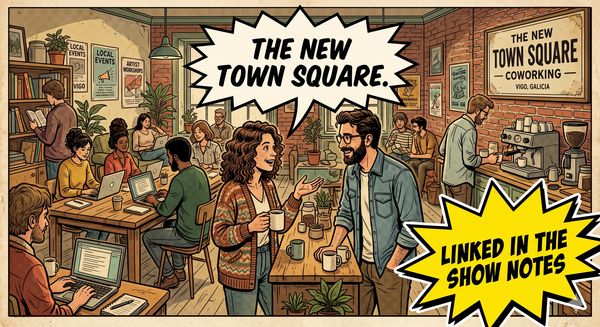
The commute is over. More people are working locally than at any point in a generation. And the independent coworking space — the one Hannah runs in Eastbourne, the ones Tom Ball has been quietly championing since 2013, the ones JJ Peterson walks into as a member and thinks about as a marketer — is the new market square. The place where the conversations happen.
Local government hasn't noticed yet. Business rates policy says they see square footage. This edition is partly about changing that.
This week in the Bullpen:
- Hannah Mojica on keeping local talent local.
- Tom Ball on why people want the kitchen, not the atrium.
- Dr. JJ Peterson on why you can't sell community — and what you can do instead.
Let's get into it.
The Assignment
Stop describing your space as an office. Start showing people what happens there — the accidental conversations, the businesses that grew, the talent that stayed. That's your case to your members, your neighbours, and your MP.
Hannah Mojica: The Coffee Shop Conversation
FOUNDRY is in Eastbourne. Not London. Not a major city. A coastal town that loses talent every morning to the commute and doesn't always get it back.
Hannah's argument is simple and it has the data behind it.
"We're stopping people commuting to London. We're keeping that wealth and building wealth within a town."
When Hannah's train was cancelled and she ended up on the platform instead of at her own panel, she bumped into Mike Lawrence APFS — a FOUNDRY member — and they went for a coffee. They talked about operations, the CEO role, what it takes to build a team that runs without you. Mike had been growing his business inside FOUNDRY — from two desks to a 14-person office.
She missed the panel. She got something better.
Hannah knows the weight of that.
"You kind of have a responsibility. You have quite a big impact on a lot of different people."
She's also honest about the economics in a way most operators won't say out loud.
"There's a dirty secret of coworking where really the open desks is what makes the community, but the private offices is what pays the rent."
Both things are true. The community draws people in. The private offices keep the lights on. You need both. And you need to be honest about both — especially when you're making the case to a local authority who wants to know why your space deserves to exist.
Independent spaces outside major cities carry something that WeWork never could — they are embedded in a place. The members are neighbours. The business growth stays local. The wealth doesn't drain down the train line every evening.
The problem is that nobody in local government is measuring this. They see a room with desks. They tax the square footage. They miss the conversation entirely.
Tom Ball: Everyone Ends Up in the Kitchen
I've known Tom Ball for about fifteen years. I went to the first DeskLodge he opened in London in 2013. He has never stopped saying the same thing — and he has never been wrong.
"The lifeblood of the country is small, independent companies."
Tom doesn't build for corporations. He builds for the freelancer, the micro and small business, the person who needs somewhere that isn't their kitchen table and isn't a corporate hotel atrium with a branded coffee machine and a receptionist who doesn't know their name.
"What do people actually want? They just want to go somewhere to get more done and to be a little bit less lonely."
He has a line about house parties that gets at the whole thing.
"You don't want to be in the hotel atrium. Everyone always ends up in the kitchen at a house party."
You can't plan for the kitchen. You just build a good house.
Dr. JJ Peterson: You Can't Sell a Conversation Before It Happens
I met JJ in Nashville in February 2020, when I was doing my StoryBrand Guide training. Sonya and Julie were there at the same time — they've been podcast guests, and they ran an Unreasonable Hospitality workshop at the Urban MBA in February 2025. In June, the three of them are running a StoryBrand and Unreasonable Hospitality workshop in Holborn.
JJ isn't a coworking operator. He's a marketing specialist who has written the training manual — with Will Guidara, author of Unreasonable Hospitality — so that people can become facilitators of the method. He thinks about how businesses make promises and whether they keep them. He walks into coworking spaces as a member and thinks about them the way Hannah and Tom think about them from behind the front desk.
His argument starts with the problem every coworking operator runs into.
"People don't understand what it means. What I believe it means is creating opportunity for connection, for commonality."
Community is a wish dream. Bonhoeffer said this about religious communities in the 1930s — the danger of arriving with an idealised vision rather than accepting what a community actually is. JJ brought it straight into the coworking conversation. You cannot sell community upfront because community is what happens after everything else goes right.
What you can sell is the promise. What you deliver on is hospitality — the deliberate work of making people feel seen as humans rather than transactions.
"They will come for the service. They will come for the way that you're treated. They will stay for the community and the hospitality."
There's a story JJ tells about the owner of a restaurant in his neighbourhood in Nashville called NOCO. The owner overheard JJ and his partner talking about their upcoming wedding — tracked down their registry online without asking — and sent an electronic salt and pepper shaker to their house. Nobody asked him to do it. It cost almost nothing. It said: I was paying attention. You are not just a table.
Hospitality lowers the defences. That's where the conversation starts.
What All Three of Them Are Actually Saying
The Cluetrain Manifesto's thesis — all markets are conversations — was published 27 years ago. The authors were worried that the internet, instead of releasing human connection, would just become another channel for blasting corporate messages at people. They wanted it to be the agora. The place where voices were real.
That argument maps exactly onto what Hannah, Tom, and JJ are describing.
Hannah's coffee shop, Tom's kitchen, JJ's NOCO restaurant — they're all the same thing. The place where the conversation happens.
The coworking space in a town like Eastbourne isn't just somewhere to put a desk. It is the place where the local economy has its conversations. Where Mike grows from two desks to a 14-person office. Where the talent doesn't disappear to London every morning. Where the freelancer sits next to the small business owner and something happens that nobody planned.
Local government looks at this and sees an office.
They're wrong. And we need to tell them.
What You Can Do This Week
These are not complicated asks. They are the simplest possible acts of coworking citizenship — for your space, your members, and your local economy.
The business rates crisis isn't waiting.
Last year Jane Sartin shared the business rates crisis and what every workspace operator needs to do now on the Coworking Values Podcast — and still needs our support to get our MPs aware.
- Download - FlexSA ‘Engaging Your MP on Business Rates and Flexible Workspaces’
- Write to Your MP — Enter your postcode, get your MP’s details
Then on the 12th May at the Flexible Space Association Conference, I'll host a panel with Karen Tait, Tom Ball, and Adam Sandford on "Embedding Flexible Workspace in Local Communities."
Contacting your MP about business rates and showing up for your local economy are the same act. One proves the other.
May 13th–15th — Creator Day with You Are The Media, Poole.
Mark Masters runs this. Jon Alexander is speaking. There are no afternoon keynotes. Instead, everyone sits down in small groups and actually works on their own projects together, backed up by the Cowork Crew and FOUNDRY.
May 19th — Unreasonable Connection, SPACE4, Finsbury Park, London.
This is our London Coworking Assembly event. Built strictly for operators and community managers who want to unpick the actual, gritty mechanics of running spaces. Tilley Harris and the team at Akou are co-facilitating, alongside the legendary Urban MBA.
June 3rd — Coworking Alliance Summit. Online.
Hector Kolonas and Ashley Proctor are back with 2026 edition,
Fearless Front-Facers This Week
Shout-out to every operator outside a major city who is quietly keeping local talent local. You are not a satellite office. You are the market.
Shout-out to Hannah Mojica for missing her own panel and living the point of it anyway — standing on the platform, bumping into Mike, and ending up in a coffee shop conversation that was better than any session she could have run. And for saying out loud what most operators won't: the open desks make the community, the private offices pay the rent.
Shout-out to Tom Ball for fifteen years of building for the freelancer, the micro-business, the person who just wants somewhere to get more done and be a bit less lonely. Still saying the same thing. Still right.
Shout-out to JJ Peterson for bringing Bonhoeffer into a coworking conversation and making it land.
Connect with this week's guests
Dr. J.J. Peterson | StoryBrand | Unreasonable Hospitality
Tom Ball | DeskLodge | B Corp™
From the Archives: Who Else Has Been Doing the Work?
The Golden Thread: Why Unreasonable Hospitality Needs a Story First with Sonya & Julie Sonya and Julie on why hospitality without a story is just service — and what it looks like when the two things actually work together. Directly upstream of JJ's conversation in this edition.
You're Never Broke If You Got Ideas: How Koder Brings Music to the Neighbourhood What it looks like when a coworking space becomes the infrastructure for local creative economy — not a product, not a service, but a place that makes things possible.
What Hospitality Actually Costs with Ian Minor Ian Minor on the real price of making people feel seen. Not the salt and pepper shaker. The decision to pay attention in the first place.
Coming Up on the Coworking Values Podcast
Gislene Haubrich — back for a deeper conversation on coworking spaces as democratic infrastructure.
Felicia Fai — the researcher behind the industrial commons framework, on what the data actually means for independent operators.
Mina Sadat Orooje — next from the RGCS world.
Head to Coworking Values Podcast to subscribe 👋
Written by