Why The People Who Build Communities Never Show Up For Themselves

You spend your whole week lowering the barrier for everyone else. Nobody does it for you.
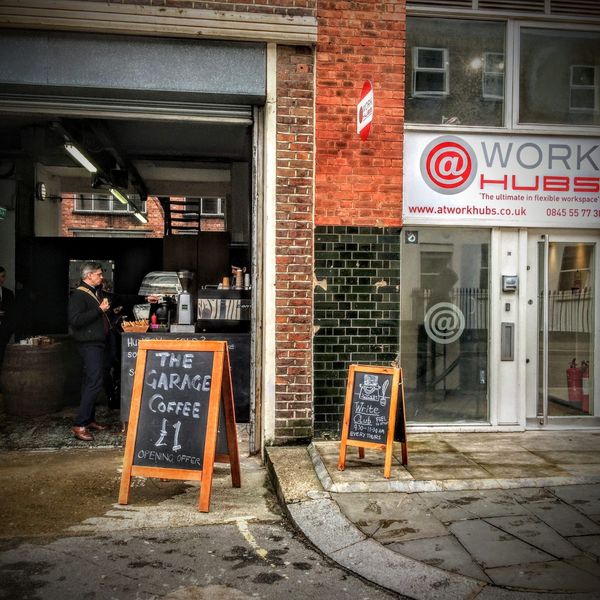
When I ran @Workhubs by Euston Station with Phil, there were days I was so exhausted it felt like the liquid had drained out of my eyes.
When you run an independent space, or when you're the community manager, it is a profoundly lonely place. You are the person holding your own shit, and everyone else's shit too.
You're having that quiet conversation in the kitchen with a member you love who is behind on their rent and having a tough time.
You're dealing with a macerator that's jammed again because someone threw dental floss down the toilet.
The space has been a ghost town for a week because of train strikes, and there's this wave of uncertainty in the air — a wave that landed hard in March 2020 and somehow just keeps growing.
And on top of all of that, you're taking the weekly throat punches of business rates and spiralling electricity bills, watching a conflict thousands of miles away from your neighbourhood punch up your operating costs.
As Karen at The Residence in Bishop's Stortford knows, those bills have tripled in four years.
And then someone sends you an invite to a "networking event."
Of course you don't go.
The cost of showing up is too high. Because nobody has done the invisible work to lower the barrier for you.
Making someone feel like they belong is the hardest, most invisible work in the economy. It doesn't show up on a balance sheet.
Last year Kofi Oppong said on our podcast: "There won't be jobs in employability as we know it. Millions of people are being pushed into independent work just to survive."
There are 5.4 million sole traders and micro-businesses in the UK right now. And here is the reality: almost every independent coworking space sits exactly in that demographic.
- We are micro-businesses holding the roof up for other micro-businesses.
- We are sole traders serving sole traders.
- We are serving our own people.
Which means you need a village just as much as they do. Not a networking event.
What lowering the barrier actually looks like
Space4 in Finsbury Park runs a Wednesday community lunch. Nearly ten years. You don't buy a desk, you don't pitch a startup. You just come and eat.
Same place. Same time. People know where to find it.
That table is where first met Dan Sofer and Founders and Coders in 2017.
Natasha and Maddy run Space4 — they're members of the co-op that owns Outlandish and Space4.
On Wednesday, Tilley went to the community lunch to sit with them and talk through how Unreasonable Connection May 19th will run in that space.
The three of them are designing the day together. Next week, people who've registered will start being connected to each other and told how to get the most out of it before they even arrive.
If you want to feel the space before you commit to anything, go to the Wednesday lunch. Say hello to Natasha and Maddy. That's the whole invitation.
Look at what the ACTionism screenings are doing for European Coworking Day on May 6th. You don't walk in and perform. You sit down, watch 25 minutes, and the conversation starts itself.
Roland at Dragon Coworking screened it in Kent — see what happened,
Koder is coming on May 19th. He'll tell you the same thing about what it takes to get people through a door who've never felt like a room was built for them.
Spaces like ARC Club, Yonder, Space4, Oru, and Patch are already hosting screenings. Everything you need is here.
The pattern is always the same. Remove the performance, and people come.
The room we're building for May 19th
We took that exact principle and built May 19th around it.
Tilley and the team at Akou are doing the invisible work before you arrive.
Before the day they'll find out what you are actually navigating between your business and your local area.
- Scary energy bills.
- Local council friction, business rates.
- How to explain to people the value of your coworking space.
- How to make an impact means something to the neighbourhood.
You'll work in small organised groups of peers dealing with the exact same friction. No small talk. Straight to the actual mechanics.
Look else is coming
Look at who's coming, these people all have first hand experience of how to take a coworking space from 'an office' to a 'rocking neighbourhood asset' - click their names to listen to our podcasts with them and follow their work.
Rose Radtke is a brand strategist, writer, and community manager — she describes herself as "a bit of an octopus." She makes the distinction of the difference between a community and a village.
In a community, lurking is fine. Participation is optional. But in a village, everyone has a role. There's an expectation of care. You extend to each other. That's what she's trying to build in Deptford, specifically for parents and carers.
Williamz runs the Job Club — open access, no eligibility criteria, no means test. Computers, internet, printing, and someone who knows their stuff, turning up in libraries and coworking spaces across London, including Space4.
Youth unemployment, digital exclusion, people who need a professional network and can't afford to buy one. He just opens the door.
Ali started Caribbean Eats in lockdown, knocking on doors with meals on her own. Now she runs a canteen model in community spaces around Hackney.
I sat around a table with her at Urban MBA — local residents, people from the estate opposite the millionaire apartments, all eating together by a 3D printer. She said it plainly: "The food is our hook. But what we do is about connection."
Lucy McInally and I were both founding members of the same coworking space in Old Street back in 2021. That space closed. She writes about what it takes to get someone back through a door after that — and she knows it from the inside.
Koder has given away 10,000 hours of free studio time in Brockley and built a sustainable business model around it.
These are people who've been in the room. By the time you sit down at Space4, you already know something real about who's next to you.
You spend your whole week making your members feel like they belong.
On May 19th, we're doing that for you.
Welcome Gate, Coworks, Nexudus, Cobot and Baseworx are 'enablers' for Unreasonable Connection who fund supporter ticket to make the event accessible and inclusive for everyone. 💚
Beyond the neighbourhood: the original UK infrastructure
I remember when I was little, looking at business centres in my local area and thinking they were where the magic happened — people on big chunky Motorola phones, Filofaxes on the desk, looking like they were running the world from a serviced office in a light industrial estate.
Long before people started buying neon signs and pouring oat milk flat whites and calling it coworking, the people in FlexSA were already grafted into their local areas.
They started in 1989 as the Federation of British Business Centres. They have been the backbone of the UK's micro and small business movement for almost 40 years.
While the imported global real estate conferences talk about "the future of work," Jane Sartin is the one relentlessly lobbying the UK government to fight the business rates that are choking independent spaces.
Probably, the only reason the UK government even knows what a coworking space is right now is because of Jane.


On May 12th, she invited me to collaborate on a panel at their conference.
The session is called - Beyond the Desks: Embedding Flexible Workspace in Local Communities, I'll be with:
- Karen Tait (The Residence Coworking).
- Tom Ball (DeskLodge)
- Adam Sandford (Runway East)
We're talking about the actual mechanics of being a community asset instead of an extraction point — how spaces actively support the local economy, like choosing neighbourhood suppliers over massive corporate vendors to keep money circulating on the high street.
Neither this, nor anything else, replaces the room at the end of your street.
Get involved!
If you'd like to 'meet the space' before May 19th — Space4's Wednesday community lunch is open.
StoryBrand & Unreasonable Hospitality Workshop, June 10-11, 2026 – This post here shares details and how to sign up.
How to Host an ACTionism Screening for European Coworking Day (May 6th)
- You cannot fix the global economy.
- But you can fix the room you're standing in.
- And the key to fixing everything is in all of us - community is the key.
Written by
What's Next?
Why AI Can't Feel the Room: Practical Operations with Carlos Almansa
"The AI cannot feel the space. It can't feel the dynamics or the vibe. But it can free up time for you to talk to your members, to have a coffee with them, to understand and to read people." — Carlos Almansa Ballesteros Episode Summary Most conversations about AI in coworking are either evangelical or dismissive. Carlos Almansa Ballesteros, co-founder of Nexudus and author of the Coworkings AI newsletter, isn't interested in either. He's been building software for this industry for 13
The Golden Thread: Why Unreasonable Hospitality Needs a Story First with Sonya & Julie
Why your coworking space needs a Story before it can practise hospitality "Marketing makes these promises and service delivers that. So for us, StoryBrand and unreasonable hospitality, really work together hand in glove. And StoryBrand is really about thinking about how you communicate that you care to your customers. And the unreasonable hospitality side of things is how you prove it." — Sonya Whittam Sonya Whittam and Julie Firth run Story22, a customer-centric marketing agency base
Start With the Building, Miss the Person — It Happened Again This Week
I spent this week watching the same argument break out in different places, with different people, in completely different conversations. None of them planned it. * Caleb Parker published a manifesto for high street coworking. * Suzanne Murdock sent her monthly newsletter from The Hub Newry. * Parisa Wright kept resharing her Hope Hub episode. And * Ann-Marie Kinlock and Anna Chuicharoen finally opened KindHaus in Hackney after three years of hurdles, setbacks, and proving that a space wher
Start Cooking. The Recipe Will Follow.
We're moving everything up a gear. At the last Unreasonable Connection Live in Lewisham, you told us the groups were too random and the curation could be tighter. You were right. 75% of you left with more momentum than you arrived with. The room worked. The curation didn't. The people in the room, the conversations that happen, and how those conversations are curated—it all matters deeply. That's why on May 19th, Tilley Harris and the team from Akou are collaborating with us to facilitate