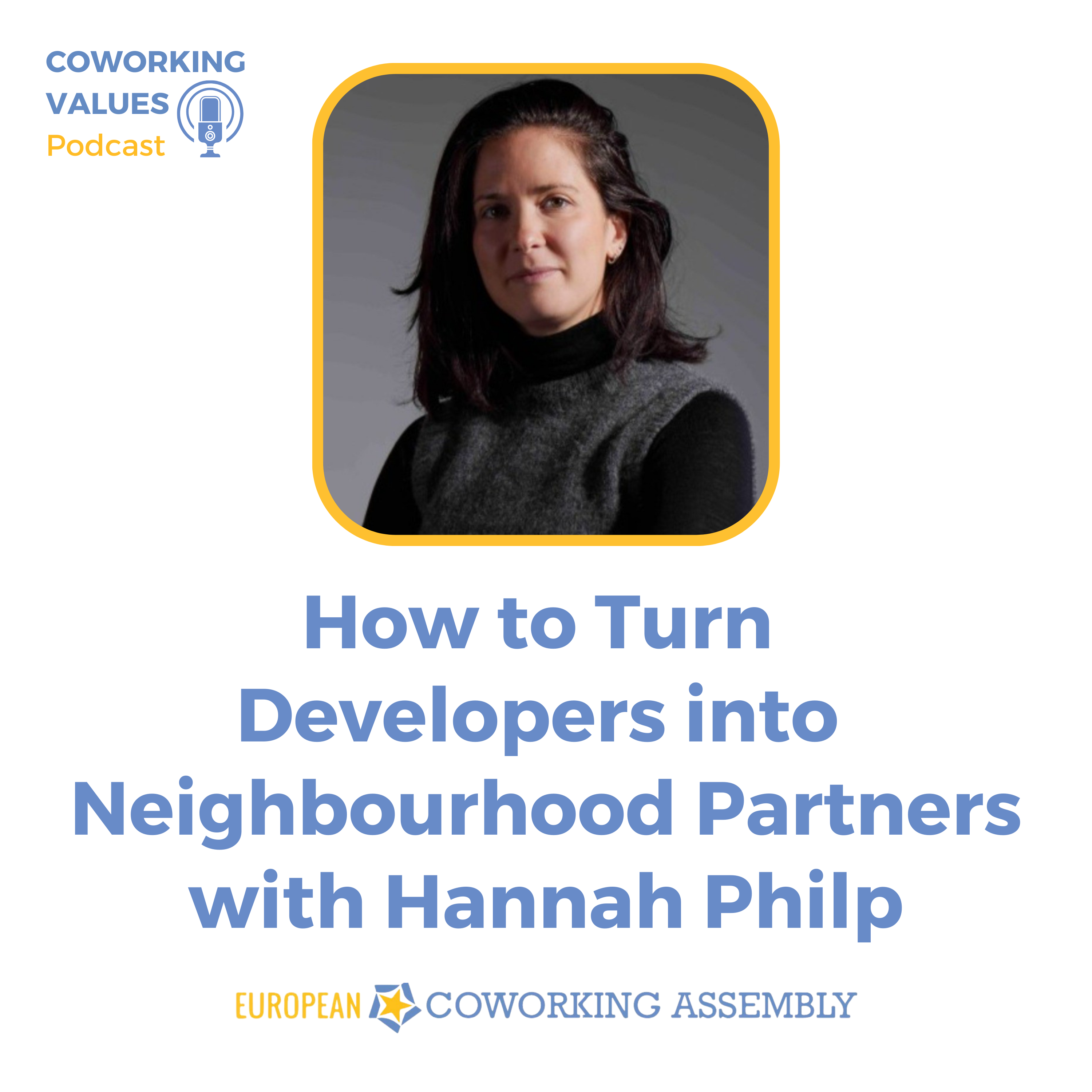
How to Turn Developers into Neighborhood Partners with Hannah Philp
How to Turn Developers into Neighbourhood Partners with Hannah Philp
Episode Summary
“We’re not a service provider beyond being a great space. I think we’re a platform, and that’s key.”
Hannah Philp
Tired of running yourself into the ground?
Then stop running alone.
On February 24th, the London Coworking Assembly presents Unreasonable Connection Goes Live!—a one-day working session for the people running London’s most vital neighbourhood spaces and the public sector allies working to help them thrive.
It’s a day to share the load, find real solutions, and build a new playbook, together.
Hannah Philp is sitting in ARC Tottenham when this conversation happens.
Even through the recording, the space feels calm—that’s the word Hannah keeps using, and you can hear why. It’s designed to be the antidote to the chaos of working from a kitchen table.
Bernie mentions he’s known ARC since the beginning, back when they hosted Urban MBA’s 12-week programme in 2021, just as London was allowed to meet in person again during COVID.
That history matters because it grounds what Hannah’s trying to do.
She didn’t set out to fix London’s housing crisis or redesign the high street.
She spotted a simpler, more personal problem.
Pre-COVID, she watched people—particularly new parents, carers, anyone with responsibilities beyond their income-generating work—drop out of the paid workforce because the 9-to-5 commute (really 8-to-6 if we’re honest) was incompatible with their lives.
The only options were expensive serviced offices for venture-backed companies or working at the kitchen table. Nothing existed for the solo entrepreneur or small team who needed somewhere between those extremes.
Hannah’s “why” isn’t abstract.
It’s watching people she knew become isolated. It’s recognising that loneliness in dense urban environments has accelerated since the advent of smartphones. It’s believed that doing focused solo work among other people mitigates that loneliness without demanding you participate in organised networking.
What started as neighbourhood coworking turned into something more pragmatic: a partnership model with residential developers who control ground floors.
Not because developers suddenly care about community (though some do).
Because the economics of residential development in the UK have become so challenging that social value is now commercially necessary to unlock planning permission.
Bernie asks the question most listeners are thinking: Aren’t developers the problem?
Hannah’s answer is refreshingly honest. She knows ARC’s limits. She’s not an urban planner or housing minister. She’s working with what exists—developers who need to make buildings financially viable and councils who want social outcomes.
ARC bridges that gap.
Then Bernie mentions something Hannah clearly doesn’t want to discuss: a central London hub that wasn’t commercially sustainable.
“It’s painful to talk about, Hannah,” Bernie says.
“I know,” she replies, and they don’t go deeper.
But that failure taught them what they’re building now. The developer partnership model exists because going it alone in expensive central London didn’t work.
The stakes are clearer when you understand what failure looks like.
If ground floors stay empty—which they are across the UK—high streets die. Mum-and-pop businesses can’t afford business rates or twenty-year leases. US private equity buys up chains, loads them with debt, and only institutional money can survive.
The neighbourhood loses the bakery, the dry cleaner, and the antique shop.
Meanwhile, new residential buildings keep getting built. Someone will decide what goes on those ground floors.
If operators don’t partner with developers, it’ll be another Tesco Metro, or the space will sit empty.
In Tottenham, ARC received backing from Haringey Council’s Opportunity Workspace Fund.
The social value metrics aren’t marketing fluff—they’re contractual obligations embedded deep in the business plan. Hannah describes ARC as a platform for local organisations already doing brilliant work in the neighbourhood, not a service provider helicoptering in with programmes nobody asked for.
The three current ARC clubs—Earlsfield in southwest London, Stratford in East London, and Tottenham in North London—operate identically in format but differ significantly in practice.
Hannah admits this was humbling. Even with similar member profiles, people's preferences for how to use space vary widely.
This isn’t a business plan you can copy and paste.
What Bernie and Hannah both recognise is that the best neighbourhood coworking spaces become what Hannah calls “your other local”—the gym, the pub, the place you buy bread.
Where accidental interaction happens.
Where you might not speak to anyone all morning, the presence of other people doing focused work mitigates the loneliness of working by yourself at home.
Hannah calls it “small c connection,” and it’s the majority of what happens at ARC. Not events. Not networking. Just being around colleagues—even if they’re working on different things.
The sense of being seen without forced interaction.
For operators wondering whether neighbourhood coworking is viable, Hannah offers pragmatic hope.
Work with forward-thinking developers. Be clear about what you can and can’t do. Acknowledge commercial imperatives without compromising your social mission. Be a platform, not a service provider.
And most importantly: learn from what doesn’t work.
The central London failure matters as much as the Tottenham success.
Timeline Highlights
[00:04] Bernie introduces the tension: “The commute and being a neighbourhood workspace... one size does not fit all.”
[01:37] Hannah on ARC’s mission: “We deliver in partnership with new residential developers to open spaces that make working life more calm, more local, more human.”
[02:13] “We go to the neighbourhoods where people are doing exciting things... We can be a place that’s potentially a catalyst for positive change.”
[03:07] The pre-COVID origin: “We wanted to create somewhere that would sit between a draining commute or working at the kitchen table, and that would support focus.”
[04:50] On mitigating loneliness: “Doing that among other people really helps... You could just be coming in and just being around my colleagues versus sitting at home by myself.”
[06:40] The “other local” concept: “ARC [is] your other local... where accidental interaction happens... the majority of connection is this small c connection.”
[07:26] Tottenham partnership approach: “We’re working with the council to actually connect with people who are already doing fantastic work in the neighbourhood... We can just be a space for them.”
[08:26] The platform principle: “We’re not a service provider beyond being a great space... I think we’re a platform, and that’s key.”
[09:27] Mixing communities: “We want to be a diverse hub... a mix of an existing community and new people... ensuring that these new buildings are also delivering social value for everyone in the local area.”
[10:41] UK development reality: “The economics of residential development in the UK are really, really challenging... Construction costs have massively risen... The risks have gone way up.”
[13:46] Commercial pragmatism: “We can help [developers] realise their commercial outcomes by putting something just brilliant and useful on the ground floor.”
[15:28] The opportunity: “We spotted an opportunity in the huge number of empty ground floor retail spaces in the UK.”
[17:30] Beyond transaction: “It’s more than just a transactional amenity... there’s an intangible value that’s not just about a desk.”
[22:19] Embedded metrics: “In ARC Tottenham... embedded really deep in our business plan are the social value metrics that we absolutely have to deliver.”
[26:32] The painful acknowledgement: Bernie asks about the central London hub—” It’s painful to talk about, Hannah.” “I know.”
[32:07] Local variation: “The way that people want to use space is just totally different in those areas... There isn’t that one-size-fits-all at all.”
The Economics Nobody Mentions (And What Happens If We Get This Wrong)
House building in the UK has stalled.
Construction costs have risen. Developer risk has multiplied.
Hannah names what most operators dance around: developers need to make money, or they won’t build anything at all.
Feeling sorry for developers isn’t the point. Understanding their commercial drivers is how you get into those buildings to do something useful.
But here’s what’s at stake if operators don’t solve this problem.
Empty ground floors kill high streets.
Walk through any British town centre and count how many retail units sit vacant. The mum-and-pop bakery can’t afford business rates—essentially, property tax that UK commercial tenants pay, which can run £20,000-£50,000 annually for a small ground-floor unit.
Landlords want twenty-year leases because their buildings are leveraged with institutional debt. Only chains backed by private equity can afford the risk.
Hannah mentions this: US private equity money has bought up well-known chains, loaded them with debt, and now they’re the only businesses that can pay the rates.
The local dry cleaner, antique shop, and independent café—they’re priced out of the market.
Meanwhile, new residential buildings keep getting constructed.
Someone will decide what goes on those ground floors.
If it’s not thoughtful operators partnering with developers, it’ll be another Tesco Metro serving residents who move in and never meet their neighbours. Or the space sits empty, the building feels dead, and the neighbourhood loses what Bernie calls an “activation point.”
This is where ARC’s model becomes interesting.
They’re not asking developers to be charitable. They’re offering a solution to a problem developers already have: what to put on the ground floor that’s financially viable, unlocks planning permission through social value, and doesn’t require a twenty-year tenant paying full business rates.
In Tottenham, this meant partnering with Haringey Council’s Opportunity Workspace Fund.
The social value metrics aren’t aspirational. They’re contractual.
ARC had to embed them deeply in the business plan to secure support. Measurable outcomes. Deliverables. Not marketing language.
This isn’t gentrification dressed up as community.
It’s acknowledging that new buildings are being built regardless, and fighting for those ground floors to serve more than just shareholder returns.
Bernie presses Hannah on this tension. Developers arriving in neighbourhoods like Stratford or Tottenham bring change. He’s watched Hackney Wick transform since 2013.
Some call it regeneration. Others call it colonisation.
How do you balance that?
Hannah doesn’t dodge.
She knows ARC’s limits. They’re not solving urban planning failures or addressing housing inequality. They’re pragmatists working within the existing system, trying to create ground-floor spaces that benefit both newcomers and long-term residents.
She also knows what happens when the model doesn’t work.
Bernie mentions a central London hub that wasn’t commercially sustainable. Hannah’s response: “It’s painful to talk about.”
That failure matters.
It’s why ARC partnered with developers instead of going it alone. It’s why they focus on ground-floor retail, where rent structures differ from those of standalone properties. It’s why social value metrics needed council backing, not just good intentions.
The economics are brutal.
But they’re fixable if you’re willing to work with the people building the buildings.
The Platform Versus Service Provider Distinction (And Why It Changes Everything)
Hannah makes a sharp distinction that matters for every operator reading this.
ARC is not a service provider.
They don’t helicopter into neighbourhoods running programmes for local people. They don’t decide what the community needs.
They provide warm, hosted, calm space—and then become a platform for organisations already doing brilliant work locally.
In Tottenham, this meant connecting with groups the council already knew.
Community organisations that needed meeting space. Networks that couldn’t afford to rent. Local freelancers who had nowhere between home and expensive serviced offices.
ARC hosts them. Provides the room. Makes the tea.
Then gets out of the way.
Bernie shares a similar experience from Work Hubs—neighbourhood groups using the meeting room for an hour or two led to painting the café next door, which led to someone else making the garden.
None of it was programmed.
It happened because space was available and people bumped into each other.
This is what Hannah means by platform.
The infrastructure exists. The connections happen organically. ARC doesn’t need to run events to prove they’re “doing community.”
The community was already there.
When you position yourself as a platform rather than a service provider, you change who you partner with.
Councils want platforms. Developers need platforms. Local organisations trust platforms.
Service providers arrive with solutions to problems they’ve diagnosed from outside.
Platforms arrive with space and let the neighbourhood decide what happens next.
But here’s what Hannah doesn’t say explicitly: being a platform is harder than being a service provider.
Service providers control outcomes. They can point to programmes and attendance numbers.
Platforms have to trust that if you create the conditions, connection will happen organically—and that takes longer to prove.
The Tottenham model works because the council partnership gave ARC legitimacy.
When the council backs you, local organisations trust you faster. New residents see you as civic infrastructure, not just another business.
But not every partnership will work.
Bernie’s question about the central London hub hangs in the conversation. What happens when developers aren’t forward-thinking? When councils don’t have workspace funds? When the economics don’t stack up?
Hannah’s answer is pragmatic: you acknowledge what’s fixable and what isn’t.
You work with the developers who understand that social value unlocks planning permission. You focus on neighbourhoods where change is already happening, and you can be part of shaping it positively.
You accept that you can’t save every high street or partner with every developer.
But you can embed yourself in enough ground floors that the model becomes replicable.
Small C Connection (And Why Big-C Community Exhausts Everyone)
Hannah introduces a phrase worth stealing: “small c connection.”
Not the capital-C Community that requires events, icebreakers, and strategic programming.
The lowercase version that happens when you’re sitting in a room with other people doing focused work, even if you don’t speak to anyone all morning.
This is ARC’s core insight.
Most members aren’t coming to network or socialise or attend workshops. They’re coming to get work done.
But they’re choosing to do it around other people instead of alone at home.
That shared presence mitigates loneliness without demanding interaction.
Hannah describes it as being seen without being forced.
Knowing the barista remembers your coffee order. Recognising faces without needing to know names. The brief exchange in the kitchen while the kettle boils.
Bernie calls it grounding.
You’re sitting in a room with other people doing the same thing. It’s really grounding.
He describes his own situation—working from a comfortable home office that’s probably the size of their old flat in Ilford, with two big desks and lots of light.
Yet going out to a coworking space every two weeks is such a treat.
Being around people is amazing, but it’s so easy to just get locked into sitting at home.
This matters because most coworking marketing promises big-C Community—collaborative projects, networking events, skill shares, and social calendars.
Then operators burn out trying to deliver it, and members feel guilty for not participating.
Bernie admits he used to put on endless events, exhaust himself, and wonder why he was buying the crisps for community gatherings.
Now he understands: here’s a space, work out how to use it.
The platform approach means the space facilitates connection without mandating it.
Small c connection gives everyone permission to just exist in the space.
To work quietly. To leave without explanation. To come in, sit down, get three hours of focused work done, and go home feeling less alone than you did at the kitchen table.
It’s ARC’s “other local” concept.
The gym where you nod at regulars. The pub where the bartender knows your order. The bakery where you chat about the weather.
You don’t have to be best friends with everyone.
You just have to know you’re not alone.
The Tottenham Model (And Why Council Partnerships Actually Work)
ARC Tottenham is different from Earlsfield and Stratford because Hannah and her co-founder Josie learned something crucial: you can’t template neighbourhood coworking.
Even with similar member profiles—solo workers, freelancers, small teams needing focused space—the way people want to use space varies wildly between neighbourhoods.
Tottenham’s partnership with Haringey Council created contractual social value metrics embedded in the business plan.
This isn’t marketing language.
These are measurable outcomes ARC is required to deliver to maintain the partnership and the financial backing from the Opportunity Workspace Fund.
Hannah describes working with the council to connect with organisations already operating locally.
Not arriving with programmes. Not deciding what Tottenham needs.
Asking: who’s already doing brilliant work here? How can ARC be useful to them?
This is platform thinking at its clearest.
The infrastructure—meeting rooms, desks, wifi, hosted space—becomes available to existing networks. The social value happens because the right people can access the space, not because ARC invented new initiatives.
Bernie notes that many councils try to reinvent what already happens in coworking spaces. They fund “innovation hubs” or “community spaces” without asking operators what actually works.
Stacey Sheppard from The Tribe is always investigating how local authorities try to reinvent coworking when the model already exists.
Bernie and Steve had been talking to Haringey back in 2020 about alternative approaches. That conversation likely led to what Hannah’s doing now.
There are forward-thinking boroughs across London experimenting with this.
For operators wondering whether council partnerships are worth pursuing, Tottenham offers a template.
Embed social value metrics in your business plan from the start.
Position yourself as a platform, not a service provider. Connect with organisations the council already trusts. Make it easy for them to say yes.
The win isn’t just financial support. It’s legitimacy.
When the council backs you, local organisations trust you faster. New residents see you as civic infrastructure, not just another business.
But partnerships can fail.
Bernie’s gentle prodding about the central London hub reminds us that not every model works. Sometimes the economics don’t stack. Sometimes the neighbourhood isn’t ready. Sometimes you need a council partner to make the numbers viable, and not every council has an Opportunity Workspace Fund.
Hannah’s honesty about ARC’s limits—they’re not urban planners, not housing ministers, just operators trying to do something useful within existing constraints—is what makes the Tottenham model replicable.
Know what you can fix.
Work with the partners who have the resources and mandate you need. Accept that you can’t solve systemic urban planning failures, but you can make individual ground floors work better for the people who live above them.
One Size Fits Nobody (And Why That’s Actually Fine)
Hannah admits something operators rarely say out loud: even within ARC’s network, each club operates completely differently.
Earlsfield in southwest London, Stratford in East London, Tottenham in North London—same brand, same model, same pricing structure.
But members use the spaces in fundamentally different ways.
This was humbling, Hannah says.
There isn’t that one-size-fits-all at all to coworking.
It is about adaptability to the local area and being really open to that.
Bernie connects this to Xavier’s Commons Hub in Brussels, which runs themed days—designers on Tuesdays, programmers on Thursdays.
Instead of trying to serve everyone every day, you create focused community days where people from the same industry gather.
You’re not just renting a desk. You’re buying access to your professional community on a predictable schedule.
This solves a real problem Bernie describes: as a coworking space user (in Vigo now, not London), he’s always wondering which day to use.
If he buys a pack of days and can just use them when needed, that’s much easier than committing to a fixed schedule.
Then there’s the pricing conversation.
Bernie describes his frustration with complicated membership tiers. Sixteen options, all with slightly different benefits, impossible to compare without asking AI which one offers the best value.
He just gives up.
It has to be simple. He wants to go to a café or coworking space for a few hours, get work done, meet a mate, and not overthink the commercial transaction.
Hannah asks what different ways people use space, and the answer reveals why templating fails.
Some members need one predictable day per week. Some want flexible packs. Some need meeting rooms for a few hours. Some want “industry days” to network. Some want access for community groups.
Some just want a quiet place that’s neither home nor a café.
Every neighbourhood prioritises these differently.
Earlsfield might value the flexible pack. Stratford might prefer fixed days. Tottenham might need access to meeting rooms for community groups.
The operator’s job isn’t to pick the “right” model.
It’s to be adaptive enough to give each neighbourhood what it needs.
Bernie references Lee Douglas from Wigan and Weave coworking—a space where so many local organisations are woven into the fabric that Wigan became a community in search of a coworking space, rather than a coworking space in search of a community.
That’s the goal.
Not to build community from scratch. To become part of the community that’s already there.
Bernie also notes the difference in how space gets used in Hackney, Old Street, Wigan, and Bristol.
When consultants arrive with 100 years of coworking data and say “this is exactly what you should do,” they’re offering a really good guide—but there’s massive variation in local needs.
London used to have many neighbourhoods. Then suddenly it wasn’t anymore.
People listening are probably wondering: how can we get our neighbourhoods back?
Bernie doesn’t know if it’s actually happening or if he just happens to hang around with twenty people who talk about it all day.
But Hannah’s work suggests it might be.
ARC’s model only works if neighbourhoods still exist beneath the surface. If people want to work near home instead of commuting to central London. If local organisations need space. If new residents moving into flats above want to meet the community that was already there.
The post-COVID shift made this conversation possible.
If Hannah had started this in 2018, people would have said: “But I’ve got to get on the tube, mate. I’ve got an Oyster card. I can’t work near home.”
Now the question isn’t whether neighbourhood coworking makes sense.
It’s about making the economics work so operators can survive delivering it.
The Caribbean Kitchen Test (And What Real Community Actually Looks Like)
Bernie and Hannah keep returning to one question: how do you know if you’ve built real community?
Bernie names it: “Community is basically the Caribbean kitchen at Urban MBA or people taking care of Elena Giroli when she had to be away for some time and just knowing that you’re missing that connection when they’re not present.”
Not events on the calendar. Not member counts.
Whether people notice when someone’s gone. Whether the kitchen has a specific smell. Whether there’s a story attached to the space that members tell each other.
If you can’t point to something that specific, you might have a workspace.
You probably don’t have a community.
Hannah agrees.
Small c connection accumulates into something real when members care about each other’s absence. When someone asks where Sarah was last week. When the space feels different without certain people there.
This isn’t something you can programme.
You can’t mandate caring. You can only create conditions where it’s possible.
That means: calm environments, not chaotic ones.
Hosted spaces where someone knows your name. Regularity, so faces become familiar. Time, because connection doesn’t happen overnight.
And patience, because not everyone will participate,e and that’s fine.
The Caribbean kitchen works because someone cooked food they cared about and shared it.
That story matters more than any networking event ever could.
That sensory memory—the smell, the taste, the generosity behind it—becomes part of the space’s identity.
Bernie describes painting the café next door to Work Hubs in Euston.
It started with neighbourhood groups using the meeting room. They’d have their meeting, make cups of tea themselves, go off, and something would happen in the neighbourhood.
Over six months, these casual interactions led to painting the café, then making the garden.
None of it was planned. It happened because space was available and people bumped into each other.
This is what platform thinking delivers.
You can’t force the Caribbean kitchen into existence. You can only create the conditions where someone might decide to cook, share, and start a story that members tell for years.
Hannah’s model in Tottenham—connecting with organisations already doing brilliant work, providing meeting rooms without complicated booking systems, being a space for them rather than helicoptering in as a service provider—is designed to let those Caribbean kitchen moments happen organically.
The measure of success isn’t how many events you run.
It’s whether members tell stories about the space. Whether they notice absences. Whether the connection feels real enough to matter when someone’s not there.
Links & Resources
Hannah Philp’s Work
Mentioned in the Conversation
- Haringey Opportunity Workspace Fund
- Urban MBA
- Community as Immunity: Beyond Economic Extraction with Xavier Damman
- When a Community Finds Its Coworking Space with Lee Dalgleish
- The UK Business Support Failure Coworking Spaces Are Already Solving with Stacey Sheppard
Projects & Community 2026
- Unreasonable Connection Live! London Coworking Assembly Forum Feb 24th
- Workspace Design Show London 25th / 26th Feb
- RGCS Symposium Berlin 5th and 6th March
- European Coworking Day: 6th May
- Coworking Alliance Summit 3rd June
- London Coworking Assembly
- European Coworking Assembly
- LinkedIn Coworking Group
Bernie’s Projects
One More Thing
Coworking brings communities together, helping people find and share their voices. Each episode of the Coworking Values Podcast explores Accessibility, Community, Openness, Collaboration, and Sustainability—values that shape the spaces where we gather, work, and grow.
If this resonates with you, rate, follow, and share the podcast. Your support helps others discover how coworking enriches lives, builds careers, and strengthens communities. Community is the key 🔑
Written by
What's Next?
They Come for the Promise. They Stay for the Hospitality. with Dr. JJ Peterson
"They come for the promise. They stay for the hospitality." — Dr. JJ Peterson Episode Summary JJ Peterson has spent eleven years inside the StoryBrand universe. He co-authored Marketing Made Simple with Donald Miller. He helped Will Guidara write the certification for Unreasonable Hospitality. He hosts the Badass Softie podcast — for leaders who are unapologetically driven but want to lead with their hearts. He is flying to London in June to teach at the first workshop in the world to b
Why AI Can't Feel the Room: Practical Operations with Carlos Almansa
"The AI cannot feel the space. It can't feel the dynamics or the vibe. But it can free up time for you to talk to your members, to have a coffee with them, to understand and to read people." — Carlos Almansa Ballesteros Episode Summary Most conversations about AI in coworking are either evangelical or dismissive. Carlos Almansa Ballesteros, co-founder of Nexudus and author of the Coworkings AI newsletter, isn't interested in either. He's been building software for this industry for 13
The Golden Thread: Why Unreasonable Hospitality Needs a Story First with Sonya & Julie
Why your coworking space needs a Story before it can practise hospitality "Marketing makes these promises and service delivers that. So for us, StoryBrand and unreasonable hospitality, really work together hand in glove. And StoryBrand is really about thinking about how you communicate that you care to your customers. And the unreasonable hospitality side of things is how you prove it." — Sonya Whittam Sonya Whittam and Julie Firth run Story22, a customer-centric marketing agency base
You're Never Broke If You Got Ideas: How Koder Brings Music to the Neighbourhood
"Ideas are currency, you know. And you're never broke if you got ideas... Everything we are looking at around us came from an idea. So for me, they are, it is a currency within itself." — Koder Koder runs Undeniable Studios, a music production conglomerate built from youth clubs, pirate radio, and 10,000 hours of free studio time in Brockley. He's now the first Creative in Residence at Blue Garage in Lewisham, where he's installing a commercial music studio, planning his Circle the Ends

Start With the Building, Miss the Person — It Happened Again This Week
I spent this week watching the same argument break out in different places, with different people, in completely different conversations. None of them planned it. * Caleb Parker published a manifesto for high street coworking. * Suzanne Murdock sent her monthly newsletter from The Hub Newry. * Parisa Wright kept resharing her Hope Hub episode. And * Ann-Marie Kinlock and Anna Chuicharoen finally opened KindHaus in Hackney after three years of hurdles, setbacks, and proving that a space wher
Start Cooking. The Recipe Will Follow.
We're moving everything up a gear. At the last Unreasonable Connection Live in Lewisham, you told us the groups were too random and the curation could be tighter. You were right. 75% of you left with more momentum than you arrived with. The room worked. The curation didn't. The people in the room, the conversations that happen, and how those conversations are curated—it all matters deeply. That's why on May 19th, Tilley Harris and the team from Akou are collaborating with us to facilitate